
WTI climbs above $99.00 as Middle East tensions escalate, Trump threatens Iran over Strait of Hormuz
 PriceONN Editorial Desk
Multi-source verification
PriceONN Editorial Desk
Multi-source verification
Oil Price Surge Fueled by Mideast Unrest
Global oil markets are experiencing a significant jolt as tensions in the Middle East reach a boiling point. West Texas Intermediate (WTI), the primary US crude oil benchmark, has broken through the psychologically important $99.00 level, trading at approximately $99.10 during early European trading hours on Monday. This upward momentum is directly linked to an intensifying conflict zone, injecting a substantial risk premium into oil prices.
The narrative driving this price action is complex, involving geopolitical maneuvering and strategic chokepoints. Reports indicate a heightened state of alert and increased military posturing in a region vital to global energy flows. Such instability invariably translates into market anxiety, as the potential for supply disruptions looms large.
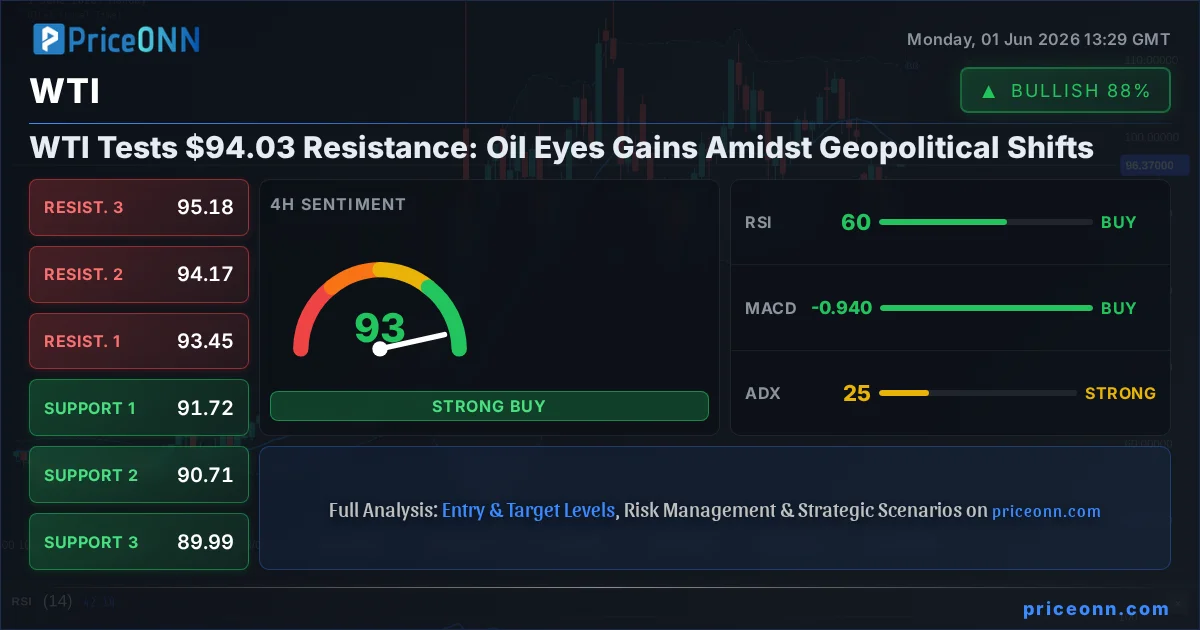
Understanding the Drivers of WTI
West Texas Intermediate, often referred to as light and sweet crude due to its low sulfur content and high API gravity, is a premium grade of oil sourced and refined primarily within the United States. Its distribution network centers around Cushing, Oklahoma, a critical hub often dubbed the 'Pipeline Crossroads of the World.' As a key price marker, the fluctuations in WTI are closely watched indicators of global energy market health.
The fundamental forces of supply and demand remain the ultimate arbiters of WTI's value. Robust global economic expansion typically spurs greater energy consumption, driving demand higher. Conversely, economic slowdowns can dampen this appetite, pressuring prices downward. However, the oil market is particularly susceptible to external shocks.
Political instability, armed conflicts, and the imposition of economic sanctions can severely disrupt the flow of oil, leading to sharp price movements. The strategic decisions made by the Organization of the Petroleum Exporting Countries (OPEC), a cartel of major oil-producing nations, also play a pivotal role. Their production quota adjustments can significantly tighten or loosen global supply, directly impacting prices.
Furthermore, the value of the US Dollar acts as an inverse influence. Since crude oil is predominantly denominated in dollars, a weaker dollar makes oil more affordable for holders of other currencies, potentially boosting demand and price. Conversely, a stronger dollar can make oil more expensive, potentially curbing demand.
Inventory Data and OPEC+'s Influence
The weekly reports detailing crude oil inventories, published by the American Petroleum Institute (API) and the Energy Information Administration (EIA), serve as critical barometers of market supply and demand dynamics. A decline in stored crude often signals robust consumption or constrained supply, typically leading to upward pressure on prices. Conversely, an unexpected build in stockpiles can suggest oversupply or weaker demand, potentially pushing prices lower.
The API releases its findings every Tuesday, with the EIA following suit the next day. While their data generally aligns closely, the EIA's figures, being from a government agency, are often considered the more definitive indicator. These reports provide a snapshot of the delicate balance between what is being produced and what is being consumed.
OPEC, comprising 12 major oil-producing countries, convenes biannually to set production targets for its member states. These decisions are instrumental in shaping market supply. When OPEC agrees to reduce output, it can create scarcity, driving prices up. An agreement to increase production, however, tends to have the opposite effect.
The expanded OPEC+ group, which includes ten non-member nations, most notably Russia, further amplifies the influence of these production decisions. Coordinated actions by this broader alliance can have an even more profound impact on global oil prices, reflecting a significant portion of world production capacity.
Reading Between the Lines
The current surge in WTI prices is a clear manifestation of how geopolitical anxieties can rapidly override purely economic fundamentals. The escalating conflict in the Middle East, coupled with specific threats concerning a critical global transit route like the Strait of Hormuz, introduces an immediate and tangible risk to oil supply. This isn't merely about supply and demand figures; it's about the potential for severe, unforeseen disruptions that could remove millions of barrels from the market overnight.
Traders are now factoring in the possibility of retaliatory actions, sanctions, or direct military engagements that could impact oil production or shipping lanes. This heightened uncertainty is a powerful catalyst for price increases, as market participants rush to secure supply or profit from anticipated volatility. The former President's direct statement adds a layer of political tension, signaling potential policy shifts that could further complicate the region's already precarious stability.
Looking ahead, market participants will be scrutinizing every piece of news emanating from the region. The response from regional powers, the stance of major global players, and any concrete actions taken regarding the Strait of Hormuz will be critical determinants of future price direction. The potential for a broader conflict, even if unlikely, casts a long shadow, keeping oil prices elevated on a 'fear premium' basis.
This situation directly impacts not only crude oil prices but also has ripple effects across related markets. Consumers can expect to see higher fuel costs at the pump, contributing to inflationary pressures. The US Dollar Index (DXY) might see some volatility as global risk sentiment shifts, and energy stocks could experience a boost. Furthermore, currencies of oil-exporting nations, such as the Canadian Dollar (CAD), could benefit from higher oil revenues, though this may be tempered by broader geopolitical risks.
Track markets in real-time
Empower your investment decisions with AI-powered analysis, technical indicators and real-time price data.
Join Our Telegram Channel
Get breaking market news, AI analysis and trading signals delivered instantly to your Telegram.
Join Channel PriceONN News
Crude oil prices experienced a significant drop, with WTI futures falling over 1.8% to $87.25, as optimism grew for a U.S.-Iran deal potentially reopening the Strait of Hormuz.
PriceONN News
(RTTNews) - Crude oil prices have tumbled on Friday as expectations of the U.S. and Iran signing a Memorandum of Understanding run high. The MoU would allow for immediate reopening of the Strait of Hormuz and pave the way for the resumption of oil and energy trade.
PriceONN News
Crude oil futures experienced a dramatic intraday reversal on Thursday, soaring overnight on geopolitical fears only to pull back significantly as reports of a potential diplomatic understanding between the U.S. and Iran emerged.
PriceONN News
Global oil prices are treading water after a significant 5% slump, as market sentiment grapples with cautious optimism over Middle East de-escalation efforts versus lingering geopolitical uncertainties. Brent crude hovers near $104.72 and WTI near $98.07.
PriceONN News
Crude oil prices experienced a significant downturn as market sentiment shifted towards optimism about a potential US-Iran Memorandum of Understanding that could reopen the Strait of Hormuz. WTI futures fell nearly 2% on the news.
PriceONN News
Crude oil futures experienced a dramatic intraday reversal, soaring to $92.52 before pulling back significantly on Thursday. The volatile session was driven by shifting geopolitical narratives and U.S. inventory data.
PriceONN News
(RTTNews) - Crude oil futures skyrocketed overnight but have shown a significant pullback over the course of the trading day on Thursday.
PriceONN News
(RTTNews) - Extending the losses from yesterday's session, crude oil prices have gone into freefall on Wednesday as investor expectations on a potential U.S.-Iran agreement continue to rise despite the U.S. refusing to ease its demands.
PriceONN News
(RTTNews) - Crude oil prices have tumbled on Tuesday as optimism about a U.S.-Iran peace deal that could lead to reopening of the Strait of Hormuz soon grows despite reports of fresh U.S. strikes on Iran yesterday.
PriceONN News
(RTTNews) - After surging early in the day, crude oil prices have tumbled over the course of the trading session on Thursday. With the downturn, crude oil is extending the losses from the two previous sessions, as investors watch the developments in U.S.-Iran peace talks.
PriceONN News
Iran's oil exports fell to their lowest level in at least six years in May as the U.S. naval blockade continued to choke off crude shipments and leave tens of millions of barrels stranded at sea. According to shipping data from Vortexa, Iran exported just 209,000 barrels per day (bpd) of crude oil and condensate in May, down from 1.34 million bpd in April and nearly 1.9 million bpd in March. Kpler had estimated May exports slightly higher at 260,000 bpd, but still the lowest level since the...
PriceONN News
The Iran war suddenly turned what had started as a year of oversupply in global oil and LNG markets into the worst oil and gas supply disruption in history. Three months after the U.S.-Israeli strikes on Iran began on February 28, the world has already lost 1 billion barrels of crude oil supply, oil and gas prices have found a new, much higher floor, and whipsaw with violent volatility nearly every day, trade routes have shifted, and tanker rates have spiked. Actual supply shortages are...