
WTI falls to near $99.50 as Trump truce hopes ease supply fears
 PriceONN Editorial Desk
Multi-source verification
PriceONN Editorial Desk
Multi-source verification
Market Snapshot
Crude oil futures experienced a notable pullback in early trading Tuesday, with the benchmark West Texas Intermediate (WTI) contract retreating from recent highs. After a four-day ascent that saw prices climb steadily, WTI found resistance around the $99.60 per barrel level during Asian trading hours. This pause in the upward momentum signals a shift in market sentiment, driven by evolving geopolitical narratives.
The primary catalyst for this price adjustment appears to be growing optimism surrounding a potential de-escalation of tensions between the United States and Iran. Reports and market chatter suggest that President Donald Trump may be exploring avenues for diplomatic engagement, a development that could significantly reduce the immediate threat of further supply disruptions from the Persian Gulf region. Such a diplomatic breakthrough would alleviate the supply-side anxieties that have been a dominant force in oil markets recently.
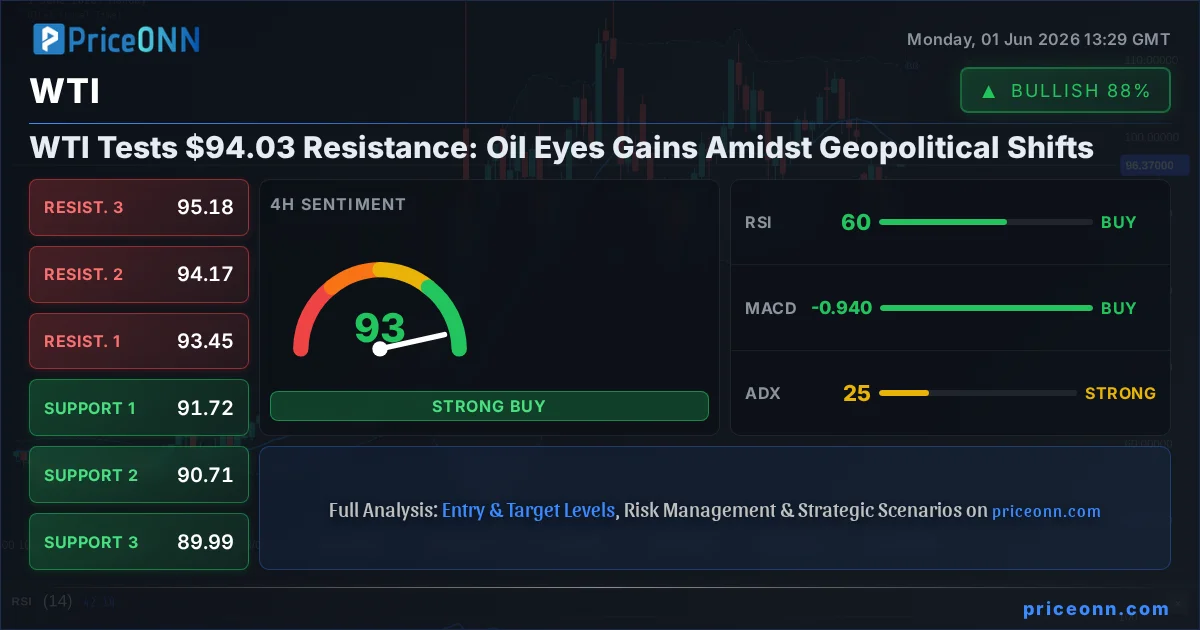
Understanding WTI's Role
West Texas Intermediate, often abbreviated as WTI, is a pivotal grade of crude oil that serves as a key benchmark for global energy markets. This specific crude is characterized by its “light” and “sweet” properties, denoting a low density and minimal sulfur content, respectively. These attributes make it highly desirable for refining into gasoline and other petroleum products, contributing to its premium quality.
Sourced predominantly from oil fields within the United States, WTI's distribution is heavily reliant on the Cushing, Oklahoma hub. This critical nexus, often dubbed "The Pipeline Crossroads of the World," facilitates the movement of vast quantities of crude, making it an indispensable artery for the North American energy supply chain. Consequently, the price of WTI is a frequently cited indicator in financial news and market analysis, reflecting broader trends in energy supply and demand dynamics.
Factors Influencing Oil Prices
The fundamental forces of supply and demand remain the ultimate arbiters of WTI's value. Global economic expansion, for instance, typically spurs greater energy consumption, thereby bolstering demand and potentially driving prices higher. Conversely, periods of economic contraction or slowdown tend to dampen demand, exerting downward pressure on crude prices.
Beyond these core economic drivers, geopolitical events play a critical role. Political instability, armed conflicts, and international sanctions in major oil-producing regions can severely disrupt supply chains, leading to sharp price spikes. The strategic decisions made by the Organization of the Petroleum Exporting Countries (OPEC), a cartel of influential oil-producing nations, also exert significant influence. Their production quota adjustments directly impact global supply levels and, by extension, WTI pricing.
Furthermore, the value of the US Dollar acts as an important counterweight. As crude oil is predominantly traded in dollars, a weaker dollar generally makes oil more affordable for holders of other currencies, potentially stimulating demand and lifting prices. Conversely, a stronger dollar can have the opposite effect, making oil more expensive and potentially curbing demand.
Market participants also closely monitor weekly oil inventory reports released by the American Petroleum Institute (API) and the Energy Information Administration (EIA). These reports offer a snapshot of crude oil and refined product stockpiles in the United States. A significant decrease in inventories often signals robust demand or constrained supply, which can push prices upward. Conversely, an unexpected build in stockpiles might suggest weaker demand or oversupply, leading to price declines. The API report is typically released on Tuesdays, with the EIA data following a day later, providing crucial insights into the immediate balance of the market.
Market Ripple Effects
The current pullback in WTI prices, spurred by a potential easing of U.S. Iran tensions, carries significant implications beyond just crude oil itself. Traders and investors should closely monitor the ripple effects across several interconnected markets. Firstly, a sustained dip in oil prices could alleviate inflationary pressures, potentially influencing central bank policy decisions. This could lead to a softening in demand for the US Dollar Index (DXY) as rate hike expectations diminish.
Secondly, a less volatile or declining energy sector could impact cyclical equity markets. While energy stocks might see some profit-taking, a broad reduction in energy costs could boost consumer spending and benefit sectors like airlines and transportation. Finally, the narrative shift away from immediate supply crises might also reduce demand for safe-haven assets. This could translate into renewed interest in riskier assets, potentially benefiting emerging market currencies and commodities that are sensitive to global growth prospects.
Track markets in real-time
Empower your investment decisions with AI-powered analysis, technical indicators and real-time price data.
Join Our Telegram Channel
Get breaking market news, AI analysis and trading signals delivered instantly to your Telegram.
Join Channel PriceONN News
Crude oil prices experienced a significant drop, with WTI futures falling over 1.8% to $87.25, as optimism grew for a U.S.-Iran deal potentially reopening the Strait of Hormuz.
PriceONN News
(RTTNews) - Crude oil prices have tumbled on Friday as expectations of the U.S. and Iran signing a Memorandum of Understanding run high. The MoU would allow for immediate reopening of the Strait of Hormuz and pave the way for the resumption of oil and energy trade.
PriceONN News
Crude oil futures experienced a dramatic intraday reversal on Thursday, soaring overnight on geopolitical fears only to pull back significantly as reports of a potential diplomatic understanding between the U.S. and Iran emerged.
PriceONN News
Crude oil prices experienced a significant downturn as market sentiment shifted towards optimism about a potential US-Iran Memorandum of Understanding that could reopen the Strait of Hormuz. WTI futures fell nearly 2% on the news.
PriceONN News
Crude oil futures experienced a dramatic intraday reversal, soaring to $92.52 before pulling back significantly on Thursday. The volatile session was driven by shifting geopolitical narratives and U.S. inventory data.
PriceONN News
(RTTNews) - Crude oil futures skyrocketed overnight but have shown a significant pullback over the course of the trading day on Thursday.
PriceONN News
(RTTNews) - Extending the losses from yesterday's session, crude oil prices have gone into freefall on Wednesday as investor expectations on a potential U.S.-Iran agreement continue to rise despite the U.S. refusing to ease its demands.
PriceONN News
(RTTNews) - Crude oil prices have tumbled on Tuesday as optimism about a U.S.-Iran peace deal that could lead to reopening of the Strait of Hormuz soon grows despite reports of fresh U.S. strikes on Iran yesterday.
PriceONN News
Iran's oil exports fell to their lowest level in at least six years in May as the U.S. naval blockade continued to choke off crude shipments and leave tens of millions of barrels stranded at sea. According to shipping data from Vortexa, Iran exported just 209,000 barrels per day (bpd) of crude oil and condensate in May, down from 1.34 million bpd in April and nearly 1.9 million bpd in March. Kpler had estimated May exports slightly higher at 260,000 bpd, but still the lowest level since the...
PriceONN News
The Iran war suddenly turned what had started as a year of oversupply in global oil and LNG markets into the worst oil and gas supply disruption in history. Three months after the U.S.-Israeli strikes on Iran began on February 28, the world has already lost 1 billion barrels of crude oil supply, oil and gas prices have found a new, much higher floor, and whipsaw with violent volatility nearly every day, trade routes have shifted, and tanker rates have spiked. Actual supply shortages are...
PriceONN News
Brent crude prices surged towards the mid-$90s amid fears of supply disruptions from Middle East tensions, only to pare gains later as whispers of a potential US-Iran diplomatic understanding emerged.
PriceONN News
Crude oil futures experienced a dramatic reversal, soaring overnight to $92.52 before plummeting nearly 6% to $89 a barrel. This volatility was driven by escalating US-Iran tensions followed by reports of a potential preliminary diplomatic understanding.