
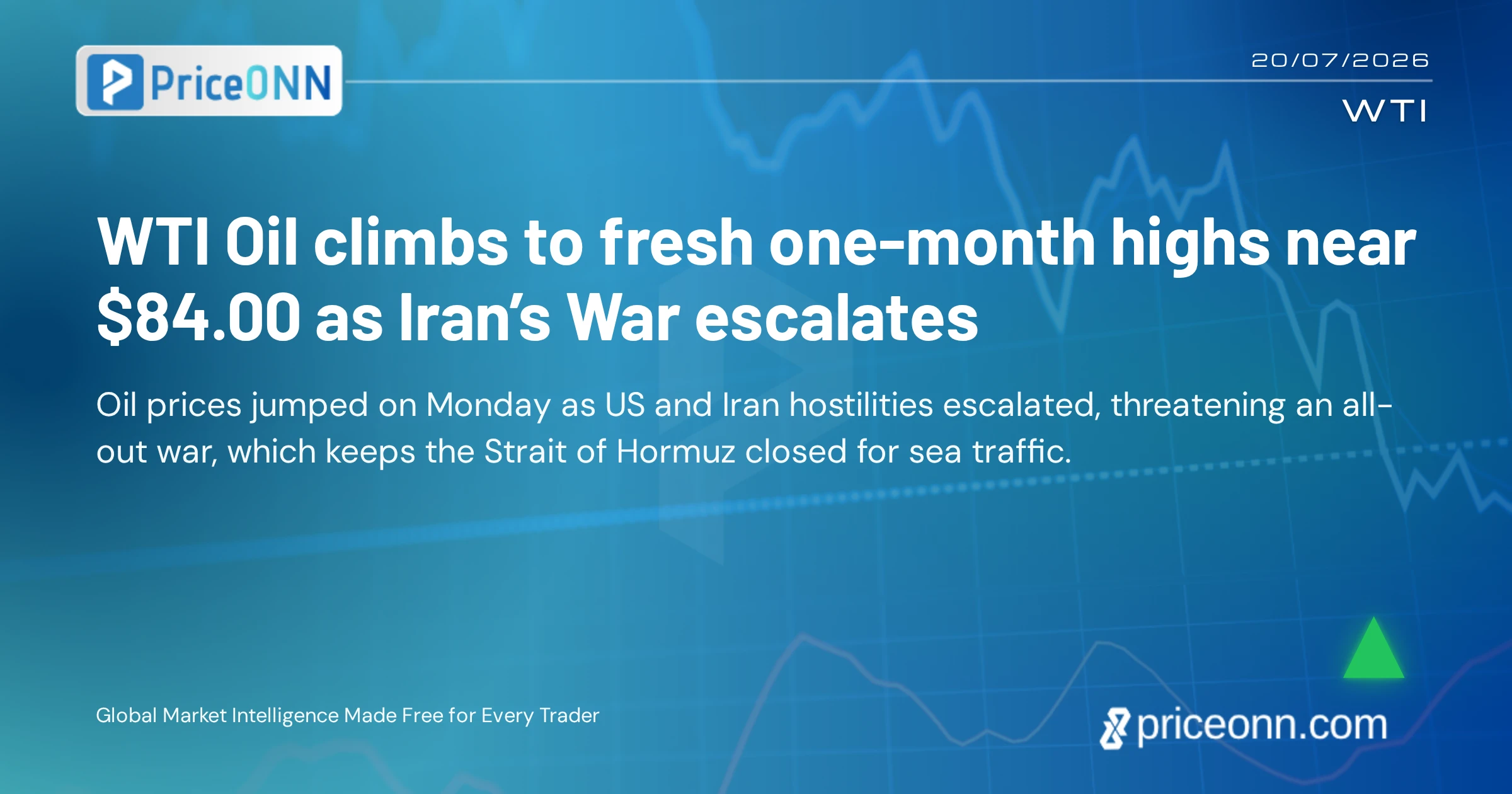
WTI Oil climbs to fresh one-month highs near $84.00 as Iran’s War escalates
 PriceONN Editorial Desk
Multi-source verification
PriceONN Editorial Desk
Multi-source verification
Oil Markets React to Escalating Middle East Conflict
A significant geopolitical flare-up in the Middle East on Monday sent shockwaves through the energy markets, driving benchmark WTI Crude Oil prices to a fresh one-month peak just shy of $84.00 per barrel. The heightened tensions, particularly concerning Iran, have ignited fears of a wider conflict that could threaten critical maritime trade routes, most notably the Strait of Hormuz.
This strategic waterway, through which a substantial portion of global oil shipments transit, becoming inaccessible would create immediate supply chain disruptions. The specter of such an event naturally triggers a risk premium in oil prices, as traders and investors price in the potential for reduced supply reaching global consumers.
Understanding the WTI Benchmark
West Texas Intermediate, or WTI, is a cornerstone of global oil pricing. Sourced predominantly within the United States and distributed through the crucial Cushing, Oklahoma hub – often dubbed the 'Pipeline Crossroads of the World' – it serves as a key reference point for the international crude market. Its designation as 'light' and 'sweet' stems from its favorable low gravity and minimal sulfur content, qualities that facilitate easier and more cost-effective refining into usable products.
The price dynamics of WTI, like any commodity, are fundamentally dictated by the interplay of supply and demand. Factors influencing this balance are multifaceted. Robust global economic expansion typically fuels increased energy consumption, thereby boosting demand. Conversely, economic slowdowns tend to dampen demand and pressure prices downward.
Beyond economic cycles, the global political landscape plays a pivotal role. Wars, sanctions, and periods of heightened political instability can directly impair oil production or disrupt transportation networks, leading to supply shortages and price surges. The strategic decisions made by the Organization of the Petroleum Exporting Countries (OPEC), a cartel of major oil-producing nations, also exert considerable influence. Their collective decisions on production quotas directly affect global supply levels.
Furthermore, the prevailing strength of the US Dollar is an important consideration. Because crude oil is predominantly priced in dollars, a weaker dollar generally makes oil more affordable for purchasers using other currencies, potentially stimulating demand and pushing prices higher. The reverse is also true; a stronger dollar can make oil more expensive internationally, potentially curbing demand.
Inventory Data and OPEC's Influence
Market participants closely scrutinize weekly inventory reports released by the American Petroleum Institute (API) and the Energy Information Administration (EIA). These data points offer insights into the current balance between supply and demand. A notable decrease in oil stocks often signals robust consumption, which can lead to upward price pressure. Conversely, an inventory build-up may indicate increased supply or weaker demand, potentially leading to price declines.
The API releases its figures each Tuesday, with the EIA following suit on Wednesday. While their findings are typically closely aligned, with results often within a 1% variance approximately 75% of the time, the EIA's government-backed status lends its data a higher degree of perceived reliability.
The collective actions of OPEC, comprising 12 key oil-producing countries, are another significant price determinant. Through bi-annual meetings, member nations establish production targets. When OPEC collectively agrees to reduce output, it constricts global supply, often resulting in higher oil prices. Conversely, an increase in OPEC production can have a dampening effect on prices.
The term OPEC+ refers to an expanded alliance that includes ten additional non-OPEC countries, with Russia being a prominent member. This broader group's coordination on production policies can further amplify or moderate the impact on global oil prices.
Reading Between the Lines
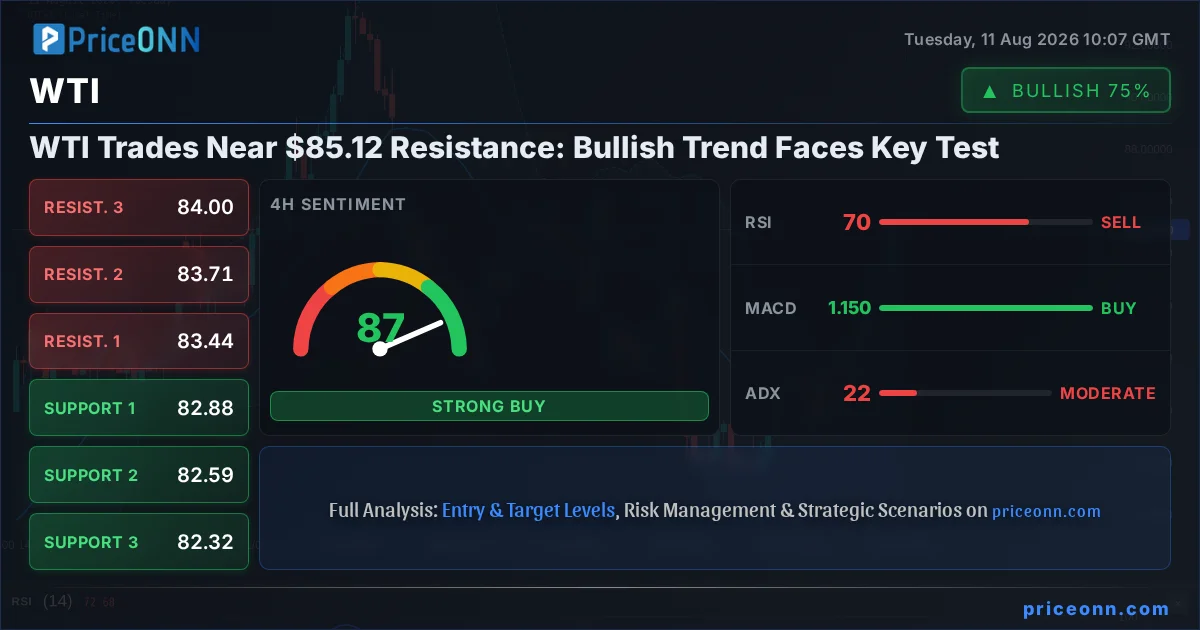
The recent surge in WTI Crude Oil prices, pushing toward the $84.00 mark, is a clear signal that geopolitical risk is back in sharp focus for energy traders. The escalating conflict involving Iran is the primary catalyst, raising concerns about potential disruptions to the Strait of Hormuz, a critical chokepoint for global oil supply. This situation directly impacts benchmarks like WTI and Brent crude.
Traders should monitor any further developments in the Middle East closely. Beyond the immediate headlines, the market will also be watching inventory data from the API and EIA for any signs of changing supply or demand dynamics. Additionally, the stance of OPEC+ members on production levels remains a key factor; any indication of coordinated cuts could further support prices, while increased output would act as a ceiling.
The immediate implication is a heightened risk premium on oil prices. Investors might consider energy sector equities or related ETFs. However, the volatility also presents opportunities for short-term trading strategies. Key risks include diplomatic de-escalation, which could rapidly unwind the current price gains, or a further escalation leading to actual supply blockades, which would propel prices significantly higher. Keep a close eye on the US Dollar Index (DXY) as well; a strengthening dollar could introduce headwinds for oil prices even amidst supply concerns.
Track markets in real-time
Empower your investment decisions with AI-powered analysis, technical indicators and real-time price data.
Join Our Telegram Channel
Get breaking market news, AI analysis and trading signals delivered instantly to your Telegram.
Join Channel PriceONN News
Brent Crude oil prices rose above $89 per barrel in early trade in Europe on Wednesday as Iran and the United States offered contrasting claims about who controls the Strait of Hormuz. Brent Crude prices were up by 0.64% at $89.60 in the morning in Europe, and WTI Crude was rising by 0.94% at $83.90, amid persistent supply concerns and risks despite claims from the U.S. that traffic at Hormuz had normalized. Iran, for its part, said on Tuesday that the Strait of Hormuz will remain closed unless...
PriceONN News
The IEA has slashed its 2026 global oil supply forecast, with output now expected to plunge 4.3 million barrels per day this year as the failure to reopen the Strait of Hormuz pushes the market deeper into deficit. The latest forecast is considerably worse than the 3.7-million-bpd decline the agency projected just last month and would leave global supply at 102.02 million bpd, its lowest forecast for 2026 yet. Supply is now expected to fall 1.27 million bpd short of demand for the year,...
PriceONN News
Oil flows from the Middle East have normalized, with Sunday traffic alone above pre-conflict averages, U.S. Secretary of Energy Chris Wright said on Tuesday in a claim that appears not to be backed by ship-tracking data. On Tuesday, Secretary Wright posted on X that “Thanks to the coordinated efforts of the U.S. military and our gulf allies, the seven-day average for oil leaving the Strait of Hormuz is currently up to almost 9 million barrels per day.” He went on to add that “When combined with...
PriceONN News
Indian state-controlled oil refiners continue to search the market for spot crude supply as term deliveries are constrained by the ongoing crisis in the Middle East and its key oil chokepoint, the Strait of Hormuz. Mangalore Refinery and Petrochemicals Limited (MRPL) and Hindustan Petroleum Corporation Limited (HPCL) are looking to buy a combined 6 million barrels of crude oil via spot tenders, Reuters reported on Wednesday, citing tender documents it has seen. HPCL is seeking up to 4 million...
PriceONN News
(RTTNews) - Crude oil prices have surged on Tuesday, extending the gains from the two previous sessions as the U.S.-Iran stalemate over new demands for compensation for war-related damages continued, diminishing the expectations of an early reopening of the Strait of Hormuz.
PriceONN News
Libya’s National Oil Corporation may declare force majeure on exports from the Zawya oil terminal as a result of drone attacks on the facility. The Zawya terminal has a daily capacity of 120,000 barrels, sourced from the country’s largest oil field, Sharara, which can produce up to 300,000 barrels daily, Reuters noted in a report on the possibility of a force majeure declaration. According to reports, a drone strike had destroyed a storage tank and another drone had targeted an oil blending...
PriceONN News
The latest Bloomberg data show that shipping transits through the Strait of Hormuz remained largely disrupted Monday morning, even as Iran and Oman reportedly moved closer to a deal. Brent crude futures traded near $85 a barrel as markets priced in the possibility that a deal to reopen the maritime chokepoint could be imminent. Yet global supply-chain stress remains near its highest level since the pandemic, and any normalization could take months, even if shipping traffic resumes. UBS senior...
PriceONN News
A drone has struck a power station at the Zawiya oil export terminal in Libya, suggesting continued attacks on one of the country’s main oil hubs. The power plant is in close proximity to the largest oil refinery in Libya, the AP noted in a report on the news. The attack follows earlier ones that caused an explosion at an oil storage tank. No one has claimed responsibility for the drone attacks, the AP also reported. The tank, according to the company operating the facility, had 4.5 million...
PriceONN News
Whatever officially occurs next in the on-again/off-again negotiations towards a peace deal between the U.S. and Iran, unofficially Tehran knows that it has established de facto control over both the world’s two key maritime energy transit routes -- the Strait of Hormuz and the Bab el-Mandeb Strait -- for at least as long as the Islamic regime remains in place in Iran. Washington, London, Brussels, Beijing, and Moscow know it too. The Strait of Hormuz remains effectively controlled by vast...
PriceONN News
The Middle East conflict and the heightened threats to shipping in the Red Sea have prompted China to boost the use of the Arctic to move containers from the Chinese east coast to Europe. The fast-melting Arctic ice offers an alternative shipping route in the summer as the Houthi threats to shipping in the Red Sea and the Bab el-Mandeb Strait make cargo operators more cautious in transiting the key chokepoints in the Middle East. Shipping through the Arctic is not something new, but this time...
PriceONN News
The American Petroleum Institute (API) estimated that crude oil inventories in the United States rose by 9.072 million barrels in the week ending August 7, compared to analyst expectations for a 500,000-barrel draw. In the week prior, U.S. crude oil inventories rose by 2.69 million barrels. The larger-than-expected build was driven in part by higher crude imports relative to exports during the week. Commercial crude oil inventories excluding the SPR have lost just over 49 million barrels over...
PriceONN News
Five months after the U.S. and Israel opened a war with Iran, global fuel markets still haven't settled down, and the latest IEA data prove it. The IEA's monthly end-use price tracker, updated Aug. 7 and covering prices through July, shows the average per-liter cost of automotive diesel across the countries it tracks sitting near $1.94 in U.S. dollar terms. That's roughly 14% above where it stood in February, before the war started, and it's actually higher than June, even as crude oil kept...