
WTI Oil struggles below $70 amid expectations of higher Middle East supply
 PriceONN Editorial Desk
Multi-source verification
PriceONN Editorial Desk
Multi-source verification
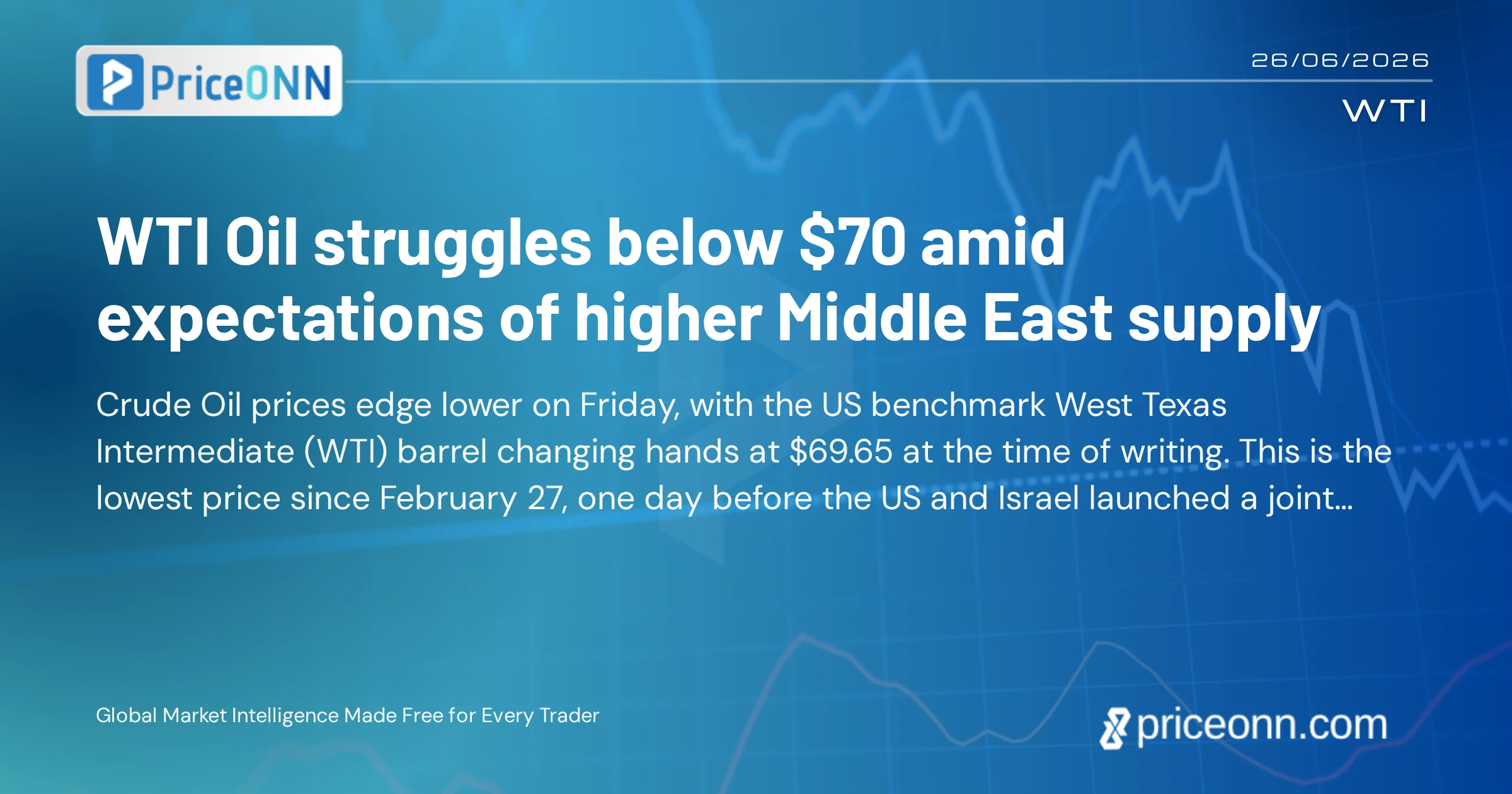
Crude Futures Test Multi-Month Lows Amid Supply Rumors
The price of West Texas Intermediate (WTI) crude, a key global oil benchmark, has fallen to its lowest point since February 27, trading hands at approximately $69.65 on Friday. This marks a significant retreat from levels seen just before a major geopolitical event involving the US and Iran in late February.
WTI crude, known for its relatively low sulfur content and high refining ease, is a cornerstone of the international oil market. Sourced primarily from the United States and distributed through the critical Cushing, Oklahoma hub, often dubbed "The Pipeline Crossroads of the World," its price movements are closely watched indicators of global economic health.
The fundamental forces of supply and demand are the primary architects of WTI's valuation. Robust global economic expansion typically fuels greater energy consumption, thereby boosting demand. Conversely, economic slowdowns exert downward pressure on prices. The complex interplay of geopolitical events, including conflicts, political instability, and international sanctions, can profoundly disrupt supply chains and send shockwaves through oil markets.
Furthermore, the strategic decisions made by the Organization of the Petroleum Exporting Countries (OPEC), a cartel of major oil-producing nations, wield considerable influence. This influential group, along with its expanded OPEC+ alliance that includes key non-OPEC producers like Russia, convenes regularly to set production quotas. Adjustments to these quotas can either tighten or loosen global supply, directly impacting WTI's price trajectory.
The strength of the US Dollar also plays a crucial role. As oil is predominantly priced in dollars, a depreciating dollar generally makes crude more accessible and thus more attractive to buyers using other currencies, potentially driving prices higher. An appreciating dollar has the opposite effect.
Inventory Data Offers Clues to Market Dynamics
Traders and analysts keenly observe weekly inventory reports from the American Petroleum Institute (API) and the Energy Information Agency (EIA). These releases provide critical insights into the balance between oil supply and demand within the United States.
A decline in reported crude oil stockpiles can signal robust demand or constrained supply, often leading to upward price pressure. Conversely, an unexpected build in inventories might suggest weaker demand or oversupply, typically contributing to price declines. While the API releases its findings on Tuesdays and the EIA follows on Wednesdays, their results usually align closely, differing by less than 1% approximately 75% of the time. The EIA's data is generally regarded with higher confidence due to its governmental backing.
Reading Between the Lines
The current slide in WTI prices, pushing it below the psychologically important $70 mark, is largely being attributed to market whispers of an impending increase in oil output from the Middle East. This anticipation is overshadowing other market drivers for now, suggesting that supply-side concerns are taking precedence over demand-side indicators.
For traders, this development highlights the persistent sensitivity of oil markets to geopolitical developments and cartel decisions. The market is essentially pricing in a scenario where increased supply could materialize, thereby capping any significant price rallies in the short to medium term. Watch for any official statements from OPEC or key Middle Eastern producers that could confirm or deny these supply increase expectations.
The broader implications extend to energy stocks and currencies sensitive to commodity prices. A sustained period of lower oil prices could put pressure on energy sector earnings and may also influence inflation expectations. Currencies of major oil-exporting nations, such as the Canadian Dollar (CAD), could face headwinds if prices remain depressed. Conversely, the US Dollar Index (DXY) might find some support if global economic concerns, often linked to energy prices, begin to resurface.
Investors and traders should monitor not only the official inventory data but also any shifts in rhetoric from OPEC+ members. Furthermore, geopolitical tensions in the Middle East remain a wildcard that could quickly alter the supply narrative. The market is currently leaning towards a supply surplus narrative, but a sudden escalation of conflict could dramatically reverse this sentiment, leading to a rapid price recovery.
Track markets in real-time
Empower your investment decisions with AI-powered analysis, technical indicators and real-time price data.
Join Our Telegram Channel
Get breaking market news, AI analysis and trading signals delivered instantly to your Telegram.
Join Channel PriceONN News
Brent Crude oil prices rose above $89 per barrel in early trade in Europe on Wednesday as Iran and the United States offered contrasting claims about who controls the Strait of Hormuz. Brent Crude prices were up by 0.64% at $89.60 in the morning in Europe, and WTI Crude was rising by 0.94% at $83.90, amid persistent supply concerns and risks despite claims from the U.S. that traffic at Hormuz had normalized. Iran, for its part, said on Tuesday that the Strait of Hormuz will remain closed unless...
PriceONN News
The IEA has slashed its 2026 global oil supply forecast, with output now expected to plunge 4.3 million barrels per day this year as the failure to reopen the Strait of Hormuz pushes the market deeper into deficit. The latest forecast is considerably worse than the 3.7-million-bpd decline the agency projected just last month and would leave global supply at 102.02 million bpd, its lowest forecast for 2026 yet. Supply is now expected to fall 1.27 million bpd short of demand for the year,...
PriceONN News
Oil flows from the Middle East have normalized, with Sunday traffic alone above pre-conflict averages, U.S. Secretary of Energy Chris Wright said on Tuesday in a claim that appears not to be backed by ship-tracking data. On Tuesday, Secretary Wright posted on X that “Thanks to the coordinated efforts of the U.S. military and our gulf allies, the seven-day average for oil leaving the Strait of Hormuz is currently up to almost 9 million barrels per day.” He went on to add that “When combined with...
PriceONN News
Indian state-controlled oil refiners continue to search the market for spot crude supply as term deliveries are constrained by the ongoing crisis in the Middle East and its key oil chokepoint, the Strait of Hormuz. Mangalore Refinery and Petrochemicals Limited (MRPL) and Hindustan Petroleum Corporation Limited (HPCL) are looking to buy a combined 6 million barrels of crude oil via spot tenders, Reuters reported on Wednesday, citing tender documents it has seen. HPCL is seeking up to 4 million...
PriceONN News
(RTTNews) - Crude oil prices have surged on Tuesday, extending the gains from the two previous sessions as the U.S.-Iran stalemate over new demands for compensation for war-related damages continued, diminishing the expectations of an early reopening of the Strait of Hormuz.
PriceONN News
OPEC’s total oil production jumped by 1.17 million barrels per day in July from June as many Gulf producers restored some output that was shut in for three months due to the closed Strait of Hormuz. Output at the 11-member OPEC rose to 19.85 million bpd in July, extending the monthly increases for the second consecutive month, according to a based on ship-tracking data and information provided by sources at OPEC, oil companies, and consultants. In May, when major Gulf producers...
PriceONN News
Libya’s National Oil Corporation may declare force majeure on exports from the Zawya oil terminal as a result of drone attacks on the facility. The Zawya terminal has a daily capacity of 120,000 barrels, sourced from the country’s largest oil field, Sharara, which can produce up to 300,000 barrels daily, Reuters noted in a report on the possibility of a force majeure declaration. According to reports, a drone strike had destroyed a storage tank and another drone had targeted an oil blending...
PriceONN News
The latest Bloomberg data show that shipping transits through the Strait of Hormuz remained largely disrupted Monday morning, even as Iran and Oman reportedly moved closer to a deal. Brent crude futures traded near $85 a barrel as markets priced in the possibility that a deal to reopen the maritime chokepoint could be imminent. Yet global supply-chain stress remains near its highest level since the pandemic, and any normalization could take months, even if shipping traffic resumes. UBS senior...
PriceONN News
A drone has struck a power station at the Zawiya oil export terminal in Libya, suggesting continued attacks on one of the country’s main oil hubs. The power plant is in close proximity to the largest oil refinery in Libya, the AP noted in a report on the news. The attack follows earlier ones that caused an explosion at an oil storage tank. No one has claimed responsibility for the drone attacks, the AP also reported. The tank, according to the company operating the facility, had 4.5 million...
PriceONN News
Whatever officially occurs next in the on-again/off-again negotiations towards a peace deal between the U.S. and Iran, unofficially Tehran knows that it has established de facto control over both the world’s two key maritime energy transit routes -- the Strait of Hormuz and the Bab el-Mandeb Strait -- for at least as long as the Islamic regime remains in place in Iran. Washington, London, Brussels, Beijing, and Moscow know it too. The Strait of Hormuz remains effectively controlled by vast...
PriceONN News
The Middle East conflict and the heightened threats to shipping in the Red Sea have prompted China to boost the use of the Arctic to move containers from the Chinese east coast to Europe. The fast-melting Arctic ice offers an alternative shipping route in the summer as the Houthi threats to shipping in the Red Sea and the Bab el-Mandeb Strait make cargo operators more cautious in transiting the key chokepoints in the Middle East. Shipping through the Arctic is not something new, but this time...
PriceONN News
The American Petroleum Institute (API) estimated that crude oil inventories in the United States rose by 9.072 million barrels in the week ending August 7, compared to analyst expectations for a 500,000-barrel draw. In the week prior, U.S. crude oil inventories rose by 2.69 million barrels. The larger-than-expected build was driven in part by higher crude imports relative to exports during the week. Commercial crude oil inventories excluding the SPR have lost just over 49 million barrels over...