
WTI remains below $68.50 amid easing Middle East tensions
 PriceONN Editorial Desk
Multi-source verification
PriceONN Editorial Desk
Multi-source verification
Energy Market Takes a Breather
The price of West Texas Intermediate (WTI) crude oil has dipped below the $68.50 mark, trading around $68.40 during Friday's Asian trading session. This modest retreat follows a period of slight gains recorded the previous day. The global energy landscape is currently experiencing a noticeable cooling as geopolitical anxieties in the Middle East begin to subside, influencing trading desks to reassess their positions.
WTI, a benchmark for crude oil traded internationally, is renowned for its quality, characterized by low gravity and minimal sulfur content. This makes it a 'light' and 'sweet' crude, easily processed into refined products. Sourced predominantly within the United States, its distribution network is anchored by the Cushing hub in Oklahoma, a critical nexus often dubbed 'The Pipeline Crossroads of the World'. The daily fluctuations in WTI's price are a constant fixture in financial media, driven by the fundamental forces of supply and demand.
Factors influencing this delicate balance are multifaceted. Robust global economic expansion typically fuels increased demand for energy, pushing prices upward. Conversely, a slowdown in economic activity can dampen consumption and exert downward pressure. Disruptions to supply, whether through political instability, armed conflicts, or international sanctions, can dramatically impact pricing dynamics. Furthermore, the strategic production decisions made by OPEC, the Organization of the Petroleum Exporting Countries, and its extended alliance known as OPEC+, play a significant role in shaping market supply and, consequently, WTI's value.
The strength of the U.S. dollar also casts a long shadow over WTI pricing. Given that oil transactions are predominantly denominated in dollars, a weaker dollar generally makes crude more accessible and affordable for holders of other currencies, potentially boosting demand and prices. Conversely, a stronger dollar can make oil more expensive globally, potentially curbing demand.
Another critical data point for traders and analysts are the weekly inventory reports released by the American Petroleum Institute (API) and the Energy Information Administration (EIA). These reports offer insights into the fluctuating levels of crude oil stocks, reflecting the real-time interplay between supply and demand. A drawdown in inventories often signals heightened demand, which can catalyze price increases. Conversely, an expansion in stockpiles might suggest oversupply, leading to price declines. While API releases its data on Tuesdays, the EIA follows suit the next day. Though their findings are typically closely aligned, with results mirroring each other within 1% approximately 75% of the time, the EIA's figures are often viewed with greater weight due to its governmental authority.
Market Ripple Effects
The current easing of Middle East tensions, while providing a temporary reprieve from upward price pressure on crude, carries broader implications for linked markets. Traders are now recalibrating their expectations, shifting focus from immediate supply shock scenarios to more sustained demand-side drivers. This development could influence not only crude oil futures but also related commodities and currency pairs.
For instance, a sustained period of lower oil prices could reduce inflationary pressures globally. This might lead central banks, particularly those sensitive to energy costs like the European Central Bank, to adopt a less aggressive stance on interest rate hikes. Consequently, the Euro (EUR) could find some support against the U.S. Dollar, though the latter's strength is also influenced by Federal Reserve policy. Energy sector stocks, particularly those of exploration and production companies, may see their valuations come under scrutiny if the price moderation persists. Companies heavily reliant on high oil prices for profitability might face headwinds, while refiners could benefit from lower input costs. Investors might also re-evaluate their exposure to commodities as a whole, potentially rotating capital towards other asset classes if the perceived geopolitical risk premium in oil continues to diminish.
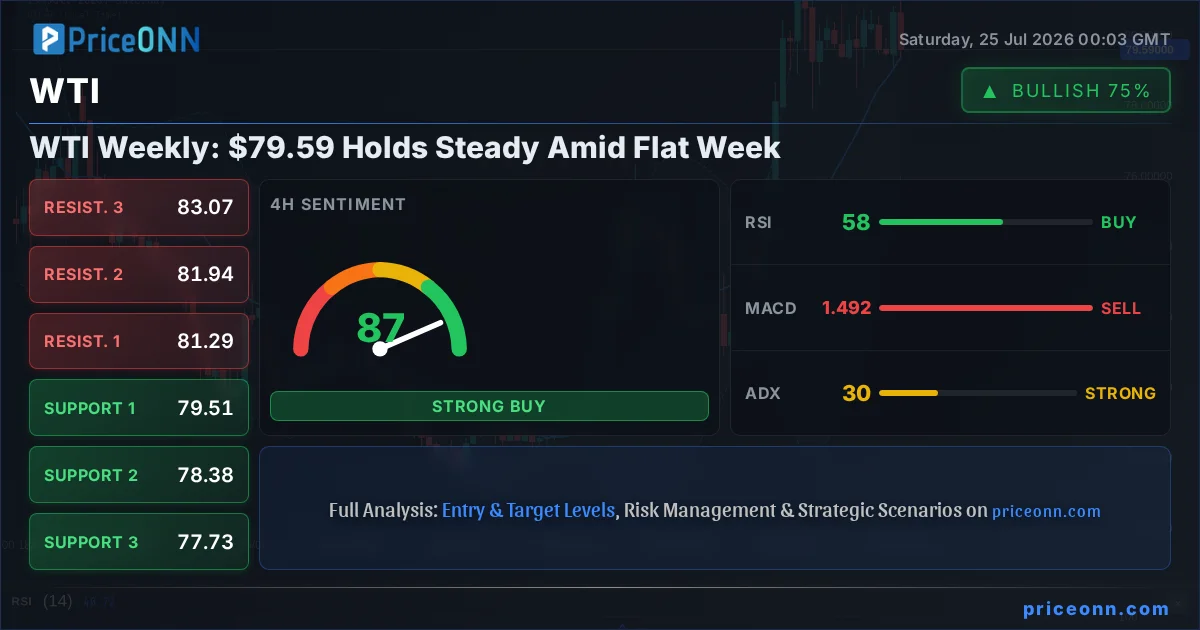
Key levels to watch include the immediate support at $68.00 for WTI. A decisive break below this level could signal further downside, potentially testing the psychological $65.00 handle. On the upside, resistance remains at the recent highs around $70.00. The market will be keenly observing any renewed escalation of tensions in the Middle East, as well as upcoming economic data from major consuming nations like China and the United States, which will offer clues about future demand trajectories.
Track markets in real-time
Empower your investment decisions with AI-powered analysis, technical indicators and real-time price data.
Join Our Telegram Channel
Get breaking market news, AI analysis and trading signals delivered instantly to your Telegram.
Join Channel PriceONN News
(RTTNews) - Partially offsetting the gains from five consecutive sessions, crude oil prices have plunged on Friday as investors opted to book profits made from the recent trades. While U.S. President Donald Trump threatened to intensify attacks on Iran, investors analyzed the imp
PriceONN News
Russia's largest Black Sea oil export terminal has effectively gone offline just days after drone attacks shut down the neighboring Caspian Pipeline Consortium terminal, tightening another artery that moves crude onto the global market. The Sheskharis terminal at Novorossiysk hasn’t loaded a crude tanker since July 21. Sheskharis exported an average of about 650,000 barrels per day during the first half of the year. Losing those barrels, even temporarily, comes on top of...
PriceONN News
Saudi Arabia, which at the start of the Iran war redirected virtually all crude exports through its East-West pipeline to Yanbu on the Red Sea, has seen crude exports from Yanbu crumble by 41% to about 2.39 million barrels per day (bpd) by June, from a peak of 4.07 million bpd in March, Wood Mackenzie vessel tracking and cargo data showed. Despite the near-total concentration of exports through Yanbu, volumes have declined steadily from the March peak, according to WoodMac's tracking data. By...
PriceONN News
The dual disruption of Hormuz and Bab el-Mandeb is tightening global oil flows, raising transport costs and fueling expectations of $100 oil. Friday, July 24, 2026 The double blockade of the Strait of Hormuz and the Bab el-Mandeb has turbo-boosted oil prices this week, with both ICE Brent and WTI gaining $10 per barrel on the week. Whilst technically the Bab el-Mandeb could be bypassed through the Suez Canal, resulting in longer routes and higher costs, the dramatic decline in transits via the...
PriceONN News
Indian refiners are in search of crude supply from as far as Angola in Africa and Venezuela in South America as their term supplies from the Middle East are trapped again and unable to reach India as planned. Some of the biggest state-held refiners in India, the world’s third-largest crude oil importer, are looking for and testing new crude grades, to offset part of the supply lost to the Middle East conflict, senior refinery executives told Indian outlet Economic Times. “We diversified our...
PriceONN News
Abu Dhabi National Oil Company ADNOC has issued its seventh tender offering crude from the United Arab Emirates since the beginning of June, expecting to sell millions of barrels of oil between August and October, both from within and outside the Persian Gulf. Despite the renewed threats to supply from the Strait of Hormuz and the new threats to shipping in the Red Sea by the Iran-aligned Houthis in Yemen, ADNOC is inviting interested buyers to bid by the middle of next week for crude loading...
PriceONN News
At least one oil tanker carrying Saudi crude oil has transited the Bab al-Mandeb Strait with its transponder switched off as risks to vessels in the Red Sea spiked this week after the Houthis announced a blockade on Saudi shipments and targeted vessels offshore Yemen. The Merbabu tanker, owned by a Greek company and laden with Saudi crude oil, transited the Bab al-Mandeb Strait in the so-called dark mode, which many shippers and tanker operators used for months to move undetected to hostile...
PriceONN News
Chinese refiners have bought up all crude oil cargoes set to load from Russia’s Far East port of Kozmino in August weeks earlier than usual, traders with knowledge of the market told Bloomberg on Friday, as risks to Middle Eastern supply spiked this week with attacks on tankers in the Red Sea. China has been snapping up the cargoes at a faster pace, which raised the price of the Russian Far Eastern crude blend ESPO to a discount of just $1 per barrel to the price of ICE Brent, up from a...
PriceONN News
Crude oil prices were on course for a sizable weekly gain today, as the Strait of Hormuz remains almost entirely paralysed and the Yemeni Houthis target tankers in the Bab el-Mandeb Strait in the Red Sea. To make matters worse, Kazakhstan has suspended oil flows via the Caspian Pipeline Consortium system following Ukrainian drone attacks. At the time of writing, Brent crude was trading at $100.30 per barrel, with West Texas Intermediate at $91.70 per barrel, both up by over $10 per barrel since...
PriceONN News
OPEC+ is expected to approve another production target increase when eight key producers meet on August 2, extending a months-long campaign to unwind voluntary supply cuts that have existed largely on paper since the Iran war upended Gulf exports. Reuters reported Thursday that Saudi Arabia, Russia, Iraq, Kuwait, Algeria, Kazakhstan, and Oman are expected to raise their combined September production target by another 188,000 barrels per day, matching the increases announced for June, July, and...
PriceONN News
India is on track to export the highest volume of refined petroleum products in months as refining margins have jumped with the re-escalation of the Middle East conflict. India is estimated to ship as many as 1.55 million barrels per day (bpd) of light and middle distillates in July, per data by commodity analysts Kpler cited by Reuters columnist Clyde Russell. The July volumes would be nearly double the fuel export volumes of just 866,000 bpd in May, when the Strait of Hormuz crisis hit crude...
PriceONN News
For years, Saudi Arabia's strategic answer to any disruption in the Strait of Hormuz has been remarkably straightforward. If volumes via the Persian Gulf were threatened, the answer was to pump west through the East-West Pipeline to Yanbu on the Red Sea. Markets have always seen this as reassuring, while strengthening Saudi energy security and reducing dependence on Hormuz. Current developments in the Red Sea, especially Bab El Mandab, however, have exposed a critical weakness in that...