
WTI slides to near $96 as US Dollar strengthens, eyes on Middle East tensions
 PriceONN Editorial Desk
Multi-source verification
PriceONN Editorial Desk
Multi-source verification

Oil Benchmark Under Pressure
The primary US crude oil benchmark, West Texas Intermediate (WTI), is experiencing downward pressure, trading precariously close to the $96.00 per barrel level during early European trading on Thursday. This slide comes as the US Dollar is exhibiting renewed strength, a key factor influencing global commodity prices.
WTI, often described as "light" and "sweet" due to its low viscosity and minimal sulfur content, is a highly regarded crude for its ease of refinement. Sourced within the United States, its primary distribution point is the Cushing, Oklahoma hub, a critical nexus often dubbed "The Pipeline Crossroads of the World." This strategic positioning solidifies its role as a pivotal benchmark, with its price frequently cited in market reports and financial news.
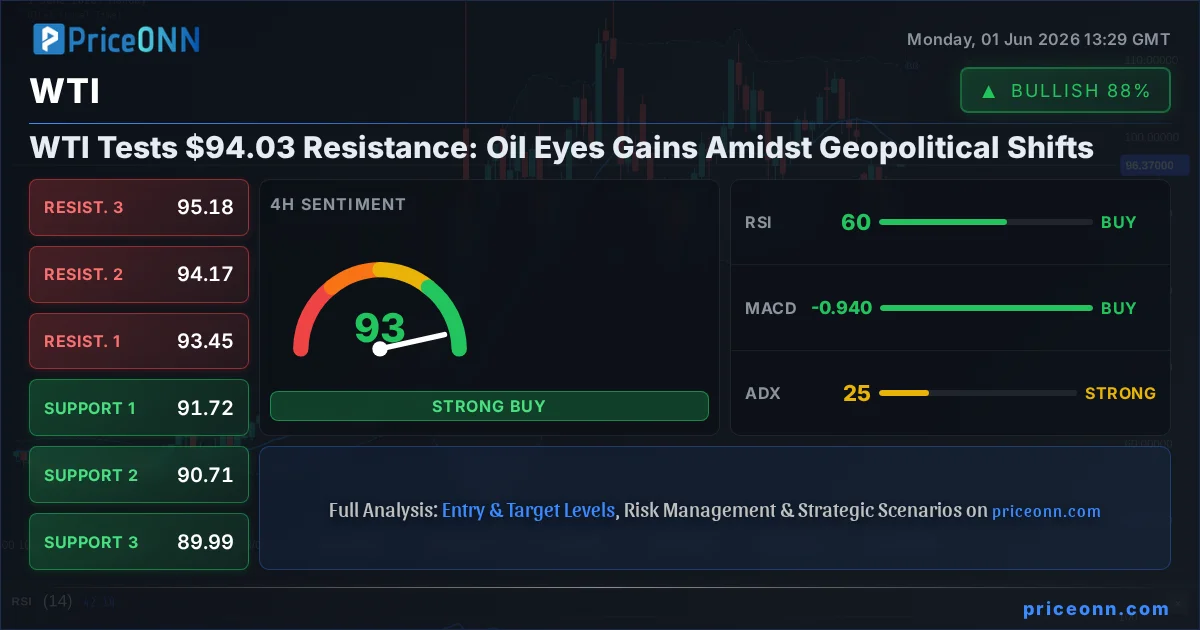
The fundamental forces of supply and demand are the primary architects of WTI's price trajectory. A robust global economy typically fuels increased energy consumption, thereby boosting demand. Conversely, economic slowdowns often dampen this demand, leading to price erosion. Geopolitical events, including conflicts, political instability, and international sanctions, possess the power to disrupt supply chains, creating volatility and upward price pressure.
Furthermore, the coordinated production decisions made by major oil-producing nations, particularly within the Organization of the Petroleum Exporting Countries (OPEC) and its allies, significantly sway market dynamics. The collective output strategy of these cartels can either tighten or loosen global oil availability, directly impacting WTI's value.
Inventory Data and Currency Dynamics at Play
Market participants are also closely monitoring weekly inventory reports released by the American Petroleum Institute (API) and the Energy Information Administration (EIA). These reports offer a snapshot of crude oil and refined product stockpiles in the United States. A steeper-than-expected decline in inventories can signal robust demand, potentially driving prices higher. Conversely, an unexpected build-up suggests weaker demand or increased supply, which typically weighs on crude prices.
The API releases its data every Tuesday, followed by the EIA's report the subsequent Wednesday. While these two sources usually offer closely aligned figures, the EIA's data, being from a governmental body, is generally considered the more definitive indicator. These inventory fluctuations are critical inputs for traders assessing the immediate supply-demand balance.
The intricate relationship between the US Dollar and oil prices cannot be overstated. Because crude oil is predominantly priced and traded in dollars, fluctuations in the greenback's value have a direct inverse effect on oil's affordability for holders of other currencies. A weakening dollar makes oil cheaper for international buyers, potentially stimulating demand and pushing prices up. Conversely, a stronger dollar makes oil more expensive, which can curtail demand and pressure prices downward. This currency dynamic is currently playing a significant role in the recent WTI slide.
Market Ripple Effects
The current downward pressure on WTI crude, driven by a stronger dollar and broader market sentiment, carries implications for several interconnected markets. Traders should closely observe the performance of the US Dollar Index (DXY), which is likely to remain buoyant as long as this trend persists. Energy sector equities, particularly those heavily reliant on oil prices for their profitability, may face headwinds. Additionally, currencies of major oil-exporting nations, such as the Canadian Dollar (CAD), could experience depreciation against the USD. Finally, the persistent geopolitical tensions in the Middle East continue to be a background risk factor, capable of injecting sudden volatility into oil prices and impacting inflation expectations globally.
Track markets in real-time
Empower your investment decisions with AI-powered analysis, technical indicators and real-time price data.
Join Our Telegram Channel
Get breaking market news, AI analysis and trading signals delivered instantly to your Telegram.
Join Channel PriceONN News
(RTTNews) - Oil prices were little changed on Thursday, after having fallen over 5 percent in the previous session amid optimism over a possible easing of Middle East tensions. Brent crude futures for July delivery were down 0.3 percent at $104.72 a barrel while WTI crude futures
PriceONN News
Crude oil prices experienced a significant drop, with WTI futures falling over 1.8% to $87.25, as optimism grew for a U.S.-Iran deal potentially reopening the Strait of Hormuz.
PriceONN News
(RTTNews) - Crude oil prices have tumbled on Friday as expectations of the U.S. and Iran signing a Memorandum of Understanding run high. The MoU would allow for immediate reopening of the Strait of Hormuz and pave the way for the resumption of oil and energy trade.
PriceONN News
Crude oil futures experienced a dramatic intraday reversal on Thursday, soaring overnight on geopolitical fears only to pull back significantly as reports of a potential diplomatic understanding between the U.S. and Iran emerged.
PriceONN News
Crude oil futures experienced a dramatic intraday reversal, soaring to $92.52 before pulling back significantly on Thursday. The volatile session was driven by shifting geopolitical narratives and U.S. inventory data.
PriceONN News
Brent crude prices surged towards the mid-$90s amid fears of supply disruptions from Middle East tensions, only to pare gains later as whispers of a potential US-Iran diplomatic understanding emerged.
PriceONN News
(RTTNews) - Crude oil futures skyrocketed overnight but have shown a significant pullback over the course of the trading day on Thursday.
PriceONN News
Crude oil benchmarks experienced a sharp decline of over 5% this week, driven by renewed optimism surrounding U.S.-Iran peace talks and a potential easing of Middle East tensions. Both Brent and WTI futures saw significant drops as market sentiment shifted towards de-escalation.
PriceONN News
Global oil prices are treading water after a significant 5% slump, as market sentiment grapples with cautious optimism over Middle East de-escalation efforts versus lingering geopolitical uncertainties. Brent crude hovers near $104.72 and WTI near $98.07.
PriceONN News
WTI Crude Oil futures experienced a sharp decline of over 5.6%, falling to $98.26 per barrel as diplomatic efforts between the U.S. and Iran gained significant momentum, easing supply disruption fears.
PriceONN News
Crude oil prices experienced a sharp decline, with WTI futures for July delivery falling 5.66% to $98.26. This drop is largely attributed to renewed diplomatic efforts aimed at de-escalating the U.S.-Iran conflict and easing tensions around the Strait of Hormuz.
PriceONN News
The Iran war suddenly turned what had started as a year of oversupply in global oil and LNG markets into the worst oil and gas supply disruption in history. Three months after the U.S.-Israeli strikes on Iran began on February 28, the world has already lost 1 billion barrels of crude oil supply, oil and gas prices have found a new, much higher floor, and whipsaw with violent volatility nearly every day, trade routes have shifted, and tanker rates have spiked. Actual supply shortages are...