AUD and NZD Face Pressure as Inflation Fears Mount and Confidence Dips

The Australian and New Zealand Dollars are navigating choppy waters as recent economic data and central bank insights point towards a challenging inflationary environment and a notable decline in business sentiment across the Tasman Sea.
Market Context
The Reserve Bank of Australia's (RBA) minutes from its March meeting have signaled a strong inclination towards further monetary tightening. Policymakers judged that inflation remains unacceptably high, with risks amplified by a recent surge in oil prices. This hawkish stance comes as the RBA observed that the Australian economy is still grappling with "excess demand", further evidenced by a labor market that has tightened beyond sustainable levels. Meanwhile, across the ditch, New Zealand's business confidence experienced a significant drop in March. Sentiment soured, particularly in the latter half of the month, as the economic consequences of the Middle East conflict became more apparent to Kiwi firms. This downturn in sentiment coincides with rising inflation expectations and a strong intention among businesses to pass on higher costs.
Analysis & Drivers
The RBA's assessment highlights a persistent inflationary challenge. Board members explicitly noted that inflation was still "too high" and that the economy continued to operate with "excess demand". The surge in crude oil prices, attributed to geopolitical tensions, was projected to "significantly push up inflation in March". While acknowledging that higher energy costs could dampen economic activity, the RBA’s priority is to prevent these supply shocks from becoming embedded in the broader price structure. This necessitates tighter monetary conditions to curb the passing of costs to final prices. Consequently, a majority of RBA members concluded that "further tightening in monetary policy would likely be required in the near term", questioning whether current financial conditions were "sufficiently restrictive". The persistence of excess demand and rising short-term inflation expectations bolster the case for proactive tightening.
In New Zealand, the March business confidence survey revealed a sharp deterioration. The headline confidence index fell to 32.5 from 59.2 in February. Expectations for own trading activity also retreated, dropping from 52.6 to 39.3. This decline in optimism is directly linked to the escalating geopolitical risks and their impact on the global economy, which are becoming more apparent to New Zealand businesses. Despite the waning confidence, inflationary pressures are building. Expected inflation for the next twelve months climbed to 3.08%, its highest level since July 2024. A striking 85% of firms anticipate their own operational costs rising, leading a net 60% of businesses to plan price hikes – the most aggressive sentiment recorded recently.
Trader Implications
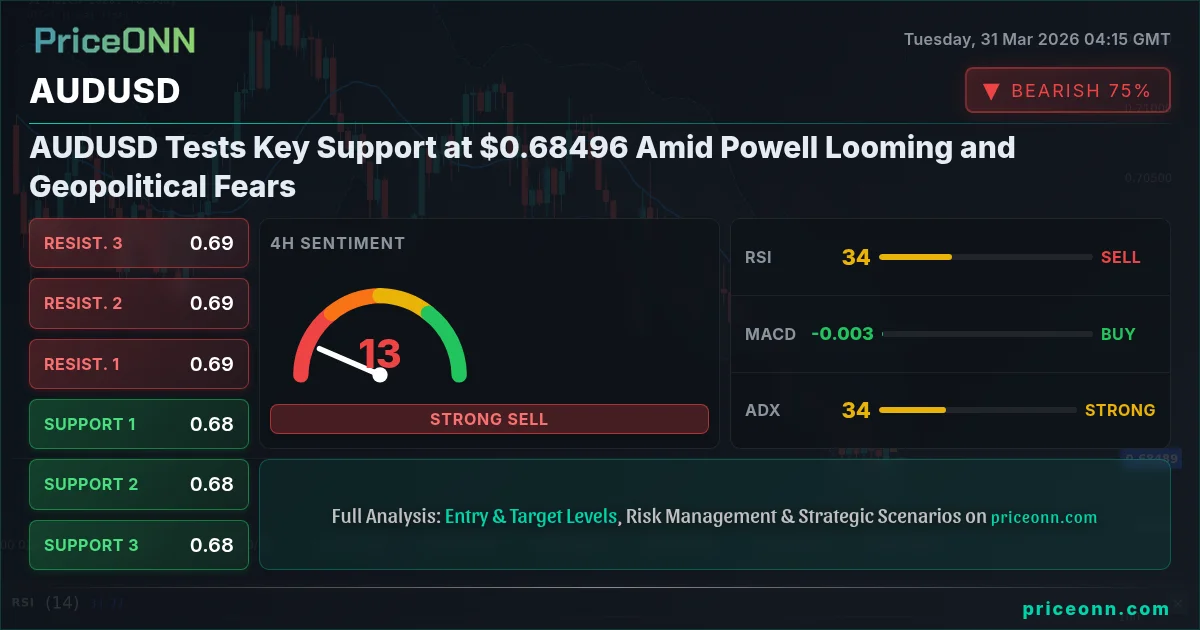
For traders monitoring the AUD, the RBA minutes suggest a continued bias towards higher interest rates. This could provide underlying support for the Australian Dollar, especially if other major central banks maintain a more dovish stance. Key levels to watch for AUD/USD include immediate resistance around 0.6600 and support near 0.6500. Any further hawkish commentary or unexpected inflation data could push the pair higher.
Conversely, the sharp decline in New Zealand's business confidence and rising inflation expectations present a mixed picture for the NZD. While the immediate sentiment is negative, the persistent inflation and the prospect of businesses passing on costs could eventually lead the Reserve Bank of New Zealand to adopt a more cautious or even hawkish approach, despite the confidence dip. For NZD/USD, traders should monitor the 0.6050 support level. A break below this could signal further downside driven by sentiment, while a rebound would likely require a shift in global risk appetite or clearer signals of sustained domestic inflation pressures that compel RBNZ action. The divergence in economic outlooks between Australia and New Zealand, particularly concerning inflation and central bank policy direction, will be a key theme for currency traders.
Outlook
The immediate outlook suggests that both the AUD and NZD may face headwinds. The RBA's hawkish leanings offer potential upside for the AUD, but this could be tempered by global growth concerns. For the NZD, the significant drop in business confidence presents a near-term risk, although rising inflation may provide a floor. Traders will be closely watching upcoming employment data from both countries and any further commentary from their respective central banks regarding the balance between inflation control and economic growth. The ongoing geopolitical situation remains a critical wildcard, capable of influencing commodity prices and global risk sentiment, thereby impacting both currencies.
Frequently Asked Questions
What is the RBA's current stance on inflation and interest rates?
The RBA minutes from March indicate a strong bias towards further monetary tightening, as policymakers judge that inflation remains too high and the economy exhibits excess demand. They believe further rate hikes are likely necessary in the near term.
How has geopolitical conflict impacted New Zealand business confidence?
The conflict has caused a significant erosion of business confidence in New Zealand, with the headline index falling to 32.5 in March. Businesses anticipate higher costs and are planning price hikes, with 60% intending to increase prices.
What are the key trading implications for AUD and NZD?
The RBA's hawkish stance may support the AUD, with key levels to watch around 0.6600 resistance and 0.6500 support. For the NZD, sentiment weakness poses a risk, but rising inflation could offer a floor, with 0.6050 being a critical support level for NZD/USD.
Track markets in real-time
Empower your investment decisions with AI-powered analysis, technical indicators and real-time price data.
Join Our Telegram Channel
Get breaking market news, AI analysis and trading signals delivered instantly to your Telegram.
Join Channel