
Is AUD/USD Poised for Further Losses as Geopolitical Tensions Grip Markets?

The AUD/USD pair is facing significant downward pressure, extending its losing streak to a fourth consecutive day and probing levels near 0.6880, the lowest in over two months. This sharp decline is primarily driven by a pronounced shift in global market sentiment towards risk aversion, fueled by escalating geopolitical tensions in the Middle East and doubts surrounding a potential ceasefire agreement between the United States and Iran.
Market Context: Risk Aversion Dominates
Market data shows that investor appetite for risk has cooled considerably, leading to a retreat from commodity-linked currencies like the Australian Dollar. The AUD/USD has fallen approximately 0.76% over the past three days, with the current move extending its losses. This risk-off sentiment typically sees capital flow into perceived safe-haven assets, with the US Dollar emerging as the primary beneficiary. The narrative has rapidly shifted from cautious optimism to renewed anxieties about regional instability, prompting a flight to safety that is weighing heavily on the Aussie.
Analysis & Drivers: Geopolitics and the Greenback's Strength
The current market environment is a textbook example of how geopolitical uncertainty can rapidly impact currency markets. Fears of a wider conflict in the Middle East are eclipsing other fundamental drivers for the Australian Dollar. Historically, the AUD is sensitive to global growth expectations and commodity prices, particularly iron ore, which is a major Australian export. However, during periods of heightened global stress, the safe-haven appeal of the US Dollar often takes precedence. Analysts note that the perceived lack of progress on a US-Iran ceasefire agreement is creating a ripple effect, increasing demand for USD as investors prioritize capital preservation over higher yields or commodity exposure.
The Reserve Bank of Australia's (RBA) monetary policy also plays a crucial role. While interest rate differentials remain a factor, they are currently being overshadowed by the immediate geopolitical concerns. The RBA aims to maintain inflation between 2% and 3%. Any indication of a shift in monetary policy stance could influence the AUD, but for now, global risk sentiment is the dominant force. Furthermore, the health of China's economy, Australia's largest trading partner, is a perennial concern. A slowdown in Chinese demand would typically pressure the AUD, but this is secondary to the current geopolitical narrative.
Trader Implications: Watching Key Levels and Sentiment Shifts
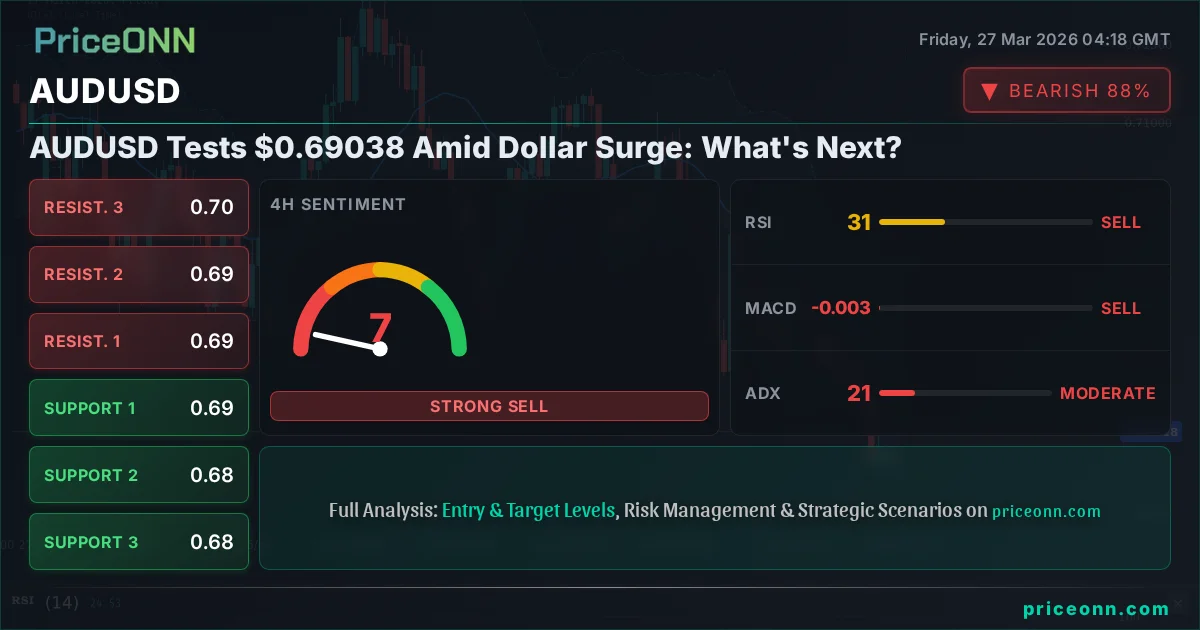
For traders, the immediate focus remains on the unfolding geopolitical situation and its impact on market sentiment. The AUD/USD pair has broken below the significant 0.6900 level, and further downside could target the 0.6870 region, which was tested earlier today. A sustained break below this level could signal a deeper correction.
Key levels to watch include:
- Resistance: 0.6900, 0.6950
- Support: 0.6870, 0.6850
Traders should monitor news flow from the Middle East closely. Any de-escalation would likely trigger a relief rally in risk assets, potentially boosting the AUD/USD. Conversely, further escalation would reinforce the demand for the USD and could push the pair lower. The US Dollar Index (DXY) will also be a key indicator to watch, as its strength directly correlates with the weakness in AUD/USD.
Outlook: Bearish Bias Persists Amid Uncertainty
The outlook for the AUD/USD remains cautiously bearish in the short term, contingent on the continuation of geopolitical tensions. While the pair saw a modest rebound to retake the 0.6900 level at one point, the underlying risk-off sentiment suggests that any upside moves may be temporary. A significant shift in the Middle East situation or a surprisingly hawkish tone from the RBA would be needed to alter this bearish bias. Until then, traders should remain vigilant, with the potential for further consolidation or declines in the AUD/USD.
Frequently Asked Questions
What is the current trading level for AUD/USD and its recent performance?
The AUD/USD is trading near 0.6880, marking its fourth consecutive day of losses and reaching over a two-month low. The pair has fallen significantly from recent highs, reflecting increased market caution.
What are the main drivers behind the AUD/USD's recent decline?
The primary driver is escalating geopolitical tensions in the Middle East and doubts about a US-Iran ceasefire, which are fueling a 'risk-off' sentiment and a surge in demand for the safe-haven US Dollar. This overshadows typical drivers like commodity prices and RBA policy.
What key levels should traders watch for AUD/USD in the coming sessions?
Traders should monitor the 0.6900 level as immediate resistance and 0.6870 as the next key support. A break below 0.6870 could open the door for further declines towards 0.6850.
Track markets in real-time
Empower your investment decisions with AI-powered analysis, technical indicators and real-time price data.
Join Our Telegram Channel
Get breaking market news, AI analysis and trading signals delivered instantly to your Telegram.
Join Channel


PriceONN