AUD/USD Tests Key Support Amid RBA Hawkishness and NZ Confidence Plunge

AUD/USD is currently testing critical support levels as divergent economic signals emerge from Australia and New Zealand. Market data shows the Australian Dollar is under pressure following the release of the Reserve Bank of Australia's (RBA) March meeting minutes, which underscored a strong bias towards further monetary policy tightening due to persistent inflation and excess demand. Concurrently, New Zealand's business confidence has experienced a dramatic nosedive in March, amplifying regional currency weakness.
Market Context
The RBA minutes revealed that policymakers judged inflation to be “too high” and the economy still grappling with “excess demand.” This assessment, coupled with a tightening labor market, has led to a clear inclination for more immediate rate hikes. The recent surge in oil prices, attributed to geopolitical tensions in the Middle East, was identified as a significant factor that will “significantly push up inflation in March.” While acknowledging the potential dampening effect on economic activity, the RBA emphasized its focus on preventing supply shocks from becoming embedded in the price structure, suggesting tighter monetary conditions are necessary to curb pass-through of higher costs.
In New Zealand, the business confidence index saw a sharp decline, falling from 59.2 in February to 32.5 in March. This significant drop, particularly pronounced later in the month, reflects growing unease over the global economic fallout from the Middle East conflict. Expectations for own trading activity also weakened considerably, dropping from 52.6 to 39.3. Furthermore, activity compared to the previous year fell from 23.4 to 17.5, indicating a broad-based cooling of business sentiment and operational performance across the Tasman.
Analysis & Drivers
The RBA's hawkish stance is primarily driven by a dual concern: stubborn underlying inflation and the inflationary impulse from rising energy prices. Board members noted that current financial conditions were not perceived as “sufficiently restrictive.” The explicit mention of “excess demand” suggests that even without the oil shock, the RBA would have been leaning towards further tightening. The oil shock, however, accelerates this need by directly impacting headline inflation and potentially raising short-term inflation expectations. The central bank's strategy is to use monetary policy to manage the demand side, thereby preventing the supply-driven inflation from becoming entrenched in the economy.
The sharp deterioration in New Zealand's business confidence is a stark indicator of how global geopolitical risks are translating into localized economic anxieties. The rise in inflation expectations to 3.08% for the next twelve months, coupled with 85% of firms expecting their own operational costs to rise, points to building price pressures. This is leading to aggressive pricing intentions, with a net 60% of businesses planning price hikes. This suggests that while the RBA is focused on demand-pull inflation, New Zealand businesses are grappling with significant cost-push pressures, which could complicate the Reserve Bank of New Zealand's (RBNZ) own policy considerations should they persist.
Trader Implications
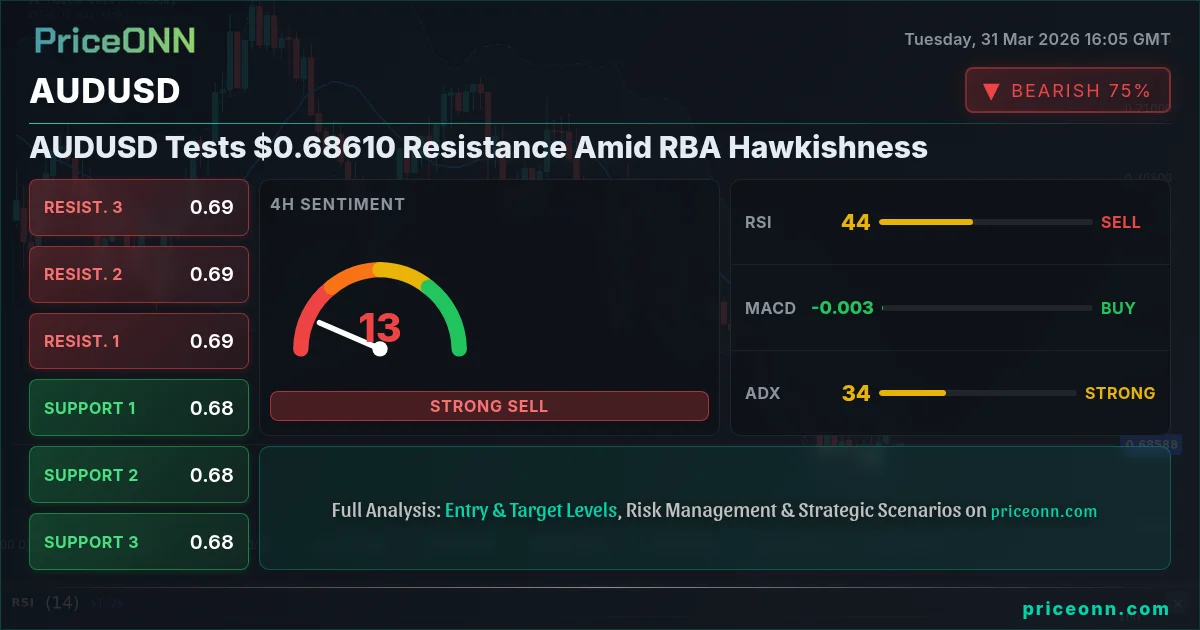
For traders, the divergence in sentiment and policy outlook presents a complex trading environment for AUD/USD. The RBA's hawkish minutes provide a foundational argument for continued Australian Dollar strength against currencies of more dovish central banks. However, the sharp drop in New Zealand business confidence introduces a regional risk factor that could spill over into the Australian market, especially given their close economic ties. Key levels to watch for AUD/USD include the immediate support around 0.6550. A break below this could signal further downside towards 0.6500. Conversely, any positive developments in global risk sentiment or a less aggressive interpretation of the RBA minutes could see the pair rebound towards resistance at 0.6600.
Traders should monitor upcoming economic data releases from both Australia and New Zealand closely. Any signs that the “excess demand” in Australia is abating faster than expected could temper the RBA’s tightening bias. Similarly, a stabilization or improvement in New Zealand business confidence would alleviate some of the regional pressure. The impact of oil prices remains a critical variable; sustained higher prices could force central banks to adopt even more restrictive policies, but also risk triggering a sharper global economic slowdown.
The immediate outlook suggests that AUD/USD may remain under pressure in the short term due to the negative sentiment emanating from New Zealand. However, the RBA’s firm commitment to fighting inflation provides a longer-term bullish underpinning for the Australian Dollar, provided inflation does not spiral out of control and trigger a severe economic downturn. The interplay between global commodity prices, central bank policy, and regional economic health will dictate the pair's trajectory in the coming weeks. Investors are advised to watch the 0.6550 and 0.6600 levels as crucial technical junctures.
Frequently Asked Questions
What is the immediate impact of the RBA minutes on AUD/USD?
The RBA's March minutes, signaling a strong bias for further tightening due to high inflation and excess demand, provide a hawkish undertone for the Australian Dollar. However, this is currently being counteracted by negative sentiment from New Zealand, causing AUD/USD to test support near 0.6550.
How are rising oil prices affecting the RBA's policy outlook?
Rising oil prices are seen by the RBA as a factor that will “significantly push up inflation in March.” While acknowledging it's a supply shock, the RBA intends to use tighter monetary policy to prevent these higher costs from becoming embedded in broader price expectations and the general price structure.
What are the key levels to watch for AUD/USD in the near term?
Traders should monitor the support level around 0.6550. A decisive break below this could lead to a test of 0.6500. On the upside, resistance is seen at 0.6600, which could be challenged if global risk sentiment improves or the RBA's hawkishness is perceived as less urgent.
Track markets in real-time
Empower your investment decisions with AI-powered analysis, technical indicators and real-time price data.
Join Our Telegram Channel
Get breaking market news, AI analysis and trading signals delivered instantly to your Telegram.
Join Channel