
Is the Aussie Dollar Set to Slide as RBA Hints at More Tightening Amidst Oil Shock?


The Australian dollar (AUD) is under scrutiny as fresh insights from the Reserve Bank of Australia (RBA) suggest a hawkish stance, potentially paving the way for more interest rate hikes. Minutes from the RBA's March meeting revealed that policymakers viewed inflation as "too high" and the economy as experiencing "excess demand," bolstering the case for additional tightening measures. This comes as New Zealand's business confidence has seen a dramatic fall, signaling a potential regional economic cooling.
Market Context: Inflationary Pressures Mount
The RBA's March meeting minutes, released recently, indicate a clear leaning towards further monetary policy tightening. Policymakers judged that inflation remains stubbornly elevated and that risks have escalated, particularly following the recent surge in global oil prices. The minutes explicitly stated that inflation was still "too high" and that the Australian economy was operating with "excess demand." This imbalance is further evidenced by a labor market that has tightened beyond sustainable levels for full employment.
A significant discussion point during the meeting was the inflationary impact of geopolitical tensions in the Middle East. Board members reached a consensus that the spike in crude oil prices would "significantly push up inflation in March." While acknowledging that higher energy costs would likely dampen economic activity, the RBA stressed that monetary policy's primary role is not to counteract such supply shocks directly. Instead, the focus is on preventing these shocks from becoming entrenched in the broader price structure. The central bank reasoned that tighter monetary conditions could "reduce the extent to which higher costs would be passed on to final prices." This strategic imperative was a core argument for further monetary policy adjustments.
Analysis & Drivers: Oil Shock and Demand Dynamics
The recent escalation in oil prices, driven by geopolitical instability, presents a dual challenge for central banks in the region. For the RBA, this surge directly contributes to higher inflation in the short term, complicating their mandate. The minutes suggest that a majority of members concluded that "further tightening in monetary policy would likely be required in the near term," expressing doubts that current financial conditions were "sufficiently restrictive." The persistent strength of excess demand, combined with an uptick in short-term inflation expectations, reinforced the argument for proactive measures.
Across the Tasman Sea, New Zealand's economy is also feeling the pressure, albeit with a different manifestation. Business confidence in March experienced its sharpest drop in months, falling to 32.5 from 59.2. This decline, particularly pronounced later in the month, coincided with a clearer understanding of the Middle East conflict's implications for the nation. Forward-looking indicators also weakened significantly, with expectations for own trading activity falling to 39.3 from 52.6. This suggests businesses are anticipating slower growth or increased headwinds.
Simultaneously, New Zealand businesses are reporting accelerating inflationary pressures. An expected inflation rate of 3.08% for the next twelve months marks the highest point since July 2024. Furthermore, a substantial 85% of firms foresee their operational costs rising, leading a net 60% of businesses to plan price hikes – the most aggressive sentiment recorded for price increases. This indicates a pass-through of rising costs is already underway, potentially exacerbating inflation concerns.
Trader Implications: Watching AUD and NZD
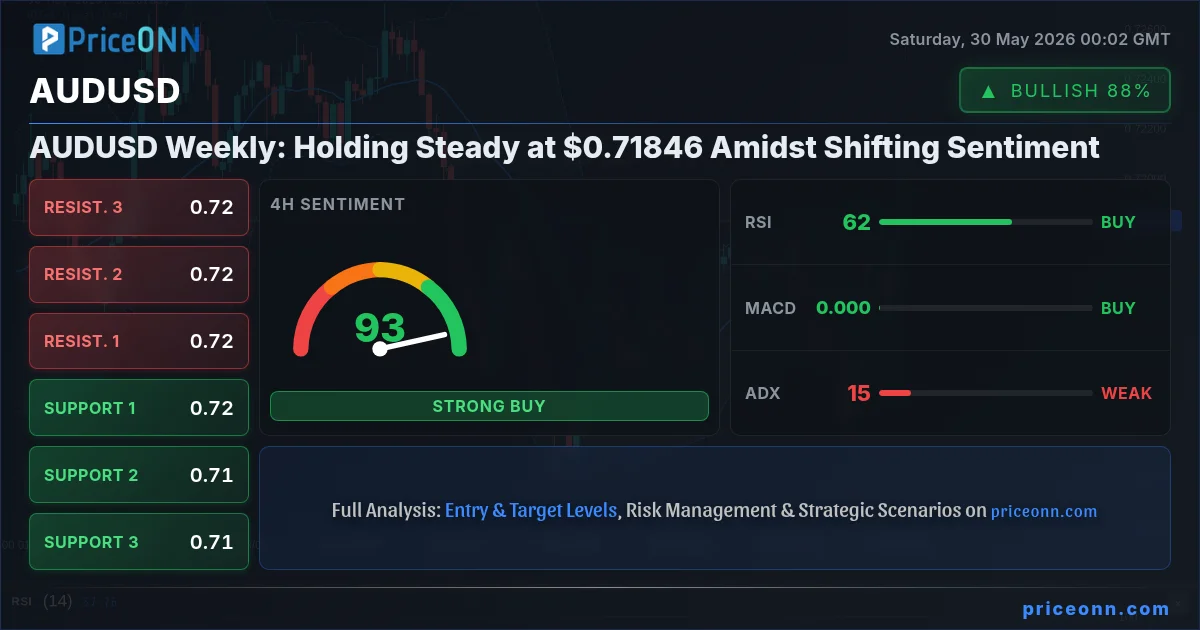
For forex traders, the diverging signals from Australia and New Zealand present a complex picture. The RBA's hawkish rhetoric, suggesting further rate hikes, could lend support to the Australian dollar in the short term, especially if inflation remains sticky and demand robust. Key resistance levels for AUD/USD will be closely watched, with a sustained move above 0.6650 potentially signaling further upside. Conversely, any indication that the RBA might be nearing the end of its hiking cycle, or a significant shift in global risk sentiment, could trigger a sell-off.
The sharp decline in New Zealand's business confidence and the rising inflation expectations could put pressure on the New Zealand dollar (NZD). While the Reserve Bank of New Zealand (RBNZ) has previously signaled a pause, persistent inflation might force a reconsideration. Traders will be monitoring the NZD/USD pair for signs of weakness, with a break below 0.6080 potentially opening the door to further declines towards 0.6000. The interplay between the RBA's tightening bias and the weakening business sentiment in New Zealand will be crucial for directional trading in both currencies.
Outlook: Policy Divergence and Global Risks
The immediate outlook suggests that the RBA's commitment to tackling inflation, even in the face of supply shocks, could keep the AUD on a firmer footing compared to the NZD. However, the global economic environment remains precarious. The ongoing geopolitical tensions and their impact on energy prices are a significant wildcard. Should these tensions escalate further, the resulting economic slowdown could override central bank tightening intentions, leading to a broader risk-off sentiment that would impact both currencies. Traders should remain vigilant for upcoming economic data releases from both countries, as well as any further commentary from their respective central banks, to gauge the evolving policy paths and market sentiment.
Frequently Asked Questions
Will the RBA raise interest rates again?
The RBA minutes from the March meeting indicated a strong bias for further tightening, with a majority of members concluding that "further tightening in monetary policy would likely be required in the near term." This suggests a high probability of another rate hike if current economic conditions persist.
What is the impact of rising oil prices on the Australian dollar?
Rising oil prices are expected to "significantly push up inflation in March," according to RBA minutes. While this can be inflationary, the RBA's focus is on preventing embedded inflation. This hawkish stance could support the AUD, but sustained high oil prices could also dampen economic growth, posing a risk.
What does the fall in New Zealand business confidence mean for the NZD?
The sharp drop in New Zealand business confidence to 32.5 suggests businesses are anticipating slower growth and are increasingly planning price hikes due to rising costs. This weakening sentiment could put downward pressure on the NZD, especially if inflation expectations continue to climb and the RBNZ signals a less hawkish stance than the RBA.
Track markets in real-time
Empower your investment decisions with AI-powered analysis, technical indicators and real-time price data.
Join Our Telegram Channel
Get breaking market news, AI analysis and trading signals delivered instantly to your Telegram.
Join Channel PriceONN News
USDJPY has returned to the area of previous interventions. The ECB is moving towards a rate hike in June. The US dollar retreated on Friday amid new record highs for stock indices and rumours of amendments to the US-Iran agreement. However, tit-for-tat exchanges between the adversaries pushed the dollar index back into the support zone […] The post Yen Braces for a New Storm appeared first on ActionForex.
PriceONN News
The US Dollar experienced a notable decline last week as markets priced in a potential diplomatic resolution to the US-Iran conflict, leading to a drop in oil prices and Treasury yields. This shift in sentiment suggests a move away from stagflation fears towards a more stable economic outlook.
PriceONN News
Markets are pricing in a potential de-escalation in the US-Iran conflict, leading to a significant drop in crude oil prices and a weakening US Dollar as diplomatic efforts appear to be gaining traction.
PriceONN News
Canada's economy showed signs of a slowdown in early 2026, but upcoming May jobs data is expected to reveal a modest uplift. Analysts anticipate the unemployment rate to fall to 6.8%.
PriceONN News
Canada's economy showed signs of life in early 2026, with analysts expecting a moderate job growth of around 25,000 positions and a potential dip in the unemployment rate to 6.8% for May.
PriceONN News
AUD/USD’s late break of 0.7183 resistance suggests that pullback from 0.7277 has already completed at 0.7076, after defending 55 D EMA. Initial bias is back on the upside this week for retesting 0.7277 high first. Firm break there will resume larger up trend. For now, risk will stay on the upside as long as 0.7076 […] The post AUD/USD Weekly Report appeared first on ActionForex.
PriceONN News
USD/CAD is showing signs of potential upward movement as Canada's economy grapples with a significant slowdown, marked by weak domestic demand and stalled investment, while trade negotiations loom large.
PriceONN News
USD/JPY is testing the critical 160 level as stalled US-Iran negotiations and hawkish Federal Reserve rhetoric fuel inflation concerns and a potential for further rate hikes. Traders are closely watching upcoming US Non-Farm Payrolls and Eurozone CPI data for direction.
PriceONN News
The USD/JPY pair is flirting with the 160 level as stalled US-Iran negotiations and hawkish Federal Reserve rhetoric fuel inflation concerns. Traders are closely watching upcoming US Non-Farm Payrolls and Eurozone CPI data.
PriceONN News
EUR/USD stalled below 1.1660 as the US Dollar defied expectations, refusing to weaken despite reports of a US-Iran ceasefire extension. Market participants remain cautious, awaiting concrete confirmation and assessing lingering inflationary pressures.
PriceONN News
The New Zealand Dollar surged on Friday, with investors interpreting Reserve Bank of New Zealand (RBNZ) comments as a sign that interest rate hikes could resume sooner and be larger than previously anticipated. This hawkish pivot has created significant trading opportunities.
PriceONN News
The US Dollar experienced a notable dip as a renewed ceasefire between the US and Iran spurred a rally in global equities, particularly in tech stocks. However, persistent core PCE inflation at 3.3% YoY continues to fuel 'higher for longer' rate expectations.