
Is the Australian Dollar Set for a Fall After RBA's Narrow Rate Hike?


The Australian Dollar faced immediate scrutiny following the Reserve Bank of Australia's (RBA) latest monetary policy decision. In a closely divided vote of 5-4, the RBA's Monetary Policy Board opted to raise the official cash rate by 25 basis points to 4.10%, a move that, while anticipated by many, has introduced a layer of uncertainty into the market regarding the future trajectory of Australian interest rates.
Market Context
The RBA's decision to tighten monetary policy further underscores concerns about persistent inflationary pressures within the Australian economy. While inflation has seen a substantial decline from its 2022 peak, market data shows it picked up materially in the latter half of 2025. Key drivers identified by the Board include perceived domestic capacity pressures and the inflationary impact of the ongoing Middle East conflict, which has led to a sharp increase in global fuel prices. These factors have contributed to a rise in short-term inflation expectations, prompting the Board to assess a material risk that inflation could remain above target for longer than previously forecast. The split decision, with a narrow 5-4 majority, highlights a divergence of opinion within the Board, making future rate hikes less certain, though analysts note that all members agreed a hike was necessary, with the debate centering on timing.
Analysis & Drivers
Several factors appear to have influenced the RBA's hawkish stance. Firstly, recent labour market data indicated a slightly tighter-than-expected employment situation, with the unemployment rate lower than anticipated and measures of labor underutilization remaining at low levels. This suggests that domestic demand momentum, particularly in the latter part of 2025, was stronger than previously assessed, contributing to capacity pressures. Business investment figures also came in above expectations, although household consumption was softer. Secondly, the geopolitical situation in the Middle East has added a significant external risk factor. The surge in oil prices, if sustained, is expected to feed into broader inflation metrics, complicating the RBA's efforts to bring inflation back within its target range. Industry reports indicate that these supply-side shocks are a primary concern for central banks globally. The RBA also noted that while some of the inflation increase observed late last year might be temporary, the underlying domestic capacity pressures are now seen as slightly greater than previously assessed, with trend growth in supply capacity estimated to be around 2%.
Trader Implications
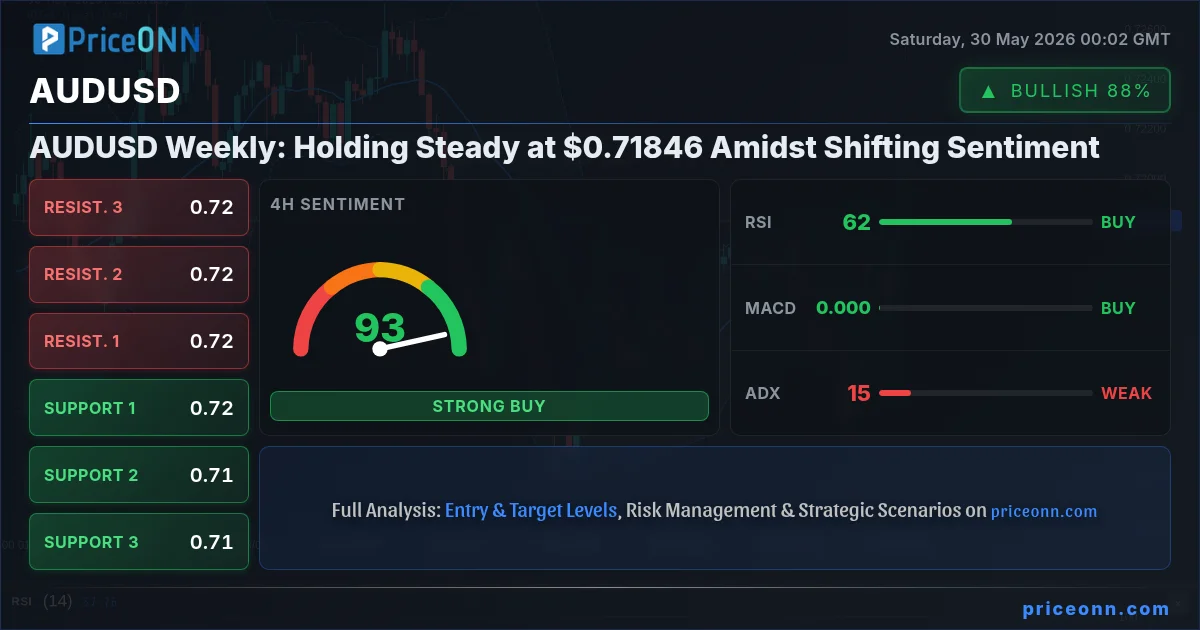
The nuanced outcome of the RBA meeting presents several implications for forex traders, particularly concerning the AUD/USD currency pair. The immediate reaction saw the Australian Dollar experience some volatility, but the narrow majority in the rate decision could dampen further upside momentum. Traders will be closely monitoring upcoming economic data releases, especially inflation figures and employment reports, to gauge the RBA's resolve. Key levels to watch for AUD/USD include the 0.6650 support and the recent highs around 0.6720. A sustained move above 0.6720 could signal further strength, while a fall below 0.6650 might indicate growing concerns about the Australian economy and the RBA's policy path. The market will also be keenly watching the RBA's communication for any hints about a potential May rate hike, with the ongoing Middle East conflict and domestic capacity pressures being crucial variables. The RBA's assessment that monetary policy remains restrictive, yet the full effects are yet to flow through, suggests a cautious approach ahead. Traders should be prepared for increased volatility as the market digests the split decision and its implications for future policy.
Outlook
Looking ahead, the RBA's path forward appears contingent on evolving inflationary dynamics and the geopolitical landscape. While a May rate hike remains the base case for some analysts, the split decision has introduced a degree of uncertainty. The RBA has signaled that rate hikes will remain on the table until inflation risks have clearly subsided. Therefore, upcoming inflation reports and any further developments in the Middle East will be critical in shaping market expectations and the RBA's next move. The Australian Dollar's performance will likely remain sensitive to shifts in global risk sentiment and the perceived divergence in monetary policy between the RBA and other major central banks.
Frequently Asked Questions
What was the RBA's cash rate decision today?
The Reserve Bank of Australia decided to increase the cash rate target by 25 basis points to 4.10%. This decision was made in a narrow 5-4 vote by the Monetary Policy Board.
Why did the RBA hike rates despite a split decision?
The RBA cited growing domestic capacity pressures and the inflationary impact of the Middle East conflict, which has driven up fuel prices and inflation expectations. These factors created a material risk that inflation could remain above target for longer than anticipated.
What is the outlook for the Australian Dollar (AUD) following this announcement?
The AUD faces uncertainty due to the RBA's split decision, which makes future rate hikes less certain. Traders will watch AUD/USD around the 0.6650 support and 0.6720 resistance levels, with upcoming inflation data being a key determinant of its direction.
Track markets in real-time
Empower your investment decisions with AI-powered analysis, technical indicators and real-time price data.
Join Our Telegram Channel
Get breaking market news, AI analysis and trading signals delivered instantly to your Telegram.
Join Channel PriceONN News
The US Dollar experienced a notable dip as a renewed ceasefire between the US and Iran spurred a rally in global equities, particularly in tech stocks. However, persistent core PCE inflation at 3.3% YoY continues to fuel 'higher for longer' rate expectations.
PriceONN News
USDJPY has returned to the area of previous interventions. The ECB is moving towards a rate hike in June. The US dollar retreated on Friday amid new record highs for stock indices and rumours of amendments to the US-Iran agreement. However, tit-for-tat exchanges between the adversaries pushed the dollar index back into the support zone […] The post Yen Braces for a New Storm appeared first on ActionForex.
PriceONN News
The US Dollar experienced a notable decline last week as markets priced in a potential diplomatic resolution to the US-Iran conflict, leading to a drop in oil prices and Treasury yields. This shift in sentiment suggests a move away from stagflation fears towards a more stable economic outlook.
PriceONN News
Canada's economy showed signs of a slowdown in early 2026, but upcoming May jobs data is expected to reveal a modest uplift. Analysts anticipate the unemployment rate to fall to 6.8%.
PriceONN News
Canada's economy showed signs of life in early 2026, with analysts expecting a moderate job growth of around 25,000 positions and a potential dip in the unemployment rate to 6.8% for May.
PriceONN News
AUD/USD’s late break of 0.7183 resistance suggests that pullback from 0.7277 has already completed at 0.7076, after defending 55 D EMA. Initial bias is back on the upside this week for retesting 0.7277 high first. Firm break there will resume larger up trend. For now, risk will stay on the upside as long as 0.7076 […] The post AUD/USD Weekly Report appeared first on ActionForex.
PriceONN News
USD/CAD is showing signs of potential upward movement as Canada's economy grapples with a significant slowdown, marked by weak domestic demand and stalled investment, while trade negotiations loom large.
PriceONN News
USD/JPY is testing the critical 160 level as stalled US-Iran negotiations and hawkish Federal Reserve rhetoric fuel inflation concerns and a potential for further rate hikes. Traders are closely watching upcoming US Non-Farm Payrolls and Eurozone CPI data for direction.
PriceONN News
The USD/JPY pair is flirting with the 160 level as stalled US-Iran negotiations and hawkish Federal Reserve rhetoric fuel inflation concerns. Traders are closely watching upcoming US Non-Farm Payrolls and Eurozone CPI data.
PriceONN News
EUR/USD stalled below 1.1660 as the US Dollar defied expectations, refusing to weaken despite reports of a US-Iran ceasefire extension. Market participants remain cautious, awaiting concrete confirmation and assessing lingering inflationary pressures.
PriceONN News
The New Zealand Dollar surged on Friday, with investors interpreting Reserve Bank of New Zealand (RBNZ) comments as a sign that interest rate hikes could resume sooner and be larger than previously anticipated. This hawkish pivot has created significant trading opportunities.
PriceONN News
The Japanese Yen is showing signs of renewed pressure, with USD/JPY approaching the psychologically significant 160 level. This comes as traders brace for key US jobs data and Eurozone inflation figures, all while lingering US-Iran tensions add a layer of uncertainty to market sentiment.