
Brent Crude Oil: Decline Amid US–Iran Ceasefire
 PriceONN Editorial Desk
Multi-source verification
PriceONN Editorial Desk
Multi-source verification
Geopolitical Calm Cools Oil Market
The scent of peace has wafted through the Persian Gulf, and it's having a dramatic effect on the oil market. Following the surprising announcement of a ceasefire between the United States and Iran on June 14, the once-lofty geopolitical risk premium attached to crude oil prices has rapidly diminished. This shift signals a profound change in market expectations, as participants begin to price in the likely resumption of unimpeded oil shipments through the critical Strait of Hormuz.
This developing scenario is directly impacting trading desks. The anticipation of increased supply, coupled with the receding threat of supply disruptions, is encouraging a wave of profit-taking among those who had built long positions during the preceding price surge. The market's focus is rapidly shifting from potential conflict to the reality of available barrels.
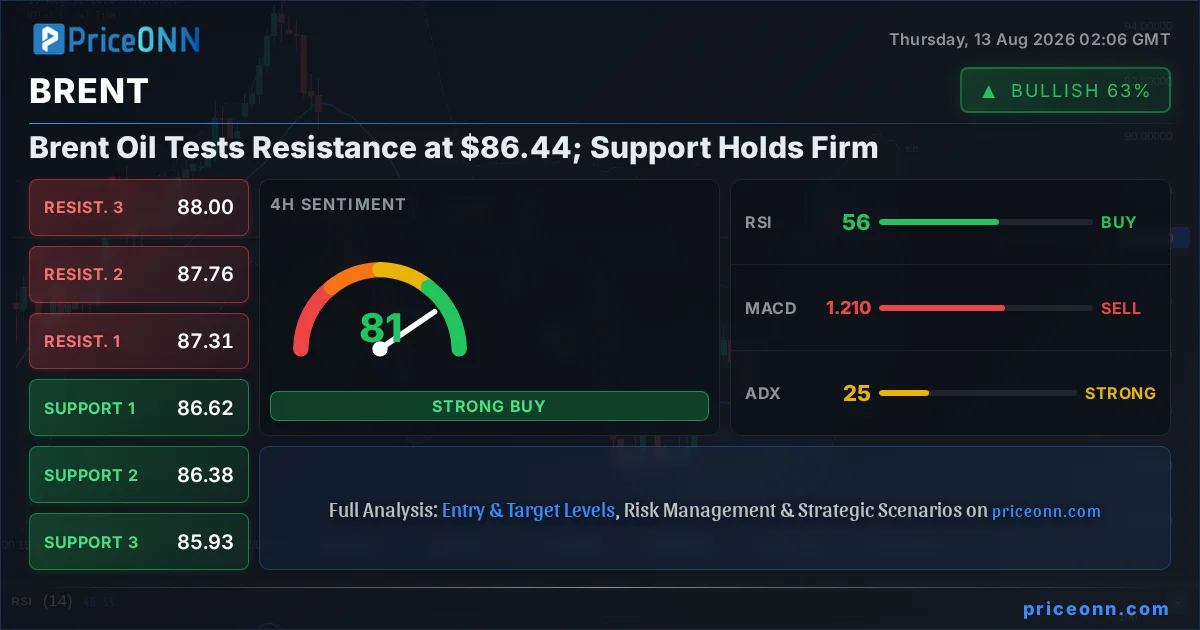
Technical Breakdown: Charting the Downtrend
The technical landscape for Brent Crude (XBRUSD) paints a clear picture of a trend reversal. The medium-term upward trajectory, which had been in place on the daily chart since mid-December 2025, suffered a decisive blow on May 25. A notable downside gap on that date signaled the beginning of a significant pullback.
Following this gap, the price action decisively broke below the lower boundary of the prevailing market profile. This technical breach appears to have accelerated the downward momentum, with traders now eyeing key support levels. If the current pace of decline persists, the $70,000 area could emerge as the next significant downside reference point.
Should a corrective rebound materialize, traders will be closely watching the confluence of the former lower profile boundary at $95,100 and the critical point of control (POC) zone situated between $103,600 and $104,000. These levels represent substantial overhead resistance. Further upside potential, should prices decisively clear the upper profile boundary at $113,000, might then bring the prominent red resistance mark at $120,500 into play.
Current momentum indicators offer a mixed, albeit cautious, signal. Readings from the Relative Strength Index (RSI) and moving averages stand at 28, 38, and 43, respectively. The moving averages are predominantly colored red, indicating bearish sentiment, while the RSI has dipped into oversold territory. This configuration suggests a period of elevated uncertainty and potentially increasing volatility in the immediate future.
Volume analysis, specifically vertical volume, has not yet displayed any unusual spikes or significant anomalies that would strongly contradict the current price action, leaving the technical picture leaning towards continued caution.
Reading Between the Lines
The confluence of easing geopolitical tensions and the technical breakdown in Brent Crude suggests a challenging period ahead for oil bulls. The market's narrative has decisively shifted from scarcity fears to an expectation of ample supply. This recalibration by market participants is crucial; it discounts future supply availability and removes the 'fear premium' that had been artificially inflating prices.
The current market structure strongly indicates a downside bias. With the medium-term uptrend now broken and expectations of additional oil entering the market, short-term price action is likely to remain under pressure. This environment calls for a re-evaluation of long-only strategies and a closer look at potential shorting opportunities or defensive positioning.
Market Ripple Effects
The softening of Brent Crude prices has broader implications across several interconnected markets. The most direct impact will be felt by oil-producing nations and companies. Currencies like the Canadian Dollar (CAD), often sensitive to commodity prices, could face headwinds if oil prices continue to slide. Energy sector equities may also experience downward pressure as profit margins are squeezed.
Furthermore, a sustained drop in oil prices could influence inflation expectations globally. Lower energy costs can reduce inflationary pressures, potentially giving central banks more breathing room. This could indirectly affect interest rate expectations and bond markets, particularly for economies heavily reliant on imported energy. The US Dollar Index (DXY) might see some strength if global risk aversion decreases due to reduced geopolitical instability, although this effect could be counteracted by lower inflation expectations.
Traders should monitor the interaction between these factors. While the immediate catalyst is geopolitical detente, the subsequent price action will be dictated by supply-demand fundamentals and the broader macroeconomic environment. The key risk remains an unexpected escalation of tensions, which could rapidly reintroduce a significant risk premium into oil prices. Conversely, continued calm and steady supply could lead to a deeper correction, testing the $70,000 level and potentially impacting broader market sentiment towards risk assets.
Track markets in real-time
Empower your investment decisions with AI-powered analysis, technical indicators and real-time price data.
Join Our Telegram Channel
Get breaking market news, AI analysis and trading signals delivered instantly to your Telegram.
Join Channel PriceONN News
Brent Crude oil prices rose above $89 per barrel in early trade in Europe on Wednesday as Iran and the United States offered contrasting claims about who controls the Strait of Hormuz. Brent Crude prices were up by 0.64% at $89.60 in the morning in Europe, and WTI Crude was rising by 0.94% at $83.90, amid persistent supply concerns and risks despite claims from the U.S. that traffic at Hormuz had normalized. Iran, for its part, said on Tuesday that the Strait of Hormuz will remain closed unless...
PriceONN News
The latest Bloomberg data show that shipping transits through the Strait of Hormuz remained largely disrupted Monday morning, even as Iran and Oman reportedly moved closer to a deal. Brent crude futures traded near $85 a barrel as markets priced in the possibility that a deal to reopen the maritime chokepoint could be imminent. Yet global supply-chain stress remains near its highest level since the pandemic, and any normalization could take months, even if shipping traffic resumes. UBS senior...
PriceONN News
The IEA has slashed its 2026 global oil supply forecast, with output now expected to plunge 4.3 million barrels per day this year as the failure to reopen the Strait of Hormuz pushes the market deeper into deficit. The latest forecast is considerably worse than the 3.7-million-bpd decline the agency projected just last month and would leave global supply at 102.02 million bpd, its lowest forecast for 2026 yet. Supply is now expected to fall 1.27 million bpd short of demand for the year,...
PriceONN News
Oil flows from the Middle East have normalized, with Sunday traffic alone above pre-conflict averages, U.S. Secretary of Energy Chris Wright said on Tuesday in a claim that appears not to be backed by ship-tracking data. On Tuesday, Secretary Wright posted on X that “Thanks to the coordinated efforts of the U.S. military and our gulf allies, the seven-day average for oil leaving the Strait of Hormuz is currently up to almost 9 million barrels per day.” He went on to add that “When combined with...
PriceONN News
Hormuz tensions are flaring again as Iranian exports collapse, pushing Brent toward $87 and raising the risk of another run toward $100. China’s Crude Drawdown Puts Iranian Barrels Back in Demand - Shrinking crude inventories in China might spur a buying spree over the upcoming weeks, particularly for Russian and Iranian crude, buoyed by a record-high July stock draw in Shandong. - Chinese teapots are expected to boost their purchases of Iranian oil in the upcoming days as stockpiles in the...
PriceONN News
Ukraine’s military claimed another drone attack on an oil refinery in Russia in the early hours on Tuesday as Ukrainian forces continue to target Russia’s energy producing and exporting infrastructure in an escalation of drone attacks at key oil refining hubs. The Ukrainian military on Tuesday said it had struck the Orsknefteorgsintez oil refinery in Orsk, in the Orenburg region. Orsk is about 1,500 kilometers (930 miles) from the frontline. “Fire was recorded. Damages are being ascertained,”...
PriceONN News
Norwegian aluminum producer Norsk Hydro's Alunorte plant in Brazil, one of the world's largest alumina refineries, reduced output by 50% following disruptions to natural gas availability. Bloomberg reports that disruptions to NatGas availability at Alunorte forced a 50% reduction in output and sent aluminum prices in London to a seven-week high. Hydro said production would return to full capacity once gas supplies normalize. Aluminum rose nearly 2% in London and traded at $3,373 a metric ton....
PriceONN News
Indian state-controlled oil refiners continue to search the market for spot crude supply as term deliveries are constrained by the ongoing crisis in the Middle East and its key oil chokepoint, the Strait of Hormuz. Mangalore Refinery and Petrochemicals Limited (MRPL) and Hindustan Petroleum Corporation Limited (HPCL) are looking to buy a combined 6 million barrels of crude oil via spot tenders, Reuters reported on Wednesday, citing tender documents it has seen. HPCL is seeking up to 4 million...
PriceONN News
A drone has struck a power station at the Zawiya oil export terminal in Libya, suggesting continued attacks on one of the country’s main oil hubs. The power plant is in close proximity to the largest oil refinery in Libya, the AP noted in a report on the news. The attack follows earlier ones that caused an explosion at an oil storage tank. No one has claimed responsibility for the drone attacks, the AP also reported. The tank, according to the company operating the facility, had 4.5 million...
PriceONN News
Whatever officially occurs next in the on-again/off-again negotiations towards a peace deal between the U.S. and Iran, unofficially Tehran knows that it has established de facto control over both the world’s two key maritime energy transit routes -- the Strait of Hormuz and the Bab el-Mandeb Strait -- for at least as long as the Islamic regime remains in place in Iran. Washington, London, Brussels, Beijing, and Moscow know it too. The Strait of Hormuz remains effectively controlled by vast...
PriceONN News
The Middle East conflict and the heightened threats to shipping in the Red Sea have prompted China to boost the use of the Arctic to move containers from the Chinese east coast to Europe. The fast-melting Arctic ice offers an alternative shipping route in the summer as the Houthi threats to shipping in the Red Sea and the Bab el-Mandeb Strait make cargo operators more cautious in transiting the key chokepoints in the Middle East. Shipping through the Arctic is not something new, but this time...
PriceONN News
(RTTNews) - Crude oil prices have surged on Tuesday, extending the gains from the two previous sessions as the U.S.-Iran stalemate over new demands for compensation for war-related damages continued, diminishing the expectations of an early reopening of the Strait of Hormuz.