
Can GBP/USD Break Higher as Dollar Weakens Ahead of BoE Decision?

GBP/USD is trading around the 1.3315 mark on Tuesday, showing a pause in its recent downward trend. While the pound managed a slight recovery yesterday, it continues to languish near three-month lows. This subdued performance is largely attributed to persistent global economic uncertainty stemming from geopolitical tensions and a continued preference for the US dollar as a safe-haven asset.
Market Context
The US dollar has been the primary beneficiary of global risk aversion, strengthening against traditional safe havens like gold and government bonds, as well as against major currencies. Since the escalation of Middle Eastern conflict, the dollar has seen consistent demand. In contrast, the British pound has demonstrated relative resilience. Over the past three weeks, GBP/USD has declined by approximately 1.7%, a less severe drop compared to the yen (around 2.0%) and the euro (around 3.0%). This relative strength in sterling can be partly explained by the UK’s lower dependence on energy imports and its prevailing higher interest rate environment, which continues to offer some support.
Analysis & Drivers
The key event this week for GBP/USD will be the Bank of England's (BoE) monetary policy decision on Thursday. Market consensus expects the BoE to hold its benchmark interest rate steady at 3.75%. Crucially, market participants have significantly adjusted their expectations for future rate cuts. Prior to the recent geopolitical flare-up, traders were pricing in two rate cuts by the end of the year. Now, that expectation has been scaled back to just one cut. This shift in anticipated monetary policy is a significant factor influencing the pound’s trajectory. Furthermore, upcoming UK labour market data is expected to signal a gradual cooling in employment and a slowdown in wage growth. Persistent inflationary pressures, exacerbated by rising energy prices, could create headwinds for the pound if the macroeconomic picture continues to deteriorate, potentially forcing the BoE's hand despite current high rates.
Trader Implications
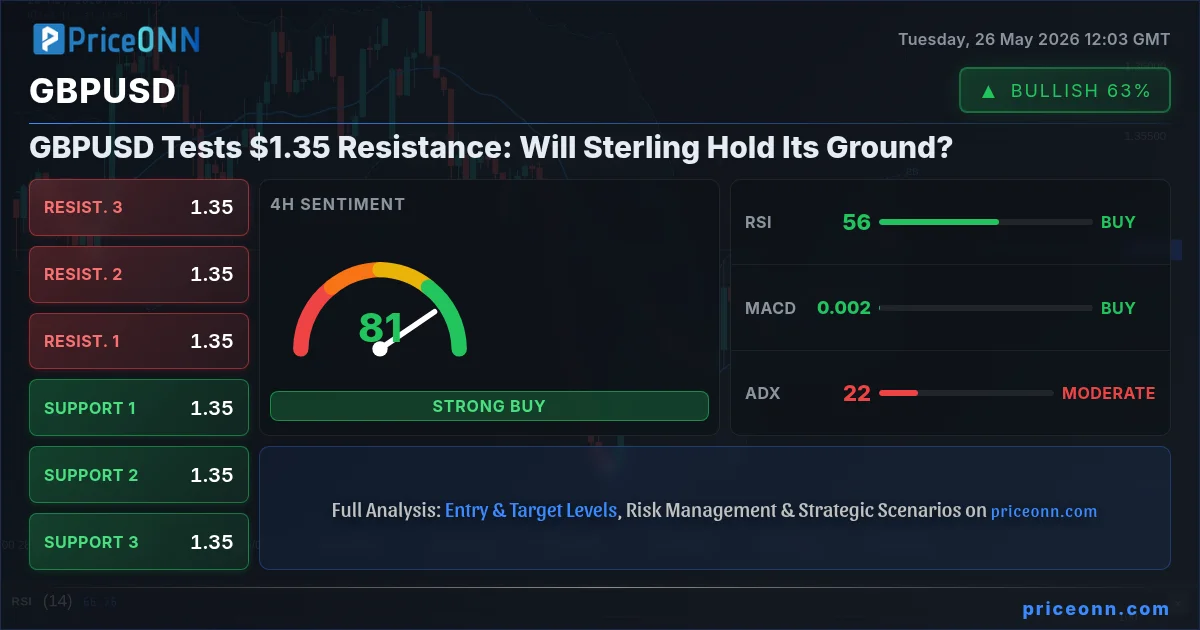
Traders will be closely monitoring the BoE’s forward guidance for any hints on the future path of interest rates, especially in light of the shifting inflation outlook and the relative strength of the UK economy. Key levels to watch for GBP/USD include the current consolidation range between 1.3283 and 1.3333. A break above 1.3333 could target 1.3360, while a decisive move below 1.3283 might open the door for a decline towards 1.3133. The MACD indicator on the H4 chart, with its signal line below zero but pointing upwards, suggests potential for upward momentum, though confirmation from price action will be critical. Investors are also gauging the broader market sentiment, particularly shifts in US dollar demand, which remains a dominant factor.
Outlook
The immediate outlook for GBP/USD remains cautious, heavily dependent on the Bank of England’s communication and incoming economic data. While the pound has shown some resilience, the backdrop of global uncertainty and the strong US dollar present significant challenges. A more hawkish tone from the BoE, or unexpected strength in UK inflation data, could provide support for sterling. Conversely, any indication of a dovish pivot or a worsening economic outlook would likely see the pair retest lower levels. The ongoing geopolitical situation will continue to act as an underlying driver for safe-haven flows, impacting the dollar's strength and, by extension, GBP/USD.
Frequently Asked Questions
What is the current trading range for GBP/USD?
GBP/USD is currently consolidating within a broad range, identified by market data between approximately 1.3283 and 1.3333. A decisive break from this range could signal the next significant price move.
What are the expectations for the Bank of England's interest rate decision?
The Bank of England is widely expected to maintain its current interest rate at 3.75%. However, market attention will be on the bank's forward guidance regarding future policy adjustments, with expectations now leaning towards only one rate cut by year-end.
What are the key factors influencing GBP/USD in the short term?
Key drivers include the Bank of England's policy decision, UK inflation and labour market data, and the broader global risk sentiment. Persistent demand for the US dollar as a safe-haven asset remains a significant headwind for GBP/USD, while geopolitical events continue to shape market dynamics.
Track markets in real-time
Empower your investment decisions with AI-powered analysis, technical indicators and real-time price data.
Join Our Telegram Channel
Get breaking market news, AI analysis and trading signals delivered instantly to your Telegram.
Join Channel PriceONN News
The US Dollar experienced a notable decline last week as markets priced in a potential diplomatic resolution to the US-Iran conflict, leading to a drop in oil prices and Treasury yields. This shift in sentiment suggests a move away from stagflation fears towards a more stable economic outlook.
PriceONN News
Canada's economy showed signs of a slowdown in early 2026, but upcoming May jobs data is expected to reveal a modest uplift. Analysts anticipate the unemployment rate to fall to 6.8%.
PriceONN News
Canada's economy showed signs of life in early 2026, with analysts expecting a moderate job growth of around 25,000 positions and a potential dip in the unemployment rate to 6.8% for May.
PriceONN News
The New Zealand Dollar surged on Friday, with investors interpreting Reserve Bank of New Zealand (RBNZ) comments as a sign that interest rate hikes could resume sooner and be larger than previously anticipated. This hawkish pivot has created significant trading opportunities.
PriceONN News
The US Dollar experienced a notable dip as a renewed ceasefire between the US and Iran spurred a rally in global equities, particularly in tech stocks. However, persistent core PCE inflation at 3.3% YoY continues to fuel 'higher for longer' rate expectations.
PriceONN News
USDJPY has returned to the area of previous interventions. The ECB is moving towards a rate hike in June. The US dollar retreated on Friday amid new record highs for stock indices and rumours of amendments to the US-Iran agreement. However, tit-for-tat exchanges between the adversaries pushed the dollar index back into the support zone […] The post Yen Braces for a New Storm appeared first on ActionForex.
PriceONN News
Canada's labor market is showing signs of stabilization, with analysts predicting a dip in the unemployment rate to 6.8% in May, driven by an expected 25,000 new jobs. This follows a period of sluggish GDP growth and rising joblessness earlier in the year.
PriceONN News
Markets are pricing in a potential de-escalation in the US-Iran conflict, leading to a significant drop in crude oil prices and a weakening US Dollar as diplomatic efforts appear to be gaining traction.
PriceONN News
USD/CAD faces pressure as Canada's economy shows signs of stalling, with Q1 GDP contracting 0.1% and domestic demand weakening. This comes as trade negotiations and geopolitical shifts add layers of uncertainty.
PriceONN News
AUD/USD’s late break of 0.7183 resistance suggests that pullback from 0.7277 has already completed at 0.7076, after defending 55 D EMA. Initial bias is back on the upside this week for retesting 0.7277 high first. Firm break there will resume larger up trend. For now, risk will stay on the upside as long as 0.7076 […] The post AUD/USD Weekly Report appeared first on ActionForex.
PriceONN News
USD/CAD is showing signs of potential upward movement as Canada's economy grapples with a significant slowdown, marked by weak domestic demand and stalled investment, while trade negotiations loom large.
PriceONN News
USD/JPY is testing the critical 160 level as stalled US-Iran negotiations and hawkish Federal Reserve rhetoric fuel inflation concerns and a potential for further rate hikes. Traders are closely watching upcoming US Non-Farm Payrolls and Eurozone CPI data for direction.