
Is the Canadian Dollar Set for a Rebound as Inflation Eases Despite Oil Shocks?

The Canadian dollar (CAD) faces a complex outlook, caught between persistent global inflationary pressures driven by energy market volatility and encouraging domestic signs of cooling inflation. While geopolitical events have injected significant uncertainty, underlying Canadian economic data offers a glimmer of hope for the Loonie's stability.
Market Context
Recent weeks have seen significant global market turbulence, largely stemming from escalating tensions in the Middle East, which have directly impacted crude oil prices. West Texas Intermediate (WTI) crude has been trading around $94 per barrel, a level that directly pressures consumer spending and business costs through higher energy prices. This energy shock threatens to overshadow positive domestic economic signals that had begun to emerge. In the United States, the Federal Reserve maintained its cautious stance, holding interest rates steady and highlighting concerns that rising oil prices could complicate the inflation outlook. Softer housing data in the U.S. further points to increasing sensitivity to higher yields and tighter financial conditions.
Analysis & Drivers
The Bank of Canada (BoC) finds itself in a delicate position. On one hand, the conflict in the Middle East has triggered an energy price surge, a scenario that typically fuels inflation and can erode purchasing power. This could lead to a potential stagflationary environment if economic growth falters alongside rising prices. However, a deeper look at Canadian economic data presents a more nuanced picture. Retail sales figures for January indicated strong momentum, with real volumes posting a solid gain and the three-month annualized gain reaching 7.7%. Preliminary February data suggested this positive trend was likely to continue. Crucially, measures of near-term core inflation were showing signs of easing, and there was evidence of excess capacity within the Canadian economy. This provides the BoC with some buffer against the immediate energy price shock, suggesting that underlying inflationary pressures, excluding volatile energy costs, might be more contained than global headlines suggest.
The divergence between global energy market anxieties and domestic inflation trends creates a challenging analytical landscape. While the headline figures driven by oil are concerning, the underlying core inflation metrics offer a counterpoint. Analysts note that if the energy shock proves to be temporary and core inflation remains anchored, the BoC may have more flexibility than anticipated.
Trader Implications
For forex traders focusing on the CAD, the key is to differentiate between the headline noise and the underlying economic fundamentals. The immediate risk is that sustained high oil prices could lead to a further weakening of the Canadian dollar as purchasing power diminishes. Traders should closely monitor the upcoming inflation reports for March, which will fully capture the impact of the energy price surge. Key support levels for USD/CAD are being tested, with any sustained move above 1.3700 potentially signaling further downside for the Loonie. Conversely, a quicker-than-expected moderation in core inflation, or a stabilization in oil prices, could present a buying opportunity for CAD pairs. The Bank of Canada's next policy meeting will be crucial for gauging their reaction function to these competing forces.
Traders should also keep a close eye on U.S. economic data, particularly employment and consumer spending figures, as these will influence the Federal Reserve's own policy path and, by extension, global risk sentiment. The U.S. dollar's strength against a basket of currencies could remain a headwind for the CAD unless domestic Canadian data significantly outperforms.
Outlook
The immediate future for the Canadian dollar appears to be a tug-of-war between geopolitical risks and domestic economic resilience. While the surge in oil prices presents a clear threat to inflation and consumer spending, the evidence of moderating core inflation and economic capacity provides a degree of reassurance. If policymakers can navigate this period without a significant escalation of the Middle East conflict, and if global energy markets stabilize, the CAD could find a footing. However, any further geopolitical flare-ups or a persistent energy shock would likely extend the pressure on the Loonie. The market will be keenly watching for signs that the energy price increases do not become embedded in broader inflation expectations.
Frequently Asked Questions
What is the current price level for WTI crude oil?
As of the time of writing, West Texas Intermediate (WTI) crude oil prices are holding around $94 per barrel, reflecting ongoing volatility due to geopolitical events.
How are Canadian retail sales performing?
Canadian real retail sales volumes showed strong momentum in January, with a three-month annualized gain of 7.7%, indicating a positive trend prior to the recent energy price surge.
What is the key risk for the Canadian Dollar in the short term?
The primary short-term risk for the Canadian Dollar is the potential for sustained high oil prices to fuel inflation and erode consumer spending, potentially leading to a weakening of the Loonie if the energy shock proves persistent.
Track markets in real-time
Empower your investment decisions with AI-powered analysis, technical indicators and real-time price data.
Join Our Telegram Channel
Get breaking market news, AI analysis and trading signals delivered instantly to your Telegram.
Join Channel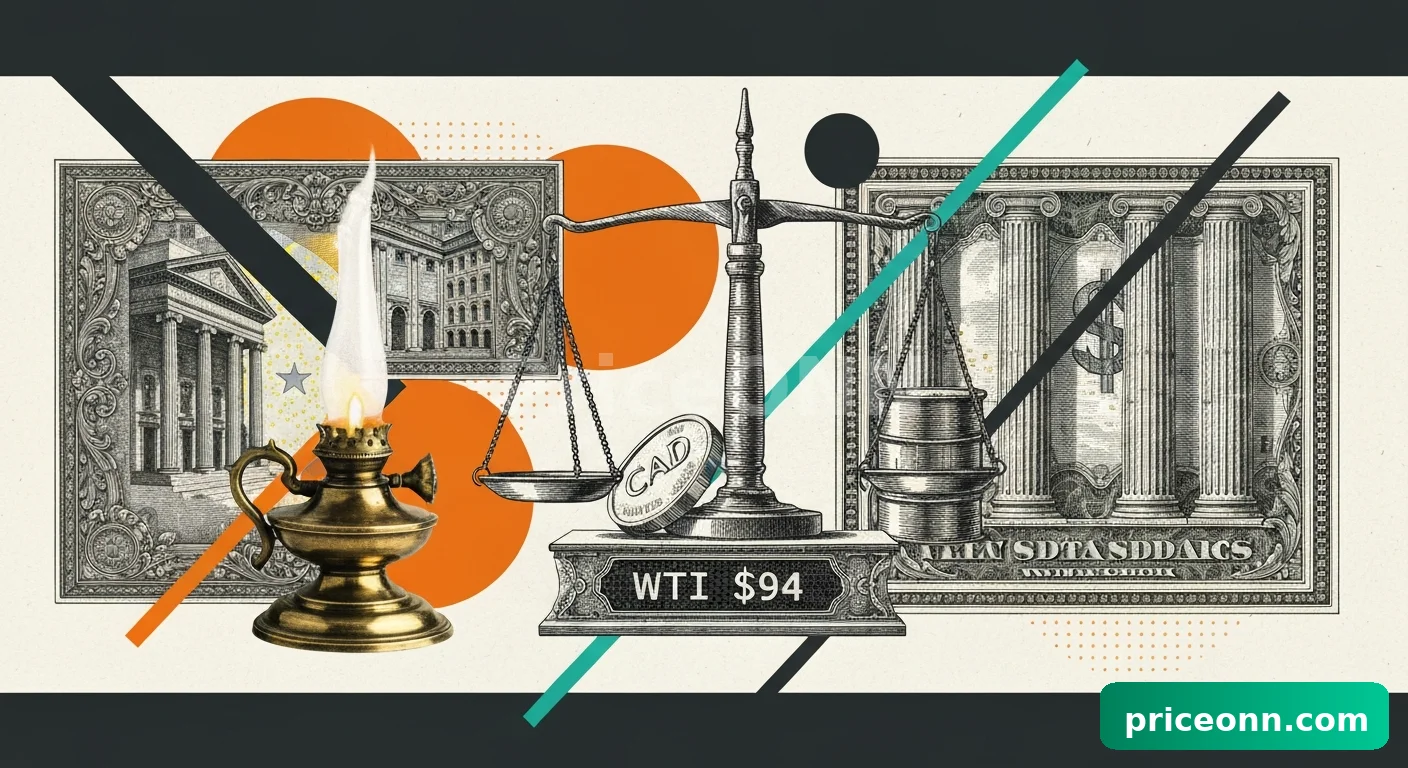

PriceONN