
Is the US Dollar Set for a Reversal as Fed Stays Put and Geopolitical Tensions Escalate?

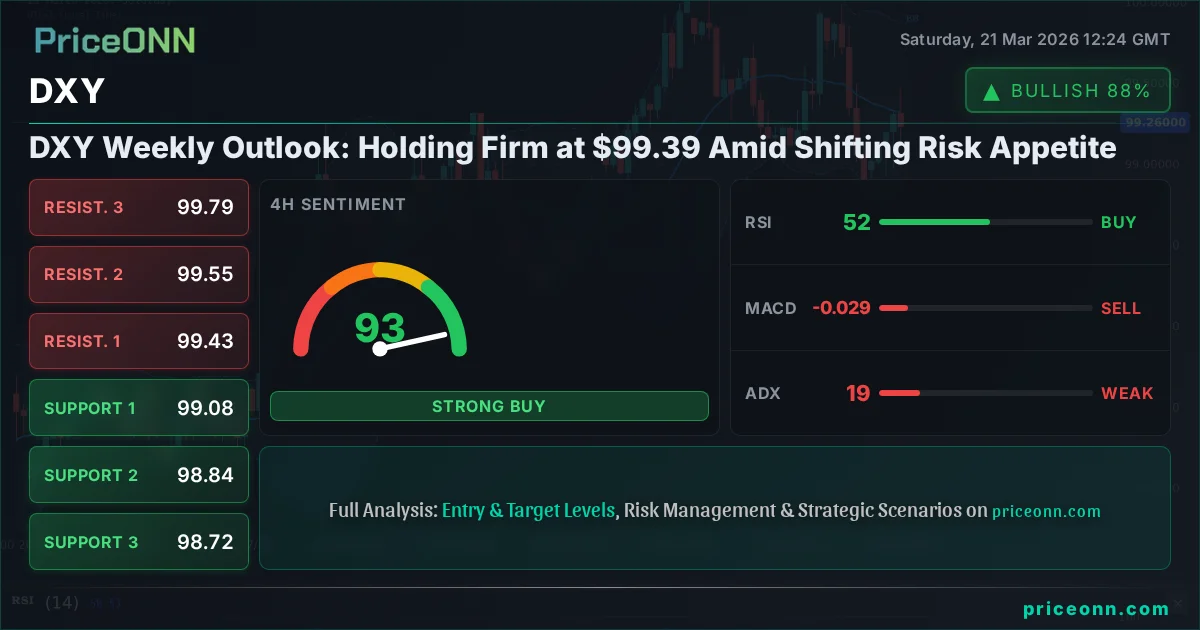
The US Dollar Index (DXY) experienced a significant pullback this past week, closing Friday at 99.60, a level that saw it slip back below the psychologically important 100.00 mark. This decline followed a mid-week surge that was largely attributed to the Federal Reserve’s decision to hold its benchmark interest rate steady within the 3.50%-3.75% range.
Market Context
The greenback's retreat suggests that while the Fed's policy remains a cornerstone of market analysis, other global factors are increasingly influencing currency valuations. The market appears to be pricing in the Fed’s current stance, allowing other major currencies to claw back some ground. The move below 100.00 on the DXY is a key technical development that traders are closely monitoring for signs of a more sustained trend reversal or simply a pause in the dollar’s prior upward trajectory.
Analysis & Drivers
The Federal Reserve’s decision to maintain interest rates at their current level, despite ongoing inflation concerns, has been interpreted by some as a signal that the central bank is reaching the end of its tightening cycle. This ‘hold’ policy, while expected, removes a key driver of dollar strength seen in recent months. Concurrently, escalating geopolitical tensions, particularly concerning Iran, have introduced a layer of uncertainty into global markets. Such events often lead to a flight to safety, which can, paradoxically, benefit the dollar. However, in this instance, the dollar's weakness suggests that the market's focus is more on the Fed’s policy path and the potential for interest rate differentials to narrow with other major central banks.
West Texas Intermediate (WTI) Crude Oil, a key commodity closely watched for its impact on global inflation and economic sentiment, also presents a complex picture. As a high-quality, light, and sweet crude, WTI is easily refined. Its price is heavily influenced by the fundamental principles of supply and demand, as well as geopolitical events. While robust economic growth typically boosts oil demand, current global economic uncertainties and the aforementioned geopolitical risks create a volatile environment. The sourcing and distribution hub in Cushing, Oklahoma, remains a critical point for price discovery. The interplay between energy demand, supply disruptions, and geopolitical risk premiums makes WTI a bellwether for broader market sentiment.
Trader Implications
For forex traders, the immediate implication of the dollar’s move below 99.60 is increased volatility across currency pairs. Key pairs to watch include EUR/USD, which may find support around 1.0700 if the dollar’s weakness persists, and USD/JPY, which could test lower levels if risk appetite wanes. The 100.00 level on the DXY now acts as a critical resistance point. A sustained break below this could open the door for further dollar depreciation. Traders should closely monitor upcoming economic data releases from the US and key European economies, as well as any further developments in geopolitical hotspots, which could rapidly shift market sentiment.
The price action in WTI Crude Oil also warrants attention. A sustained rise in oil prices due to supply concerns could reignite inflation fears, potentially forcing the Fed to adopt a more hawkish tone in the future, thereby supporting the dollar. Conversely, a drop in oil prices might ease inflation pressures, reinforcing the Fed’s dovish stance and further weakening the dollar. Key support for WTI lies around $75 per barrel, with resistance near $85 per barrel.
Outlook
The upcoming week presents a mixed outlook for the US Dollar. While the Fed's steady hand on interest rates removes a key pillar of support, the escalating geopolitical tensions offer a potential counterbalancing force through safe-haven flows. Market participants will be keenly awaiting further clarity on the Fed’s forward guidance and any significant shifts in global risk sentiment. A sustained break below 99.00 on the DXY could signal a more profound dollar downturn, while a rebound above 100.50 would suggest the prior uptrend may resume. The interplay between monetary policy and geopolitical risk will dictate the dollar's near-term trajectory.
Frequently Asked Questions
What is the current key support level for the US Dollar Index (DXY)?
The US Dollar Index (DXY) recently fell below the significant 100.00 level, closing at 99.60. This level now acts as a key resistance, while traders will be watching if it can hold above 99.00 as a potential support.
How might geopolitical tensions affect the US Dollar?
Escalating geopolitical tensions, such as those involving Iran, can often trigger safe-haven flows that historically benefit the US Dollar. However, the market’s current reaction suggests that the Federal Reserve’s steady interest rate policy is a more dominant factor, leading to dollar weakness despite these risks.
What is the outlook for EUR/USD based on the current market conditions?
If the US Dollar continues its downward trend, the EUR/USD pair could find support around the 1.0700 level. This assumes the Federal Reserve maintains its current interest rate policy and geopolitical risks do not trigger substantial safe-haven demand for the dollar.
Track markets in real-time
Empower your investment decisions with AI-powered analysis, technical indicators and real-time price data.
Join Our Telegram Channel
Get breaking market news, AI analysis and trading signals delivered instantly to your Telegram.
Join Channel



PriceONN