CHART: Billions wiped of mining stocks as gold, silver, copper prices plummet

Mining Stocks Face Unprecedented Sell-Off Amid Commodity Collapse
The global mining sector is reeling, with the world's largest mining companies witnessing a staggering loss of approximately 30% in market capitalization since the onset of the recent geopolitical conflict. This dramatic downturn coincides with a sharp decline across key commodities, pushing copper into a technical bear market, silver down 40% from its zenith, and gold enduring its worst weekly performance in decades.
Gold futures in New York experienced a significant drop, falling by $225 per ounce from opening levels to settle near $4,492 an ounce. This represents a 3.5% loss for the day and a more than 11% slide over the week. Silver, known for its volatility, followed suit with even wilder price swings. The precious metal traded hands at $67.81, marking a 6.9% decrease from the start of Friday's session. Meanwhile, copper concluded the day 4.0% lower, last valued at $5.30 per pound ($11,690 per tonne), and registered a 7.4% loss for the week.
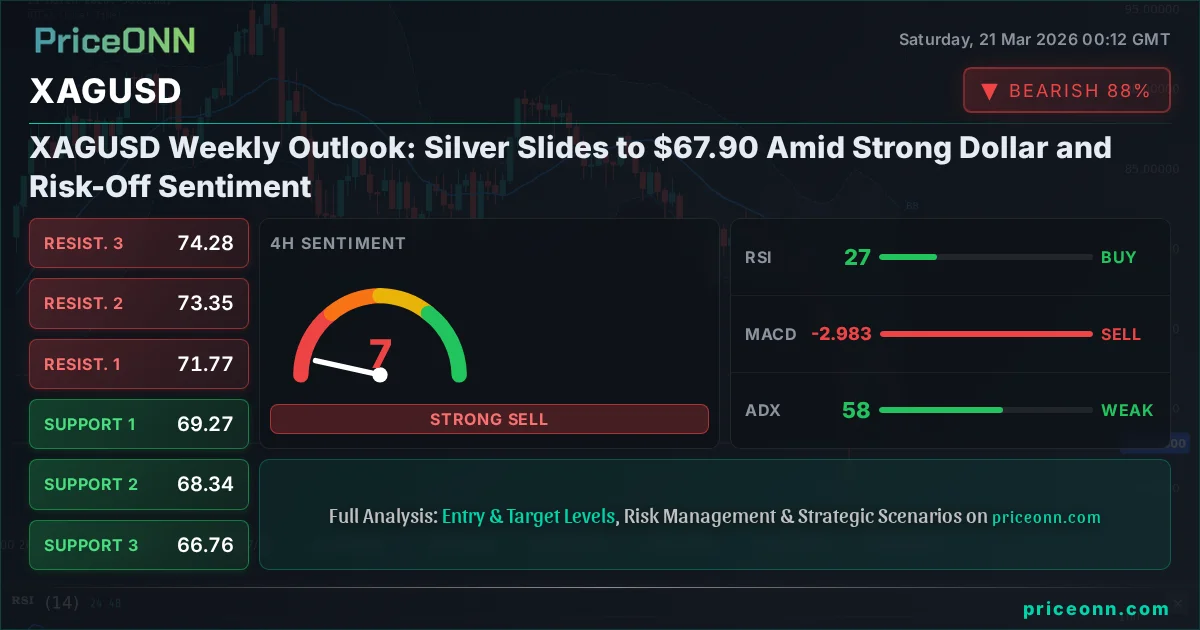
The confluence of these price movements has pushed gold, silver, and copper into technical bear market territory. Gold has fallen over $1,100, or more than 20%, from its January 29 record high. Silver has seen a more severe decline of 44%, while copper has shed nearly 20%, or over $2,800 per tonne, from its all-time peak reached concurrently.
Precious Metals and Copper Producers Bear the Brunt
Stocks of companies heavily invested in gold, silver, and platinum have borne the brunt of this market correction. Newmont (NYSE:NEM), a leading gold producer, is currently trading 26.3% below its pre-conflict levels from late February. Friday's trading session saw a substantial volume of 30.7 million shares change hands for the company.
Similarly, Barrick Mining (NYSE:B) has seen its stock value decrease by 26.8% over the same period, with 29.1 million shares traded on Friday alone. Newmont's market valuation has shrunk from a peak of $143 billion in late January to $104 billion, while Barrick's market worth has diminished by $27 billion since then, standing at $62 billion as of Friday.
Further down the list, Anglogold Ashanti (NYSE:AU) has experienced a dramatic 37.4% slide in March, leaving its market value at $40 billion. Gold Fields (NYSE:GFI) has lost 33.6%, now valued at $35 billion, and Kinross Gold has retreated 28.3%, holding a market capitalization of $32 billion.
Royalty and streaming companies, often considered less volatile, have also been significantly impacted. Wheaton Precious Metals (NYSE:WPM) has fallen just under 30% since the conflict's inception, now worth $52 billion. Franco-Nevada, while not immune, saw a more modest 20.7% decline, resulting in a $43 billion valuation.
In the silver mining space, over-the-counter shares of Fresnillo (OTCPK:FNLPF) trading in the US are down 31.3% for March, reducing its market cap to $30 billion. Pan American Silver (NYSE:PAAS) has suffered a 32.1% decline, falling to under $20 billion.
Valterra Platinum (OTCPK:ANGPY) stands out as one of the worst performers, dropping 35.3% from a multi-year high reached just before the conflict began, settling at a $20 billion market cap within three weeks.
Diversified Miners and Copper Producers Show Mixed Resilience
While precious metal miners faced the steepest declines, some copper producers and diversified mining giants also saw significant losses, though generally less severe. Losses have exceeded 20% across the board for most, with only a few exceptions.
BHP (NYSE:BHP) shares traded in the US have shed 20.0%, retreating from a historic peak valuation of $213 billion at the war's start. Despite record profits and China's significant role as a customer, the company has not been insulated from the broader market fallout. The incoming CEO faces the challenge of balancing ambitious spending with investor return expectations following a period marked by strategic missteps, including a failed bid for Anglo American.
Southern Copper (NYSE:SCCO) underperformed its peers, with March losses reaching 31.1% and its valuation falling to $126 billion. This decline saw the company, part of the Grupo Mexico conglomerate, lose its standing as the world's second most valuable miner to Rio Tinto (NYSE:RIO). Rio Tinto has experienced a relatively lighter fall of 16.3%, with its market cap standing at $143 billion.
Rio Tinto's stock received a boost after announcing progress on securing acreage in Arizona for its proposed Resolution copper mine, a project anticipated to become a major US copper source. The company plans a $500 million drilling campaign for the deposit, which it co-owns with BHP.
Freeport-McMoRan (NYSE:FCX) was among the most actively traded mining stocks, with over 25 million shares exchanged. After a 23.5% retreat in March, Freeport's valuation stands at $74 billion, a significant drop from its February peak near the $100 billion mark.
The company has initiated environmental permitting for a $7.5 billion expansion of its El Abra copper mine in Chile, which could significantly boost annual copper output. Furthermore, a memorandum of understanding was signed to extend the mining permit for its iconic Grasberg mine in Indonesia beyond 2041.
Glencore (OTCPK:GLNCY) has emerged relatively unscathed, with only a 4.3% loss since the conflict's escalation. This resilience is partly attributed to its extensive oil trading operations, which are expected to benefit from rising crude and gas prices. Glencore currently holds an $81 billion valuation and is the best-performing major mining stock year-to-date with a 25.6% gain.
Speculation arose last week regarding a potential renewed bid by Rio Tinto to form the world's largest mining company, fueled by a surge in coal prices and recent meetings between industry leaders.
Anglo American (OTCPK:NGLOY) losses have reached 23.4% for the month, mirroring the 23.4% decline of its potential merger partner, Teck Resources (NYSE:TECK). Anglo American's valuation stands at $41 billion compared to Teck Resources' $22 billion.
Anglo American is reportedly considering a third impairment of its De Beers diamond business, citing persistent weak diamond prices and ongoing asset sales ahead of its potential merger, which is currently under EU antitrust review.
Retail investor favorite Ivanhoe Mines (TSX:IVN) is down 30.5% for March, valued at $11 billion. Copper specialist First Quantum Minerals (TSX:FQM) has fallen by 30.5% to $18 billion.
Antofagasta (OTCPK:ANFGF) and KGHM (OTCPK:KGHPF) saw their pink sheets drop 28.2% and 21.5% respectively, with valuations of $41 billion and $14 billion.
Chinese mining giant Zijin Mining (OTCPK:ZIJMY), despite its US OTC units plunging 30.2% since the conflict began, maintains a significant market value of $123 billion, ranking it as the world's fourth most valuable mining firm.
Market Ripple Effects
The widespread collapse in precious and industrial metal prices, coupled with the sharp decline in mining stocks, sends significant tremors through the broader financial landscape. This sell-off is not merely confined to the resource sector; it signals a potential shift in investor sentiment and global economic outlook.
The immediate impact is felt across equity markets, particularly in sectors heavily reliant on commodity prices or with substantial mining exposure. Investors are reassessing risk appetites, and the sharp downturn in gold, a traditional safe haven, raises questions about underlying economic stability and inflation expectations. The decline in copper, a bellwether for global industrial activity, suggests a potential slowdown or recessionary fears are gaining traction.
Consequently, currencies of major commodity-exporting nations, such as the Australian Dollar (AUD) and the Canadian Dollar (CAD), are likely to face downward pressure as demand for their primary exports weakens. Conversely, a flight to safety might temporarily bolster the US Dollar Index (DXY), even as gold's safe-haven appeal appears diminished in the current climate. Investors should closely monitor bond yields, as a significant economic slowdown could prompt central banks to reconsider tightening monetary policy, potentially impacting the trajectory of interest rates and fixed-income markets.
Track markets in real-time
Empower your investment decisions with AI-powered analysis, technical indicators and real-time price data.
Join Our Telegram Channel
Get breaking market news, AI analysis and trading signals delivered instantly to your Telegram.
Join Channel