
Why Did Gold Prices Tumble 3% This Week Amidst Escalating Gulf Tensions?
Gold futures saw a sharp decline this past week, with April contracts shedding $30.10 to settle at $4,575.60 per troy ounce by Friday's close. This marks the third consecutive session of losses for the precious metal, driven by a complex interplay of escalating geopolitical tensions in the Persian Gulf and shifting expectations surrounding monetary policy.
Market Context
The precious metal's retreat occurred as a series of aggressive strikes targeted vital energy infrastructure in the Gulf region. These attacks have not only stoked broader inflationary concerns but have also significantly reduced the probability of an imminent U.S. Federal Reserve rate cut. The ripple effects were also felt keenly in the silver market, where April futures plummeted by 2.10%, or $1.489, to close at $69.485 per troy ounce.
Analysis & Drivers
The primary catalyst for the market's turmoil appears to be a chain of retaliatory actions and direct assaults within the region. Reports indicate that drone attacks, attributed to Iran, struck Kuwait's Mina al-Ahmadi oil refinery, a facility with a capacity of approximately 730,000 barrels per day, forcing operational shutdowns. This incident followed substantial Israeli strikes on Iran's South Pars gas field, which prompted Iran to launch counter-attacks. These counter-attacks reportedly targeted an oil refinery in Haifa, Israel, and the critical Ras Laffan energy hub in Qatar. The Ras Laffan facility, home to Qatar's largest liquefied natural gas (LNG) plant, has halted production, with projections suggesting over a year of repairs will be needed due to extensive damage. Prior to these events, Iran had also conducted drone assaults on Saudi Aramco's SAMREF refinery in Yanbu. The cumulative impact of these disruptions, beginning around February 28, has led to a near-total blockade of tanker traffic through the Strait of Hormuz. This severely constricted supply route has sent crude oil prices soaring, simultaneously amplifying global inflation anxieties and leading market participants to reassess the Federal Reserve's monetary easing timeline.
Trader Implications
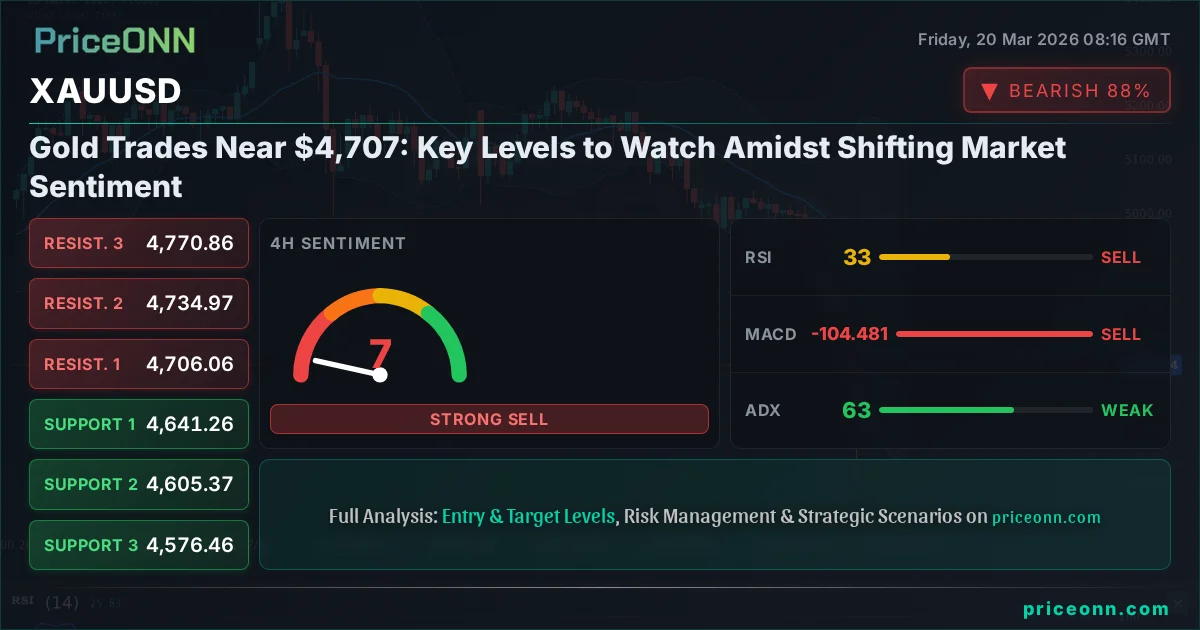
Traders should closely monitor the geopolitical developments in the Persian Gulf as they are now the dominant driver for gold and silver prices. The disruption to oil supply and the subsequent inflationary pressures could lead to a delayed response from central banks, potentially keeping interest rates higher for longer. Key levels to watch for gold include the recent lows around $4,500 as potential support, with resistance overhead at the $4,650 mark. For silver, traders will be watching the $68 level for support and $71 for resistance. The ongoing conflict introduces significant volatility, making risk management paramount. Any de-escalation in the region could trigger a sharp reversal, while further escalations would likely reinforce the bearish sentiment in precious metals, at least in the short term, as capital flows towards perceived safe havens like the U.S. Dollar in times of extreme uncertainty.
Outlook
The immediate outlook for gold and silver remains clouded by the geopolitical situation in the Middle East. While the escalating conflict has pushed inflation expectations higher, the simultaneous dampening of Fed rate cut expectations could, paradoxically, weigh on non-yielding assets like precious metals if U.S. Treasury yields continue to climb. However, sustained supply disruptions in the energy markets could provide a floor for gold prices. Traders should remain vigilant for any news regarding de-escalation or further escalation of hostilities, as well as key U.S. economic data that could influence the Federal Reserve's future policy decisions.
Frequently Asked Questions
What is the immediate impact of the Gulf attacks on oil prices?
The attacks on key refineries and LNG facilities in the Persian Gulf have led to a near-total blockade of the Strait of Hormuz, causing crude oil prices to surge due to supply concerns. This disruption is a significant factor contributing to renewed inflationary pressures globally.
How are these events affecting Federal Reserve rate cut expectations?
The escalating geopolitical tensions and resulting inflationary concerns have significantly diminished expectations for a near-term Federal Reserve rate cut. Market data now suggests a lower probability of easing in the coming months, as central bankers may prioritize combating inflation.
What are the key price levels to watch for gold and silver following this downturn?
For gold, traders are watching the $4,500 level as potential support and $4,650 as overhead resistance. Silver is seeing attention at the $68 mark for support and $71 for resistance. These levels will be critical in determining the short-term price direction.
Track markets in real-time
Empower your investment decisions with AI-powered analysis, technical indicators and real-time price data.
Join Our Telegram Channel
Get breaking market news, AI analysis and trading signals delivered instantly to your Telegram.
Join Channel
PriceONN