
Crude Oil Moves Lower As Middle East Tensions Gradually Ease
 PriceONN Editorial Desk
Multi-source verification
PriceONN Editorial Desk
Multi-source verification
Easing Geopolitical Heat Squeezes Oil Prices
The market for crude oil experienced a notable downturn on Friday, continuing the slide that began the previous day. This downward pressure emerged as diplomatic channels, facilitated by third-party mediators, intensified their push to bring the United States and Iran back to the negotiation table. Crucially, the volatile Middle East region has remained free of any new direct confrontations between the two nations over the last 24 hours, a development that has visibly cooled investor sentiment.
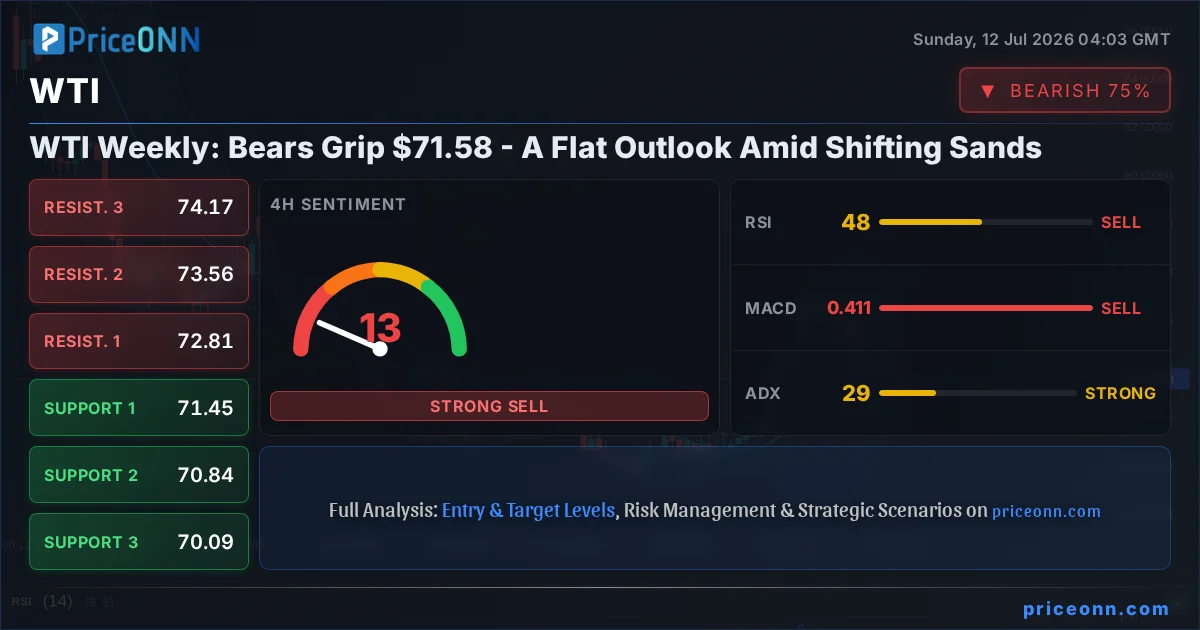
The August delivery contract for West Texas Intermediate (WTI) crude was last observed trading down by $0.75, representing a 1.04% decrease, settling at $71.33 per barrel. This pullback occurs despite a prior memorandum of understanding aimed at a 60-day halt to mutual hostilities. Nevertheless, a brief but significant exchange of fire took place on July 7 and 8, following three separate incidents where vessels traversing the critical Strait of Hormuz were struck by projectiles.
President Donald Trump indicated that negotiations were permitted to proceed, noting Iran's perceived urgent need for a deal with the U.S. However, he simultaneously voiced skepticism regarding Iran's capacity to adhere to any such agreement. While the ultimate success of these peace talks remains uncertain, the absence of fresh attacks in the immediate past has provided a degree of relief to energy markets.
The U.K. Maritime Trade Operations Agency has flagged the security threat level in the Strait of Hormuz as "severe," its highest designation. In a recent advisory to mariners, the UKMTO urged heightened vigilance and recommended passage via the strait's southern route. Data compiled by Kpler revealed a significant drop in LNG and oil tanker traffic, with only 10 vessels transiting on Thursday, marking the lowest count since June 28. This contrasts sharply with the 14 ships on Wednesday and 22 on Monday, indicating a tangible impact on shipping activity.
Reinforcing these de-escalation efforts, a Qatari delegation is reportedly in Iran today, aiming to foster mediation, reduce tensions, and cultivate conditions conducive to broader U.S.-Iran discussions. These diplomatic overtures are being conducted with U.S. coordination. President Trump shared via his Truth Social platform that Iran had requested to continue talks, a proposal the U.S. accepted. He also stated that the U.S. had communicated to Iran that the ceasefire period had concluded.
Global Demand Outlook and OPEC+ Adjustments
In its latest Oil Market Report, projecting to 2026, the International Energy Agency (IEA) in Paris noted a gradual increase in global oil consumption. This recovery follows a May low, attributed to improving supply conditions and reduced prices. However, the agency tempered expectations for demand growth, forecasting a weaker-than-anticipated rise due to the lingering Middle East conflict, which now includes Israel and Lebanon alongside the U.S. and Iran.
The IEA's revised outlook predicts an annual increase in global oil consumption of up to 1 million barrels per day, a significant upgrade from its previous projection of a 1.1 million barrel-per-day decline. Global oil supply, according to the agency, surged by 4.1 million barrels per day in June to reach 98.8 million barrels per day. Despite this increase, the supply level remains approximately 9.4 million barrels per day below pre-conflict figures. The IEA further anticipates a decline in global oil supply by an average of 3.7 million barrels per day in 2026.
Following the U.S.-Iran exchanges on July 7-8, supply-related anxieties have been a primary driver of oil prices. This has occurred even amidst an unexpected build in U.S. crude inventories and a recent decision by OPEC+ to boost production. On Sunday, OPEC+ announced that seven of its member nations would collectively increase output by 188,000 barrels per day starting in August. This marks the fifth consecutive output hike from the alliance.
These seven core members have collectively raised their production by nearly 800,000 barrels per day between April and July. However, the operational impact of potential Strait of Hormuz closures has demonstrably hampered supply flows for key OPEC+ members, including Saudi Arabia, Kuwait, and Iraq, underscoring the delicate balance between production capacity and geopolitical risk.
Market Ripple Effects
The fluctuating geopolitical landscape surrounding U.S.-Iran relations and its impact on crude oil prices presents a complex scenario for traders and investors. The reduction in tanker traffic, particularly through the Strait of Hormuz, directly affects supply availability and introduces price volatility. While diplomatic progress offers a ceiling to upward price momentum, any resurgence in hostilities could trigger a swift reversal.
For traders, the immediate focus remains on the credibility and sustainability of the de-escalation efforts. Key indicators to watch include further official statements from involved parties, the ongoing tanker traffic volume, and any shifts in the U.S. strategic petroleum reserve. The broader market is also closely monitoring the U.S. dollar index (DXY), as a stronger dollar typically exerts downward pressure on dollar-denominated commodities like oil. Additionally, the performance of energy sector equities and related exchange-traded funds (ETFs) will likely reflect these price movements. Investors should also consider the impact on inflation expectations, as sustained high oil prices can contribute to broader inflationary pressures, potentially influencing central bank policy decisions.
Track markets in real-time
Empower your investment decisions with AI-powered analysis, technical indicators and real-time price data.
Join Our Telegram Channel
Get breaking market news, AI analysis and trading signals delivered instantly to your Telegram.
Join Channel PriceONN News
West Texas Intermediate (WTI) – the benchmark US Crude Oil price – steadies during the Asian session on Friday, stalling the previous day's downfall amid mixed messaging from the US and Iran.
PriceONN News
Wednesday’s jump in oil prices to a two-week high suggests that market participants were too complacent about the U.S.-Iran ‘deal to make a deal’ and that the ceasefire would hold and oil flows through the Strait of Hormuz would only increase, analysts at ING said on Thursday. Oil prices surged by over 5% on Wednesday, gaining 7% at one point to a two-week high, after the escalation in the region. The Iranian attacks on three commercial ships on Tuesday, including an oil tanker and an LNG...
PriceONN News
A week after it warned that an oil glut is coming, Goldman Sachs has done a U-turn, warning that the renewed hostilities in the Persian Gulf threaten an extended supply disruption. “While Middle Eastern producers have started reopening their shut-in wells over the last month, Hormuz disruptions could slow down the production recovery,” the bank’s commodity analysts said, as quoted by Bloomberg. They added that Middle East oil production remains 10.5 million barrels daily below pre-war levels....
PriceONN News
The Middle East is once again at the center of global energy markets due to the renewed military confrontation involving Iran. Markets, however, should recognize that, unlike in previous crises, the world is entering this new phase with a significantly weaker strategic safety net. At present, crude oil prices still respond to headlines surrounding military operations, shipping incidents, and diplomatic statements. Still, it is now time that markets should no longer overlook the structural...
PriceONN News
Renewed U.S.-Iran strikes have revived the Middle East risk premium, lifting Brent above $76 as traffic through the Strait of Hormuz slows and supply disruption fears return. Friday, July 10, 2026 The return of the Middle Eastern geopolitical risk premium has lifted global oil prices by $4 per barrel this week, with ICE Brent set to settle above $76 per barrel. Renewed US-Iran strikes pushed traffic through the Strait of Hormuz back toward a near-standstill as market concerns about continued...
PriceONN News
Refining margins for gasoline and diesel jumped this week to new record highs after the re-escalation in the Middle East, Russia’s ban on diesel exports, and crumbling global fuel inventories. The surge in fuel margins and the price spread over crude prices suggest that the global fuel markets remain very tight despite the millions of barrels of crude that have managed to exit the Strait of Hormuz in recent weeks. Diesel refining margins in Europe jumped to a record high of over $60 per...
PriceONN News
According to the latest forecast from the International Energy Agency (IEA), the global Oil demand will rise by 1.2 million barrels per day (bpd) Year-on-Year (YoY) in the last quarter of this year.
PriceONN News
What was a flood of oil and gas leaving the Strait of Hormuz two weeks ago has now ground to a halt as the United States and Iran began firing missiles again and President Trump declared the ceasefire over, calling the Iranian leadership “scum”, “liars”, and “cheats”. Bloomberg reports that, earlier today, there was only one tanker moving along the waterway, and it was a sanctioned very large crude carrier that passed along the Iran-controlled route along with an Iranian container ship....
PriceONN News
Kazakhstan is growing more possessive of its petroleum products as a gasoline shortage tightens its grip in Russia and the US-Iran conflict reignites. Kazakh officials have established new police checkpoints on almost 60 roads along the country’s lengthy border with Russia to curb ‘gasoline tourism,’ according to local news reports. In addition, new restrictions have been introduced at border checkpoints, limiting trucks and cars to one crossing per day. In recent weeks, as gasoline shortages...
PriceONN News
The United Arab Emirates (UAE) produced 4.1 million barrels per day (bpd) of crude oil in June, its highest output ever, according to estimates by the International Energy Agency. The UAE’s crude oil production jumped from 3.3 million bpd in May to 4.1 million bpd in June after the country left OPEC effective May 1, started raising output, and managed to sneak a lot of exports out of the Middle East even as the Strait of Hormuz was mostly blockaded for the first half of June. The crude oil...
PriceONN News
Despite the tentative recovery of oil flows through the Strait of Hormuz and the first build-up in global stocks since the war began, this week’s re-escalation of the U.S.-Iran hostilities could flip the outlook for an oil market surplus for next year, the International Energy Agency said on Friday. Oil prices have plunged since the United States and Iran signed the memorandum of understanding (MoU) in the middle of June, with North Sea Dated prices down by $31 per barrel in June to $68 a...
PriceONN News
Close to half a dozen liquefied natural gas carriers have gone into the Strait of Hormuz in the past few days and six have exited the strait, despite the recent return to hostilities between the United States and Iran. According to Kpler data cited by Reuters, five ballast LNG tankers have entered the chokepoint in recent days, four of them linked to Qatar, and the fifth one owned by a Greek shipping company. The five vessels were previously seen outside Hormuz earlier this month. An earlier...