
Oil’s Calm Is Over as Middle East Risks Return
 PriceONN Editorial Desk
Multi-source verification
PriceONN Editorial Desk
Multi-source verification
Middle East Flashpoint Ignites Oil Market Volatility
The fragile calm in global oil markets has shattered. Renewed confrontations between the United States and Iran have injected a significant geopolitical risk premium back into crude prices, propelling ICE Brent futures to breach the $76 per barrel mark this week. This resurgence in tension has tangible impacts, with maritime traffic through the critical Strait of Hormuz approaching a standstill and reigniting widespread concerns over potential supply chain interruptions.
The escalating situation has effectively overshadowed diplomatic overtures. Even as President Trump made another bid for talks with Tehran on a recent Friday, market sentiment was dominated by the growing apprehension of prolonged supply disruptions. This shift underscores the delicate balance in energy markets, where geopolitical events can rapidly override other fundamental drivers.
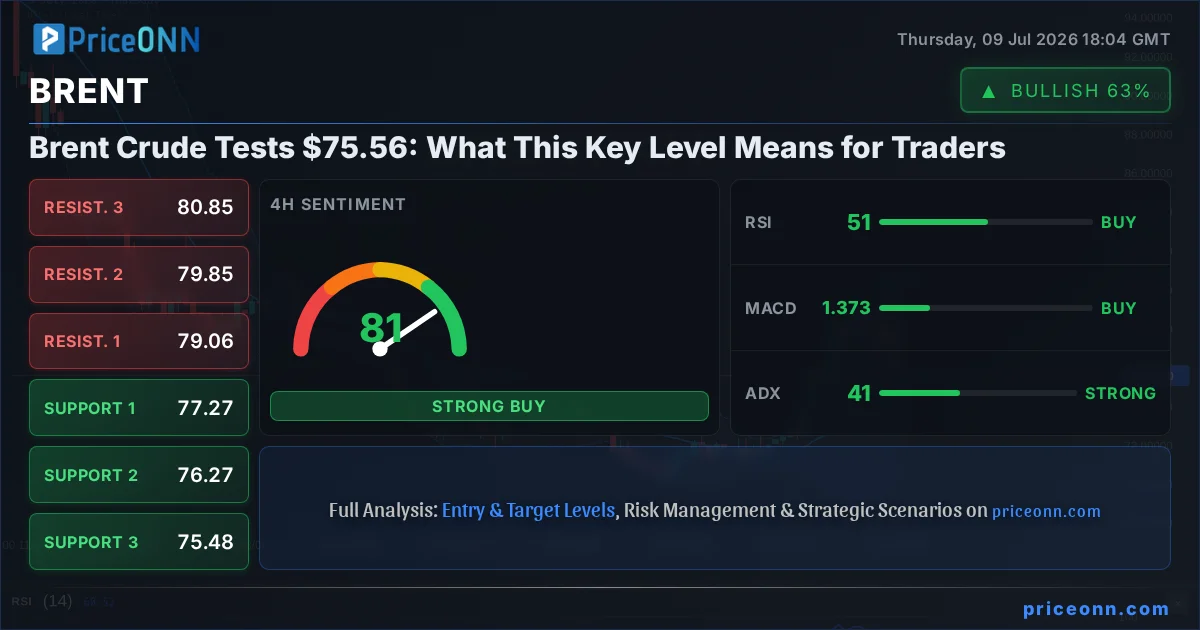
Global Energy Landscape Under Strain
The ripple effects of the Middle East tensions are being felt across the energy sector. The International Energy Agency (IEA) has adjusted its outlook, now anticipating a steeper drop in oil demand for 2026, projected at 1 million barrels per day. Simultaneously, the agency maintains a bullish stance for the current year, forecasting a substantial global oil supply deficit of 3.7 million barrels per day, largely attributed to ongoing disruptions stemming from the Middle East.
Nations are actively responding to these vulnerabilities. India, having witnessed the precariousness of its limited crude reserves during the recent Hormuz blockade, is accelerating its strategic petroleum reserve (SPR) expansion. Its state-controlled firm, ONGC, is set to construct a new 13-million-barrel crude storage facility in Mangalore. This move highlights a broader trend of countries seeking to bolster their energy security in the face of unpredictable global supply dynamics.
Iran Ramps Up Exports Amidst Blockade Threats
In a race against time, Iran has been aggressively maximizing its oil exports. On Thursday, the nation loaded approximately 11 million barrels of crude onto tankers. This surge in shipments comes as US President Trump has signaled the potential reimposition of a blockade on Iranian oil flows via the Gulf of Oman, following the disintegration of a short-lived ceasefire agreement. The threat of renewed sanctions looms large over Iranian crude output.
Maritime Trade Faces Significant Disruption
The vital maritime routes through the Strait of Hormuz are once again becoming perilous. Recent attacks on vessels transiting this key chokepoint have compelled shipping companies to halt movements. Notably, QatarEnergy's liquefied natural gas (LNG) carriers, including the Al Ghariya, Duhail, and al Ruwais, were forced to reverse course from the waterway. This heightened risk has predictably driven up insurance costs for maritime operations in the region.
Russia and Europe Grapple with Diesel Shortages
Beyond the Middle East, other significant energy market developments are unfolding. Russia has implemented a month-long prohibition on diesel exports, a measure aimed at curbing soaring domestic prices. This decision, partly a response to Ukrainian drone incursions, removes an estimated 0.5 million barrels per day from global export markets. Consequently, European diesel crack spreads have surged to a staggering 15-year high of $60 per barrel.
Ukraine Strikes Target Energy Infrastructure
The conflict zone in Eastern Europe continues to impact energy logistics. Ukraine's armed forces successfully targeted an oil tanker chartered by US energy giant Chevron with a drone. The Yasa Polaris tanker, en route to Russia's Black Sea port of Novorossiysk, was struck while preparing to load Kazakh-origin CPC Blend crude. The vessel subsequently diverted towards the Turkish coast, underscoring the persistent risks to energy infrastructure in conflict-affected areas.
China and Venezuela Adjust Energy Policies
In Asia, China has eased restrictions on refined fuel exports for state refiners for the remainder of July, also permitting private refiner ZPC to resume shipments after a four-month hiatus. This move targets approximately 3 million tonnes of gasoline, diesel, and jet fuel exports this month. Meanwhile, Venezuela's acting president has approved a revamped Hydrocarbons Law, a move intended to modernize its energy sector regulations and attract foreign investment after years of nationalization.
US Signals Shift on Syria, Impacting Energy Investments
President Donald Trump has informed Congress of his intention to remove Syria from the US list of state sponsors of terrorism. This proposed change, subject to a 45-day review period, could lead to the easing of sanctions on energy investments in the country. Preliminary exploration deals signed by Chevron and ConocoPhillips suggest a potential shift in the energy investment landscape in Syria.
Qatar Halts LNG Restart Amidst Carrier Attack
QatarEnergy has put a temporary hold on restarting production at its Ras Laffan liquefaction facilities. This pause follows a recent attack on the Al Rekayyat LNG carrier, despite the availability of 11 empty vessels positioned outside the port. The incident highlights the lingering security concerns affecting critical energy infrastructure in the region.
Turkey and Iraq Agree on Oil Pipeline Extension
In a diplomatic breakthrough, Turkey and Iraq have extended their agreement for crude flows via the Kirkuk-Ceyhan pipeline for another 12 months. This stopgap measure, agreed upon just before the initial contract's expiry on July 27, aims to secure continued oil exports while both nations work towards finalizing a long-term deal in the coming days.
Reading Between the Lines
The current surge in oil prices is a stark reminder of how quickly geopolitical instability can disrupt energy markets. The renewed focus on the Strait of Hormuz, a critical artery for global oil supply, underscores the inherent vulnerability of maritime trade routes. Traders and investors should monitor the escalation of US-Iran tensions closely, as any further military engagements or stricter blockades could send crude prices significantly higher, potentially impacting inflation expectations and global economic growth.
The heightened risk premium suggests that current prices may not fully reflect the potential for sustained supply disruptions. Key indicators to watch include shipping insurance rates in the Persian Gulf, the actual volume of crude transiting the Strait of Hormuz, and official statements from the involved nations. Related assets to monitor include the US Dollar Index (DXY), as a strong dollar can sometimes temper dollar-denominated commodity prices, and the performance of energy sector equities, which could see significant volatility. Additionally, the impact on emerging market currencies, particularly those reliant on energy imports, warrants attention.
Track markets in real-time
Empower your investment decisions with AI-powered analysis, technical indicators and real-time price data.
Join Our Telegram Channel
Get breaking market news, AI analysis and trading signals delivered instantly to your Telegram.
Join Channel PriceONN News
Wednesday’s jump in oil prices to a two-week high suggests that market participants were too complacent about the U.S.-Iran ‘deal to make a deal’ and that the ceasefire would hold and oil flows through the Strait of Hormuz would only increase, analysts at ING said on Thursday. Oil prices surged by over 5% on Wednesday, gaining 7% at one point to a two-week high, after the escalation in the region. The Iranian attacks on three commercial ships on Tuesday, including an oil tanker and an LNG...
PriceONN News
(RTTNews) - Extending the losses from Thursday's session, crude oil prices have declined sharply on Friday as efforts by third-party mediators to bring the U.S. and Iran back to the negotiating table intensify while the Middle East remained free from any new U.S. versus Iran atta
PriceONN News
A week after it warned that an oil glut is coming, Goldman Sachs has done a U-turn, warning that the renewed hostilities in the Persian Gulf threaten an extended supply disruption. “While Middle Eastern producers have started reopening their shut-in wells over the last month, Hormuz disruptions could slow down the production recovery,” the bank’s commodity analysts said, as quoted by Bloomberg. They added that Middle East oil production remains 10.5 million barrels daily below pre-war levels....
PriceONN News
What was a flood of oil and gas leaving the Strait of Hormuz two weeks ago has now ground to a halt as the United States and Iran began firing missiles again and President Trump declared the ceasefire over, calling the Iranian leadership “scum”, “liars”, and “cheats”. Bloomberg reports that, earlier today, there was only one tanker moving along the waterway, and it was a sanctioned very large crude carrier that passed along the Iran-controlled route along with an Iranian container ship....
PriceONN News
The Middle East is once again at the center of global energy markets due to the renewed military confrontation involving Iran. Markets, however, should recognize that, unlike in previous crises, the world is entering this new phase with a significantly weaker strategic safety net. At present, crude oil prices still respond to headlines surrounding military operations, shipping incidents, and diplomatic statements. Still, it is now time that markets should no longer overlook the structural...
PriceONN News
Refining margins for gasoline and diesel jumped this week to new record highs after the re-escalation in the Middle East, Russia’s ban on diesel exports, and crumbling global fuel inventories. The surge in fuel margins and the price spread over crude prices suggest that the global fuel markets remain very tight despite the millions of barrels of crude that have managed to exit the Strait of Hormuz in recent weeks. Diesel refining margins in Europe jumped to a record high of over $60 per...
PriceONN News
Close to half a dozen liquefied natural gas carriers have gone into the Strait of Hormuz in the past few days and six have exited the strait, despite the recent return to hostilities between the United States and Iran. According to Kpler data cited by Reuters, five ballast LNG tankers have entered the chokepoint in recent days, four of them linked to Qatar, and the fifth one owned by a Greek shipping company. The five vessels were previously seen outside Hormuz earlier this month. An earlier...
PriceONN News
West Texas Intermediate (WTI) – the benchmark US Crude Oil price – steadies during the Asian session on Friday, stalling the previous day's downfall amid mixed messaging from the US and Iran.
PriceONN News
Kazakhstan is growing more possessive of its petroleum products as a gasoline shortage tightens its grip in Russia and the US-Iran conflict reignites. Kazakh officials have established new police checkpoints on almost 60 roads along the country’s lengthy border with Russia to curb ‘gasoline tourism,’ according to local news reports. In addition, new restrictions have been introduced at border checkpoints, limiting trucks and cars to one crossing per day. In recent weeks, as gasoline shortages...
PriceONN News
The United Arab Emirates (UAE) produced 4.1 million barrels per day (bpd) of crude oil in June, its highest output ever, according to estimates by the International Energy Agency. The UAE’s crude oil production jumped from 3.3 million bpd in May to 4.1 million bpd in June after the country left OPEC effective May 1, started raising output, and managed to sneak a lot of exports out of the Middle East even as the Strait of Hormuz was mostly blockaded for the first half of June. The crude oil...
PriceONN News
Russia's oil production in 2026 and 2027 is set to be lower than previously expected, due to intensified Ukrainian drone attacks on Russia's energy infrastructure, the International Energy Agency said in its monthly oil market report on Friday. Russia produced on average 9.2 million barrels per day (bpd) in 2025. The forecasts for this year and next, however, has been downgraded from previous projections as Ukraine continues to inflict damage on Russia's storage, refining, and transportation...
PriceONN News
ADNOC Logistics and Services has placed a $900-million order for four newbuild LNG carriers to expand its fleet as Abu Dhabi’s national oil company seeks to boost gas exports to seize the global rise in LNG demand. ADNOC Logistics and Services on Friday announced a newbuilding order for an additional four next-generation LNG carriers with a total value of approximately $900 million, or 3.3 billion UAE dirhams. The newly-built vessels will be constructed at Jiangnan Shipyard in Shanghai, China,...