
Hormuz Tanker Traffic Grinds to a Halt After U.S.-Iran Escalation
 PriceONN Editorial Desk
Multi-source verification
PriceONN Editorial Desk
Multi-source verification
Critical Chokepoint Falls Silent
The arteries of global energy supply, the shipping lanes slicing through the Strait of Hormuz, have suddenly constricted. Just a fortnight ago, a steady stream of oil and gas tankers navigated this crucial passage. Today, that flow has virtually ceased. This dramatic shift follows a sharp escalation in hostilities between the United States and Iran, marked by renewed missile firings and strong rhetoric from President Trump, who labeled Iran's leadership "scum," "liars," and "cheats," effectively declaring an end to any perceived ceasefire.
Ship-tracking data paints a stark picture of the current paralysis. Earlier today, monitors registered only a single vessel traversing the waterway. This solitary ship was a sanctioned very large crude carrier that proceeded along the Iranian controlled section of the strait, accompanied by an Iranian container ship. Crucially, the Omani coast route, a corridor ostensibly under United States oversight, showed no detected traffic whatsoever. This near-complete shutdown presents a dramatic reversal from recent weeks.
The implications for energy logistics are immediate and severe. Three liquefied natural gas (LNG) carriers, all bound for Qatar's pivotal Ras Laffan export terminal, appear to have halted their progress. Adding to the disruption, a supertanker carrying crude oil destined for India executed a U-turn. This maneuver occurred after Iran launched strikes against three vessels within the waterway on Tuesday, a clear signal of escalating regional instability.
Market Repercussions Accelerate
The sudden cessation of traffic has predictably sent tremors through the energy markets. Oil prices experienced a significant surge, completely erasing the prior downward trend. This downturn had been underpinned by optimistic forecasts of a return to oil market glut conditions, fueled by the recent recovery in tanker movements through Hormuz. Those predictions, it seems, were dramatically premature.
This event underscores the extreme sensitivity of global oil prices to geopolitical flashpoints, particularly those involving major energy producers and critical transit routes. The Strait of Hormuz, through which approximately 30% of the world's seaborne oil passes, remains a highly vulnerable chokepoint. Any disruption here has an outsized impact on supply expectations and, consequently, price levels.
The narrative of a returning oil glut has been abruptly interrupted by the reality of escalating Middle Eastern tensions. Traders and investors are now recalibrating their expectations, factoring in the heightened risk premium associated with this renewed conflict. The quiet waters of the Strait of Hormuz are now a deafening indicator of market uncertainty.
Reading Between the Lines
The dramatic halt in shipping through the Strait of Hormuz is more than just a logistical bottleneck; it's a potent reminder of the delicate geopolitical balance governing global energy supplies. The U.S. and Iran's renewed military posturing has effectively weaponized this vital chokepoint, immediately impacting the perceived availability of crude oil and LNG.
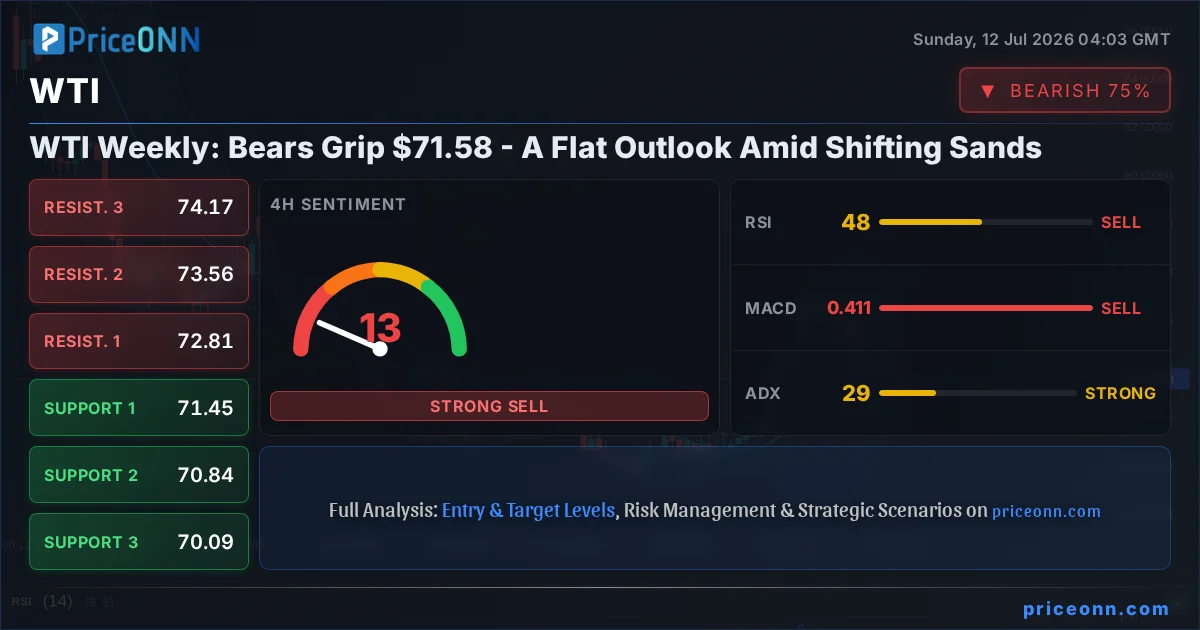
For traders, this development signals a swift return of risk premium into oil prices. The previous narrative of ample supply is now overshadowed by the tangible threat of supply disruptions. This could lead to increased volatility in crude benchmarks like Brent and WTI. Furthermore, the heightened tensions may also influence currency markets, potentially strengthening the US Dollar Index (DXY) as a safe-haven asset, while also impacting the Canadian Dollar due to its correlation with oil prices.
What smart money is watching extends beyond immediate price action. Desks are likely analyzing options market positioning for signs of increased bearish bets being unwound or new defensive strategies being implemented. They are also keenly observing the term structure of oil futures, looking for contango or backwardation shifts that might indicate market expectations of prolonged supply constraints. The U.S. administration's rhetoric and Iran's response will be critical catalysts to monitor, with any further escalations potentially leading to broader market contagion, impacting equity markets sensitive to energy costs and inflation expectations.
Track markets in real-time
Empower your investment decisions with AI-powered analysis, technical indicators and real-time price data.
Join Our Telegram Channel
Get breaking market news, AI analysis and trading signals delivered instantly to your Telegram.
Join Channel PriceONN News
(RTTNews) - Extending the losses from Thursday's session, crude oil prices have declined sharply on Friday as efforts by third-party mediators to bring the U.S. and Iran back to the negotiating table intensify while the Middle East remained free from any new U.S. versus Iran atta
PriceONN News
Renewed U.S.-Iran strikes have revived the Middle East risk premium, lifting Brent above $76 as traffic through the Strait of Hormuz slows and supply disruption fears return. Friday, July 10, 2026 The return of the Middle Eastern geopolitical risk premium has lifted global oil prices by $4 per barrel this week, with ICE Brent set to settle above $76 per barrel. Renewed US-Iran strikes pushed traffic through the Strait of Hormuz back toward a near-standstill as market concerns about continued...
PriceONN News
Wednesday’s jump in oil prices to a two-week high suggests that market participants were too complacent about the U.S.-Iran ‘deal to make a deal’ and that the ceasefire would hold and oil flows through the Strait of Hormuz would only increase, analysts at ING said on Thursday. Oil prices surged by over 5% on Wednesday, gaining 7% at one point to a two-week high, after the escalation in the region. The Iranian attacks on three commercial ships on Tuesday, including an oil tanker and an LNG...
PriceONN News
A week after it warned that an oil glut is coming, Goldman Sachs has done a U-turn, warning that the renewed hostilities in the Persian Gulf threaten an extended supply disruption. “While Middle Eastern producers have started reopening their shut-in wells over the last month, Hormuz disruptions could slow down the production recovery,” the bank’s commodity analysts said, as quoted by Bloomberg. They added that Middle East oil production remains 10.5 million barrels daily below pre-war levels....
PriceONN News
The Middle East is once again at the center of global energy markets due to the renewed military confrontation involving Iran. Markets, however, should recognize that, unlike in previous crises, the world is entering this new phase with a significantly weaker strategic safety net. At present, crude oil prices still respond to headlines surrounding military operations, shipping incidents, and diplomatic statements. Still, it is now time that markets should no longer overlook the structural...
PriceONN News
Refining margins for gasoline and diesel jumped this week to new record highs after the re-escalation in the Middle East, Russia’s ban on diesel exports, and crumbling global fuel inventories. The surge in fuel margins and the price spread over crude prices suggest that the global fuel markets remain very tight despite the millions of barrels of crude that have managed to exit the Strait of Hormuz in recent weeks. Diesel refining margins in Europe jumped to a record high of over $60 per...
PriceONN News
Close to half a dozen liquefied natural gas carriers have gone into the Strait of Hormuz in the past few days and six have exited the strait, despite the recent return to hostilities between the United States and Iran. According to Kpler data cited by Reuters, five ballast LNG tankers have entered the chokepoint in recent days, four of them linked to Qatar, and the fifth one owned by a Greek shipping company. The five vessels were previously seen outside Hormuz earlier this month. An earlier...
PriceONN News
West Texas Intermediate (WTI) – the benchmark US Crude Oil price – steadies during the Asian session on Friday, stalling the previous day's downfall amid mixed messaging from the US and Iran.
PriceONN News
Kazakhstan is growing more possessive of its petroleum products as a gasoline shortage tightens its grip in Russia and the US-Iran conflict reignites. Kazakh officials have established new police checkpoints on almost 60 roads along the country’s lengthy border with Russia to curb ‘gasoline tourism,’ according to local news reports. In addition, new restrictions have been introduced at border checkpoints, limiting trucks and cars to one crossing per day. In recent weeks, as gasoline shortages...
PriceONN News
The United Arab Emirates (UAE) produced 4.1 million barrels per day (bpd) of crude oil in June, its highest output ever, according to estimates by the International Energy Agency. The UAE’s crude oil production jumped from 3.3 million bpd in May to 4.1 million bpd in June after the country left OPEC effective May 1, started raising output, and managed to sneak a lot of exports out of the Middle East even as the Strait of Hormuz was mostly blockaded for the first half of June. The crude oil...
PriceONN News
Russia's oil production in 2026 and 2027 is set to be lower than previously expected, due to intensified Ukrainian drone attacks on Russia's energy infrastructure, the International Energy Agency said in its monthly oil market report on Friday. Russia produced on average 9.2 million barrels per day (bpd) in 2025. The forecasts for this year and next, however, has been downgraded from previous projections as Ukraine continues to inflict damage on Russia's storage, refining, and transportation...
PriceONN News
ADNOC Logistics and Services has placed a $900-million order for four newbuild LNG carriers to expand its fleet as Abu Dhabi’s national oil company seeks to boost gas exports to seize the global rise in LNG demand. ADNOC Logistics and Services on Friday announced a newbuilding order for an additional four next-generation LNG carriers with a total value of approximately $900 million, or 3.3 billion UAE dirhams. The newly-built vessels will be constructed at Jiangnan Shipyard in Shanghai, China,...