
Crude Oil Nosedives As Efforts To Settle U.S.-Iran Conflict Gain Momentum
 PriceONN Editorial Desk
Multi-source verification
PriceONN Editorial Desk
Multi-source verification

Market Tumbles on De-escalation Hopes
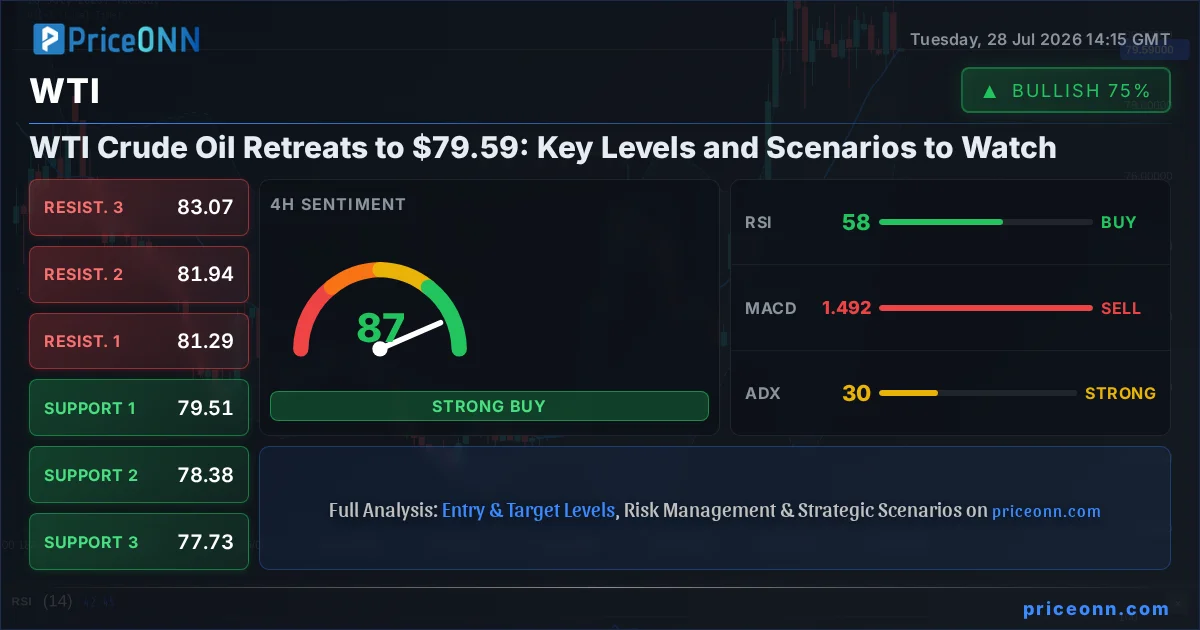
The price of WTI Crude Oil futures for July delivery suffered a substantial blow, shedding $5.89, or approximately 5.66%, to trade at $98.26 per barrel. This dramatic price movement underscores a significant shift in market sentiment as investors digest the latest developments in the protracted U.S.-Iran dispute.
The conflict, now in its 82nd day, has led to the effective closure of the vital Strait of Hormuz. This choke point is critical not only for oil transit but also for a substantial portion of global fertilizer supply. The halt in this trade route has raised alarms from the U.N. Food and Agriculture Organization, which warns of a potential global food price crisis if the situation persists.
Recent days have seen a fluctuating approach from U.S. President Donald Trump regarding the crisis. Initially oscillating between openness to negotiations and threats of military action, his pronouncements created an environment of uncertainty that kept investors on the sidelines. Last week, Trump indicated that a ceasefire order in April was made reluctantly, primarily at the behest of Pakistan and other Arab nations.
Following a series of strong statements on social media over the weekend, Trump issued a stark warning to Iran, urging swift action to reach a settlement or face severe consequences. This heightened pressure coincided with a reported 14-point proposal from Iran, conveyed via Pakistan, aimed at ending the hostilities. While the U.S. administration reviewed this proposal, Trump announced the cancellation of a planned large-scale military strike against Iran, citing a request from Gulf leaders.
Despite pausing the offensive, Trump reiterated that U.S. forces remained prepared for a massive retaliatory strike should a resolution not be achieved promptly. He emphasized the limited timeframe for a settlement, suggesting that strikes could resume if diplomatic progress faltered. In response, Iranian officials signaled a readiness to present unexpected outcomes, with the Islamic Revolutionary Guards Corps warning that any renewed conflict could spill beyond the Middle East.
President Trump himself stated he was not rushed to finalize a deal, yet characterized the conflict as being in its "final stages." He cryptically suggested that the outcome would either be a deal or "some things that are a little bit nasty," expressing hope that the latter would be avoided. Regarding U.S. ally Israel, Trump indicated Prime Minister Benjamin Netanyahu's alignment with his decisions on Iran.
Pakistan's Interior Minister Mohsin Naqvi has engaged in significant diplomatic shuttle diplomacy, visiting Iran for the second time recently to facilitate message exchanges as Iran reviews a new U.S. proposal. U.S. Vice President JD Vance affirmed that bilateral talks were progressing positively.
Inventory Data Shows Unexpected Drawdowns
Adding to the downward pressure on oil prices, recent inventory data revealed significant shifts in U.S. crude stockpiles. The American Petroleum Institute reported a surprising decrease of 9,100,000 barrels in U.S. crude oil inventories for the week ending May 15. This figure dramatically exceeded the consensus expectation of a 3,400,000-barrel draw and followed a 2,190,000-barrel decline in the preceding week.
Official figures from the U.S. Energy Information Administration confirmed a substantial drawdown of 7,860,000 barrels for the same period. The data also indicated a decrease of 1,548,000 barrels in gasoline inventories. However, distillate inventories saw a modest increase of 372,000 barrels, and heating oil stocks rose by 21,000 barrels.
Market Ripple Effects
The sharp decline in crude oil prices, driven by easing geopolitical tensions and surprising inventory data, has several implications for related markets. The immediate impact is felt across energy commodities, particularly affecting currencies of major oil-exporting nations. The Canadian Dollar (CAD), often sensitive to oil price fluctuations, may face headwinds as the commodity weakens.
Furthermore, the potential resolution of the U.S.-Iran conflict could reduce inflationary pressures stemming from energy supply disruptions. This might influence central bank policy expectations, potentially affecting the trajectory of interest rate hikes or cuts. Consequently, bond yields, particularly those sensitive to inflation expectations, could see adjustments.
Equity markets may also react. While lower energy costs could benefit consumers and certain industries, energy sector stocks might experience downward pressure. Investors will be closely monitoring the U.S. Dollar Index (DXY) for any signs of shifts in global risk appetite, as a de-escalation in geopolitical conflict often leads to reduced demand for safe-haven assets.
Track markets in real-time
Empower your investment decisions with AI-powered analysis, technical indicators and real-time price data.
Join Our Telegram Channel
Get breaking market news, AI analysis and trading signals delivered instantly to your Telegram.
Join Channel PriceONN News
WTI crude oil plunged by more than 7% on 27 July 2026 after the US suspended a series of strikes against Iran over the weekend, raising hopes of a diplomatic solution and the reopening of shipping through the Strait of Hormuz. Brent crude also fell below $90 per barrel. Meanwhile, Bloomberg reported […] The post WTI Analysis: Gap Breaks Short-Term Trend as Price Remains Trapped Between the Poc and Profile Boundary appeared first on ActionForex.
PriceONN News
(RTTNews) - Crude oil prices have gone into a tailspin on Monday, extending the losses from Friday's plunge after the U.S. halted nearly two weeks of military attacks against Iran following which near-term oil supply-disruption concerns reduced.
PriceONN News
Oil prices continued to trend lower in early Asian trade on Tuesday as a fourth night passed without any attacks from either Iran or the United States. At the time of writing, WTI crude was trading at $81.55 per barrel, down 1.28% on the session, while Brent crude had slipped to $87.36 per barrel, a decline of 1.13%. On Monday, President Trump sought to boost hopes of a diplomatic resolution between Washington and Tehran by claiming that the U.S. was engaged in "good talks" with Iran. Iranian...
PriceONN News
The Houthi threats to shipping in the Red Sea and its chokepoint, the Bab el-Mandeb Strait, have forced at least one oil tanker carrying Saudi crude to Asia to choose the much longer route through the Suez Canal, the Mediterranean, and around Africa. The supertanker Olympic Luck, partially laden with Saudi crude at Yanbu on the Red Sea, transited the Suez Canal into the Mediterranean late on Sunday, according to shipping data monitored by Bloomberg. The U-turn from Bab el-Mandeb indicates that...
PriceONN News
China is likely to have increased its crude oil imports this month, with the daily average at 7.8 million barrels, according to calculations by Kpler, as cited by Bloomberg. Refiners have been buying more Russian crude and have seen more tankers arrive from the Middle East, the report noted. The figure could add fuel to oil’s rally, as the July average would be a solid increase from the 6.2 million barrels daily that Chinese refiners imported in June. That was the lowest import rate for China...
PriceONN News
Oil prices plunged by more than 5% in early Asian trade on Monday as the U.S. and Iran halted attacks after two weeks of escalation that had driven Brent above $100. At the time of writing, WTI crude was trading at $84.47, down 5.39%, while Brent crude had fallen to $91.80, a decline of 5.15%. The retreat came after Washington signaled on Friday that it would temporarily halt its bombing campaign against Iran. Talking to Face the Nation on Sunday, U.S. Ambassador to the United Nations Mike...
PriceONN News
Less than a month ago, analysts were warning of a looming glut of crude oil as tanker traffic via the Strait of Hormuz began to recover amid a U.S.-Iran ceasefire. Within days of these warnings, the ceasefire was a painful memory, missiles were flying again, and now Yemen’s Houthis are striking tankers in the Red Sea, which makes two blocked oil chokepoints and a very real danger of a global recession. Brent crude this week topped $100 per barrel on reports that the Houthis had struck two Saudi...
PriceONN News
Crude oil prices are retreating after Brent hit $100 again last week as the United States and Iran took a break from hostilities over the weekend. Yet with the outcome of the war still highly uncertain, the outlook for stock markets has dimmed. Add to that Big Tech’s AI spending binge and fresh warnings about energy commodity shortages, and we are looking at extended market turbulence ahead. Last week saw a rare pile-up of adverse market developments that must have shaken the confidence of many...
PriceONN News
Tanker traffic through the Bab el-Mandeb Strait slumped to a multi-month low on Sunday amid Houthi attacks on Saudi oil infrastructure on the Red Sea coast. Only 11 tankers carrying commodities transited the Bab el-Mandeb chokepoint between the Red Sea and the Arabian Sea on Sunday, the lowest in months, according to Kpler’s shipping data cited by Reuters. Tanker traffic at the Red Sea started to slow a week ago after the Iran-aligned Houthis in Yemen announced a blockade on Saudi shipments and...
PriceONN News
European natural gas prices plunged by 8.6% at the open in Amsterdam on Monday as the United States paused strikes on Iran over the weekend and Tehran signaled a halt to retaliatory attacks across the Middle East. Hopes of de-escalation sank oil prices on Monday in Asian trade, too, with Brent Crude dropping to $90 per barrel. Europe’s benchmark natural gas prices, which had surged in the past two weeks amid the renewed hostilities, retreated on Monday from the multi-month highs of last week,...
PriceONN News
Oil prices gave up earlier gains on Friday after reports that Pakistan is trying to broker a return to U.S.-Iran nuclear negotiations. China is strongly backing the effort as the conflict and the closure of the Strait of Hormuz continue to threaten its energy security and weigh on its economy. Brent crude for September delivery fell 4.4% to trade at $96.36 per barrel at 1.35 pm ET while WTI crude for September delivery was down 3.6% to change hands at $88.86/bbl. However, Standard Chartered...
PriceONN News
U.S. airlines are grappling with soaring jet fuel costs again after the return of hostilities in the Middle East shattered the three-week-long U.S.-Iran ‘deal to make a deal’ and sent Brent crude oil prices soaring past $100 per barrel again. The U.S. jet fuel market has been tightening since March, although there haven’t been concerns about any shortages in America, unlike in Europe, which in April was supposed to run out of stockpiles within six weeks. Europe didn’t see shortages, but the...