
Did Gold Just Crash Below $4,600? Yields Surge, Fed Cut Bets Delayed

Gold (XAU/USD) experienced a dramatic sell-off, plummeting by more than 4.5% on Thursday, trading below the critical $4,600 level. This sharp retreat marks a significant shift in market sentiment for the precious metal, which has recently benefited from its safe-haven status.
Market Context
The precious metal's rapid descent occurred as U.S. Treasury yields surged, reflecting growing investor unease. A robust U.S. jobs report released earlier in the week bolstered the narrative of a resilient economy, prompting a significant repricing of Federal Reserve interest rate expectations. Traders have now largely priced out any possibility of a rate cut in 2026, with the first potential reduction pushed back to 2027. This hawkish shift in monetary policy expectations directly impacts gold, an asset that typically struggles in an environment of rising borrowing costs and stronger currency valuations.
Analysis & Drivers
Several key factors converged to pressure gold prices. The primary driver was the sharp increase in U.S. Treasury yields. As yields on government debt rise, they offer a more attractive risk-free return, diminishing the appeal of non-yielding assets like gold. This yield differential is a critical determinant of gold's price action. Furthermore, the persistent concern over high energy prices, while not explicitly detailed in recent data, often contributes to broader inflationary pressures. Such an environment can paradoxically support gold as an inflation hedge, but the immediate impact of rising yields and delayed Fed cuts overshadowed this potential upside. The inverse correlation between gold and the U.S. Dollar also played a role; a stronger dollar, often a byproduct of higher U.S. interest rates, makes gold more expensive for holders of other currencies, thus dampening demand. Historically, central banks have been significant buyers of gold, adding substantial reserves as a hedge against currency depreciation and economic uncertainty. However, even these institutional buyers may pause or re-evaluate positions amid a backdrop of rising yields and a potentially stronger dollar.
Trader Implications
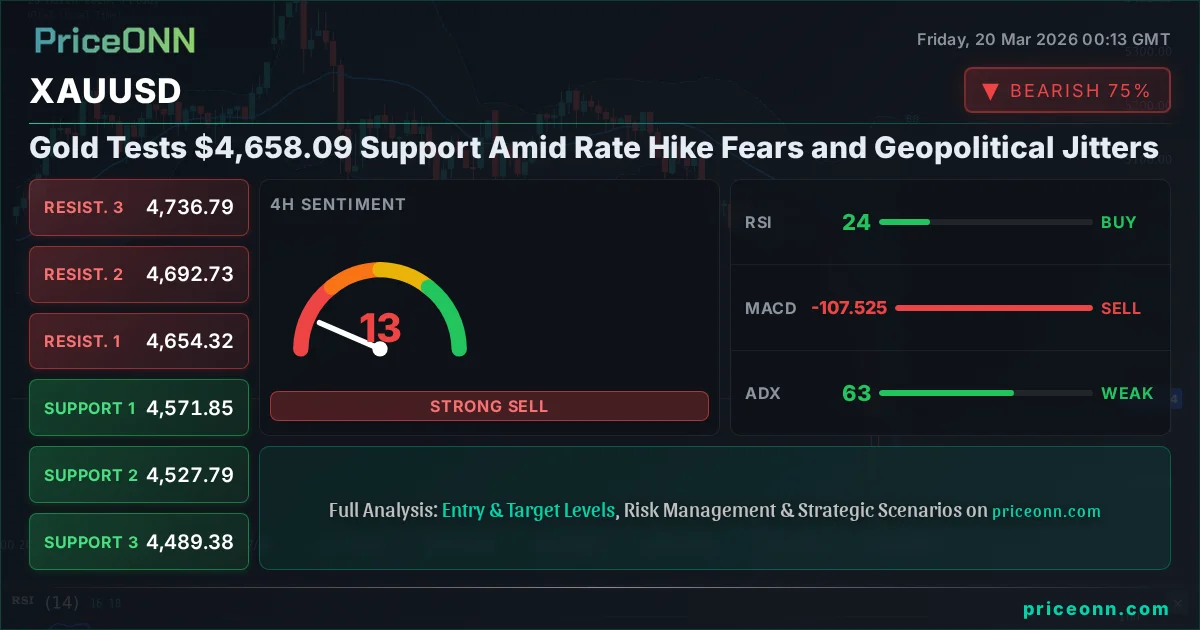
For traders, the break below $4,600 is a significant technical development. Key levels to watch include immediate support around $4,550 and a more substantial floor potentially forming near $4,500. A sustained move below this latter level could signal further downside. On the upside, resistance may be encountered back towards the $4,700-$4,750 range. The primary risk factor remains the path of U.S. interest rates and the strength of the U.S. Dollar. Traders should closely monitor upcoming economic data, particularly inflation reports and employment figures, for any signs that might alter the Federal Reserve's hawkish stance. Geopolitical events could offer temporary support for gold due to its safe-haven appeal, but the dominant trend appears to be dictated by monetary policy and yield movements. A prudent approach would involve looking for confirmation of a bottoming pattern before considering long positions, or alternatively, looking for opportunities to short rallies if the bearish momentum continues.
Outlook
The immediate outlook for gold remains cautious. The shift in Fed rate cut expectations to 2027 suggests a higher-for-longer interest rate environment, which is structurally bearish for gold. While the precious metal's role as an inflation hedge and safe haven is well-established, its performance is currently being overshadowed by yield dynamics. Any significant geopolitical escalation could provide a temporary reprieve, but without a clear pivot from the Federal Reserve or a substantial weakening of the U.S. Dollar, gold may struggle to regain its upward momentum in the short to medium term. Traders should remain vigilant for any data that challenges the current hawkish narrative.
Frequently Asked Questions
What caused gold to fall below $4,600?
Gold dropped over 4.5% below $4,600 primarily due to a surge in U.S. Treasury yields and a reassessment of Federal Reserve rate cut timelines. Investors are now anticipating the first rate cut in 2027, making higher-yielding assets more attractive than gold.
What are the key support and resistance levels for gold?
Immediate support for gold is seen around $4,550, with a more critical floor at $4,500. On the upside, traders should watch for resistance near the $4,700-$4,750 area.
What is the outlook for gold prices given the Fed's delayed rate cut expectations?
The outlook is cautious, as a higher-for-longer interest rate environment is generally bearish for gold. While safe-haven demand can offer support, the current trend suggests gold may face headwinds until the Federal Reserve signals a shift in its monetary policy stance.
Track markets in real-time
Empower your investment decisions with AI-powered analysis, technical indicators and real-time price data.
Join Our Telegram Channel
Get breaking market news, AI analysis and trading signals delivered instantly to your Telegram.
Join Channel


PriceONN