
Is Gold's Safe-Haven Status Fading as Rate Hike Fears Intensify?
Gold (XAU/USD) has experienced a sharp decline, hitting its lowest point in over a month as market sentiment shifts decisively towards the Federal Reserve's anti-inflation stance, even amidst ongoing geopolitical instability.
Market Context
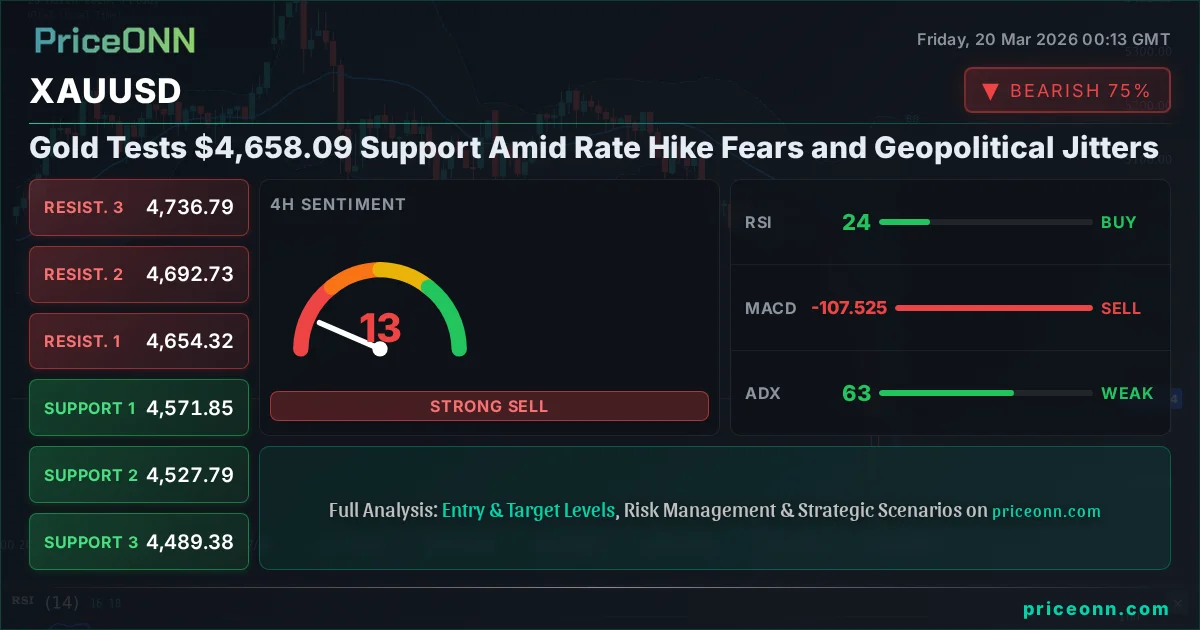
The yellow metal broke below critical support levels on Thursday, trading at its weakest point in more than 30 days. This significant price action reflects a recalibration of investor priorities, with the prospect of higher interest rates now taking precedence over gold's traditional role as a safe-haven asset. While geopolitical tensions in the Middle East remain a persistent concern, they are currently insufficient to counterbalance the potent influence of anticipated monetary policy tightening.
Historically, gold has been a cornerstone of value and a hedge against economic uncertainty and currency erosion. Its intrinsic value, independent of any single government, has made it a preferred asset during times of global instability. Central banks globally recognize this. In 2022, official reserves saw a record accumulation of 1,136 tonnes of gold, valued at approximately $70 billion, with emerging economies like China, India, and Turkey leading the acquisitions. This strategic move by central banks typically aims to bolster currency strength and demonstrate economic resilience.
The typical inverse relationship between gold and the US Dollar, where a weaker dollar usually boosts gold prices, appears to be taking a backseat. Similarly, robust stock market performance often correlates with softer gold prices, while market sell-offs can propel gold higher. However, the current dominant narrative is centered on interest rates.
Analysis & Drivers
The primary driver behind gold's current weakness is the perceived hawkish outlook from the Federal Reserve. As an asset that generates no yield, gold becomes significantly less attractive when interest-bearing assets, such as US Treasuries, offer higher returns. Market data indicates a growing expectation that the Fed may maintain a tighter monetary policy for longer than previously anticipated, or even consider further rate hikes to ensure inflation is fully subdued. This prospect directly competes with gold's appeal, drawing capital away from the precious metal.
Geopolitical events, while typically supportive of gold, are currently failing to ignite significant safe-haven demand. The ongoing conflict in the Middle East, which historically would spur substantial buying pressure on gold, is being overshadowed by domestic economic policy concerns. This suggests that while external risks remain, the internal economic outlook and central bank policy are the dominant forces shaping market sentiment for gold at this juncture.
Trader Implications
Traders should be closely monitoring Federal Reserve communications for any further signals regarding monetary policy direction. Key price levels to watch include the recent low around $2,150 per ounce. A sustained break below this level could signal further downside potential towards the $2,100 mark. Conversely, any indication of a dovish pivot from the Fed or a significant escalation in geopolitical tensions could trigger a swift recovery, with immediate resistance likely found near the $2,200 level.
The current market environment suggests that short-term trading strategies might favor bearish positions on gold as long as the hawkish Fed narrative persists. However, long-term investors may see current price levels as an attractive entry point, given gold's historical performance during periods of economic uncertainty and its role as a diversifier. Risk management through strict stop-loss orders is crucial, given the potential for rapid price reversals based on central bank pronouncements or unexpected geopolitical developments.
Outlook
The immediate outlook for gold remains cautious, contingent on the Federal Reserve's policy trajectory and the evolving geopolitical landscape. Should the Fed maintain its hawkish stance, gold prices could face further pressure. However, any sign of inflation cooling faster than expected or a de-escalation of global conflicts could quickly shift sentiment back in favor of the precious metal. Upcoming economic data releases, particularly inflation and employment figures, will be critical in shaping the Fed's next moves and, consequently, gold's price path.
Frequently Asked Questions
What caused gold prices to fall to a one-month low?
Gold prices have fallen to a one-month low, trading below $2,150 per ounce, primarily due to a hawkish outlook from the Federal Reserve. Renewed concerns about interest rates outweighing geopolitical risks have driven this decline.
How do Federal Reserve policy expectations impact gold?
When the Federal Reserve signals a hawkish stance or higher interest rates, gold becomes less attractive. As a non-yielding asset, it cannot compete with the higher returns offered by interest-bearing investments like bonds, leading to potential price drops.
What are the key levels to watch for gold traders?
Traders should watch the recent support level near $2,150. A break below this could lead to a test of $2,100. Resistance is likely near $2,200, with a decisive move above this level potentially signaling a trend reversal.
Track markets in real-time
Empower your investment decisions with AI-powered analysis, technical indicators and real-time price data.
Join Our Telegram Channel
Get breaking market news, AI analysis and trading signals delivered instantly to your Telegram.
Join Channel
PriceONN