
Why Did Gold Prices Tumble Below $4,850 Amid Fed Rate Hike Fears?

Gold (XAU/USD) has experienced a significant downturn, breaking below key support levels and settling at its weakest point in over a month. The precious metal, historically a bastion of value and a hedge against uncertainty, is currently trading below $4,850 as market participants recalibrate their expectations for future monetary policy.
Market Context
The yellow metal's decline underscores a shift in market sentiment, where the Federal Reserve's commitment to combating inflation is taking precedence over gold's traditional role as a safe-haven asset. This is occurring even as geopolitical friction persists in the Middle East. For millennia, gold has been a cornerstone of value, serving as a reliable medium of exchange and a critical hedge against economic instability. Its appeal is particularly pronounced during periods of global unrest or currency devaluation. Unlike fiat currencies, gold's intrinsic value is not tied to any single government or central bank, offering a unique layer of security.
Analysis & Drivers
The primary driver behind gold's recent weakness appears to be the anticipation of a hawkish stance from the Federal Reserve. As an asset that generates no yield, gold becomes less attractive when interest rates are high or expected to remain elevated. This makes fixed-income assets like US Treasuries more appealing to investors seeking returns. Market data shows that central banks have been significant buyers of gold, with a record 1,136 tonnes, valued at approximately $70 billion, added to official reserves in 2022, according to industry reports. Emerging economies, including China, India, and Turkey, have been leading this accumulation. While this indicates strong underlying institutional demand, short-term price action is being dominated by interest rate differentials. The historical inverse relationship between gold and the US Dollar also plays a role; a strengthening dollar typically exerts downward pressure on gold prices, and recent Fed rhetoric has supported dollar strength.
Trader Implications
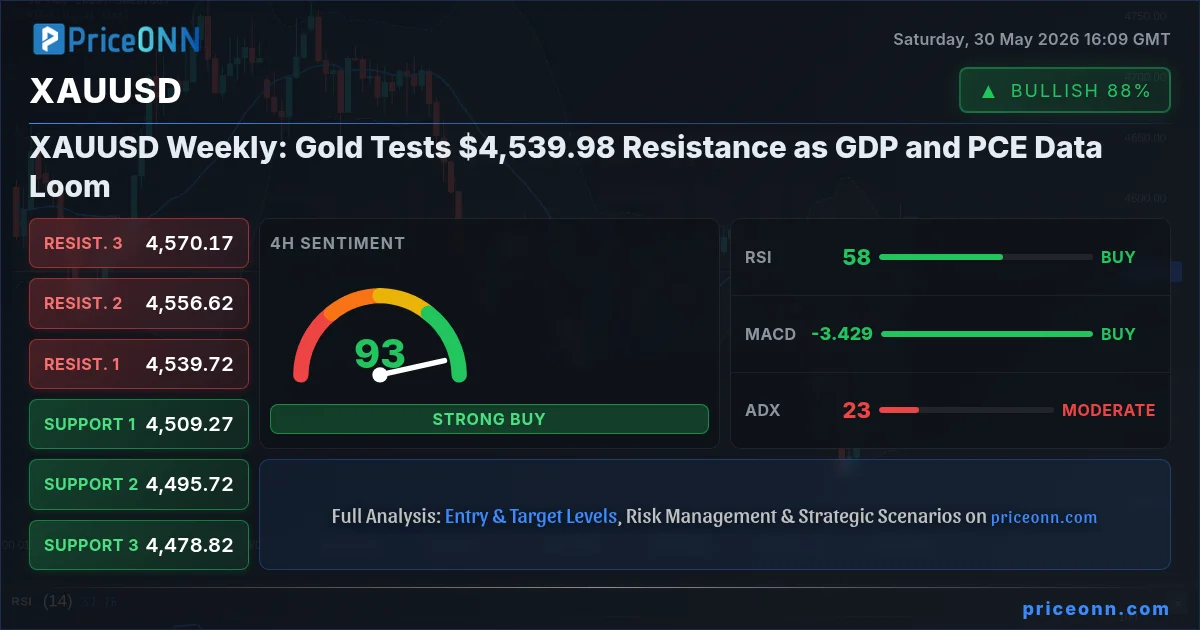
Traders should closely monitor the Federal Reserve's upcoming communications for any further signals regarding interest rate policy. Key price levels to watch for gold include the recent low around $4,830 as immediate support. A sustained break below this could open the door for further declines towards the $4,700 psychological level. On the upside, a move back above $4,900 would be needed to signal a potential reversal. Geopolitical developments remain a wildcard that could quickly shift market sentiment back towards safe-haven demand, but for now, the interest rate narrative is dominant. Investors looking to hedge against inflation might find current price levels attractive for long-term accumulation, but short-term volatility is expected.
Outlook
The immediate outlook for gold remains cautious, contingent on the Federal Reserve's monetary policy path and incoming economic data. Should inflation show signs of persistent stickiness, leading the Fed to maintain a hawkish stance or even consider further tightening, gold could face additional headwinds. Conversely, any indication of a pivot or a pause in rate hikes, especially if accompanied by rising geopolitical risks, could reignite demand for the precious metal. Upcoming inflation reports and central bank speeches will be critical in shaping market expectations and guiding gold's trajectory in the coming weeks.
Frequently Asked Questions
What is the current support level for gold prices?
Gold prices are currently testing support near the recent low of $4,830. A decisive break below this level could lead to further price depreciation towards the $4,700 mark.
Why are higher interest rates bad for gold?
Gold is a non-yielding asset, meaning it does not generate interest income. When interest rates rise, assets like bonds and savings accounts become more attractive as they offer higher returns, making gold relatively less appealing to investors.
What is the outlook for gold prices in the short term?
The short-term outlook for gold remains subdued, largely dependent on the Federal Reserve's monetary policy decisions. Further hawkish signals could pressure prices lower, while signs of a Fed pivot or escalating geopolitical tensions might support a recovery above $4,900.
Track markets in real-time
Empower your investment decisions with AI-powered analysis, technical indicators and real-time price data.
Join Our Telegram Channel
Get breaking market news, AI analysis and trading signals delivered instantly to your Telegram.
Join Channel PriceONN News
Gold prices retreated to $4,504.30 per troy ounce despite ongoing geopolitical tensions and the closure of the Strait of Hormuz, suggesting a complex market dynamic beyond typical safe-haven demand. Silver, however, managed a modest gain.
PriceONN News
(RTTNews) - Gold prices traded lower on Friday and headed for a weekly loss despite renewed optimism about U.S.-Iran talks. Both the sides are still at odds over Tehran's uranium stockpile and future control of the Strait of Hormuz.
PriceONN News
Gold futures broke above $4,500 per ounce on Friday, driven by increasing optimism for a de-escalation in the U.S.-Iran conflict and the potential reopening of the Strait of Hormuz. Silver also saw significant gains, reflecting a broader shift towards precious metals as geopolitical tensions ease.
PriceONN News
Gold prices experienced a significant decline on Wednesday, falling over 1% as diplomatic optimism surrounding U.S.-Iran talks grew, despite ongoing military actions. The June gold contract settled at $4,444.50.
PriceONN News
Gold prices experienced a significant downturn, shedding 2% this week to settle near $4,444.50 per ounce. This decline is attributed to evolving U.S.-Iran diplomatic efforts and concerns over potential central bank rate hikes.
PriceONN News
(RTTNews) - Gold prices traded lower on Wednesday, extending losses from the previous session as investors fretted about oil-driven inflation and the potential impact on interest rates.
PriceONN News
Gold prices are facing intense scrutiny at the critical $4500 per ounce support level, even as industrial metals like copper surge and the US dollar softens amid renewed geopolitical optimism.
PriceONN News
Gold prices surged by 1% to approximately $4,556 on Monday as market participants reacted to developing news of a potential US-Iran peace deal. The speculation weakened the US Dollar and sent oil prices tumbling.
PriceONN News
Gold prices are under intense scrutiny as they hover around the critical $4500 per ounce support level. The precious metal faces pressure from a risk-on environment, despite a weaker dollar and strength in industrial commodities like copper.
PriceONN News
Gold prices fell on Friday as concerns over crude oil inventories and the prolonged closure of the Strait of Hormuz fueled inflation anxieties, overshadowing U.S.-Iran peace talks. The June Comex Gold contract settled down 0.55% at $4,517.40.
PriceONN News
(RTTNews) - Gold dipped toward $4,500 an ounce on Thursday, weighed down by a firm dollar and higher Treasury yields.
PriceONN News
(RTTNews) - Gold prices were little changed on Wednesday, recouping early losses despite a stronger dollar and higher U.S. Treasury yields.