Gold extends losses as Fed hawkish outlook weighs
Yellow Metal Under Pressure as Interest Rate Fears Mount
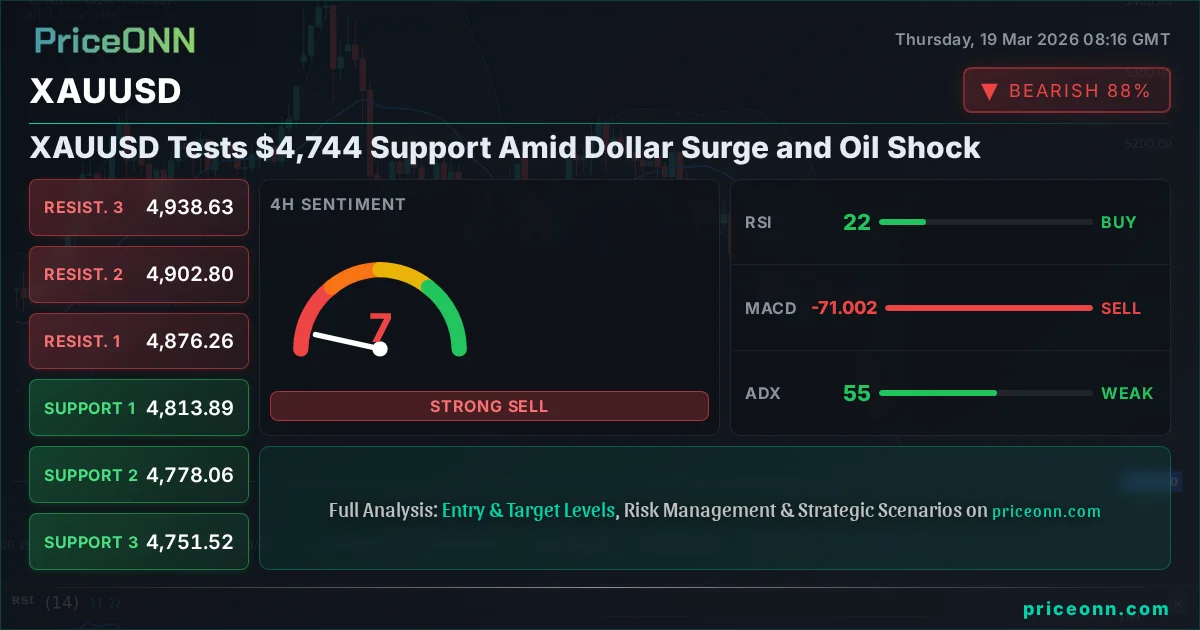
The precious metal known as gold experienced a significant downturn on Thursday, breaking below key support levels and settling at its weakest point in more than 30 days. This decline comes as market participants recalibrate their expectations for future monetary policy, prioritizing the Federal Reserve's commitment to combating inflation over traditional safe-haven demand, even with persistent geopolitical friction in the Middle East.
Historically, gold has served as a cornerstone of value, a reliable medium for exchange, and a critical hedge against economic uncertainty. Its appeal as a safe asset is particularly pronounced during periods of global instability or when currency values are eroding. Unlike fiat currencies, gold's intrinsic value is not tied to any single government or central bank, providing a unique layer of security.
Central banks globally recognize this inherent stability. In 2022, a record 1,136 tonnes of gold, valued at approximately $70 billion, were added to official reserves, according to data from the World Gold Council. This marked the largest annual accumulation since records began, with emerging economies like China, India, and Turkey leading the charge in bolstering their gold holdings. Such acquisitions are often strategic moves to enhance currency strength and demonstrate economic resilience.
The interplay between gold, the US Dollar, and US Treasuries is well documented. Typically, a weakening dollar bolsters gold prices, offering investors and central banks a valuable diversification tool. Conversely, a strong dollar tends to exert downward pressure on the yellow metal. This inverse relationship also extends to risk assets; robust stock market performance often correlates with softer gold prices, while market sell-offs can propel gold higher.
However, the prevailing narrative now centers on interest rates. As an asset that generates no yield, gold becomes less attractive when borrowing costs rise. The prospect of prolonged higher interest rates, driven by the Fed's hawkish rhetoric, is significantly dampening demand for the non-yielding metal. While geopolitical events can still spark short-term rallies, the dominant force currently dictating gold's trajectory is the anticipation of sustained tight monetary policy.
Reading Between the Lines
The recent slide in gold prices is not merely a reaction to immediate market sentiment; it reflects a deeper shift in investor priorities. For months, geopolitical tensions and a simmering fear of recession provided a solid floor for gold. Central bank buying added another layer of fundamental support. Yet, the persistent messaging from the Federal Reserve about its unwavering focus on inflation control is now the dominant theme, overriding these other factors.
The market data shows a clear recalibration. Traders are pricing in a scenario where interest rates remain elevated for longer than previously anticipated. This makes holding an asset like gold, which offers no yield, increasingly costly from an opportunity cost perspective. The US dollar's strength, often a byproduct of higher US interest rates, further exacerbates this pressure on gold, as the commodity is priced in dollars.
The implications are significant. While gold's role as a safe haven is unlikely to disappear, its effectiveness is being temporarily overshadowed. Investors are being forced to weigh the tangible benefit of potential interest rate hikes against the more abstract security of gold during uncertain times. This tension is creating a challenging environment for gold bulls.
Market Ripple Effects
This sustained pressure on gold prices has broader implications across financial markets. The US Dollar Index (DXY), which often moves inversely to gold, may find further support if the Fed's hawkish stance continues to attract capital. Investors seeking stability might increasingly favor dollar-denominated assets or even US Treasury yields, which are now offering more attractive returns.
The performance of equities, particularly growth-oriented tech stocks that are sensitive to interest rate changes, could also be indirectly affected. Higher rates can reduce the present value of future earnings, posing a headwind for these sectors. Conversely, sectors that benefit from a strong dollar or that are less sensitive to interest rate hikes might see relative outperformance.
Furthermore, the outlook for inflation expectations is closely watched. While gold is traditionally seen as an inflation hedge, its current struggle suggests that market participants believe central banks will ultimately succeed in taming price pressures, even if it means enduring a period of higher interest rates. This narrative could temper demand for other inflation-sensitive assets as well.
Track markets in real-time
Empower your investment decisions with AI-powered analysis, technical indicators and real-time price data.
Join Our Telegram Channel
Get breaking market news, AI analysis and trading signals delivered instantly to your Telegram.
Join Channel