
Gold Tests $4,800 Amid Fed Rate Pause and Geopolitical Jitters


Gold (XAU/USD) experienced a notable price correction, touching a one-month low of approximately $4,800 during early Asian trading on Thursday. This retreat follows the Federal Reserve's decision to maintain interest rates at their current levels, a move that typically lessens the appeal of non-yielding assets like gold. However, a concurrent downtick in the US Dollar and lingering geopolitical uncertainties provided a floor for the precious metal, triggering a modest recovery from its session lows.
Market Context
The precious metal found itself under selling pressure, trading near the $4,830 mark in the early Asian session on Thursday. The catalyst for this decline appears to be the Federal Reserve's recent monetary policy announcement, where it kept interest rates unchanged. While this decision might ordinarily boost gold by making it relatively more attractive compared to interest-bearing assets, the market's immediate reaction suggested other factors were at play or that the Fed's stance was already priced in. Historically, gold has maintained its status as a premier safe-haven asset, a role it plays during times of economic instability and heightened geopolitical risk. Its ability to act as a hedge against inflation and currency devaluation further solidifies its appeal. The inverse correlation often observed between gold and the US Dollar means that a weakening dollar typically supports gold prices, a dynamic that provided some solace to gold bulls on Thursday.
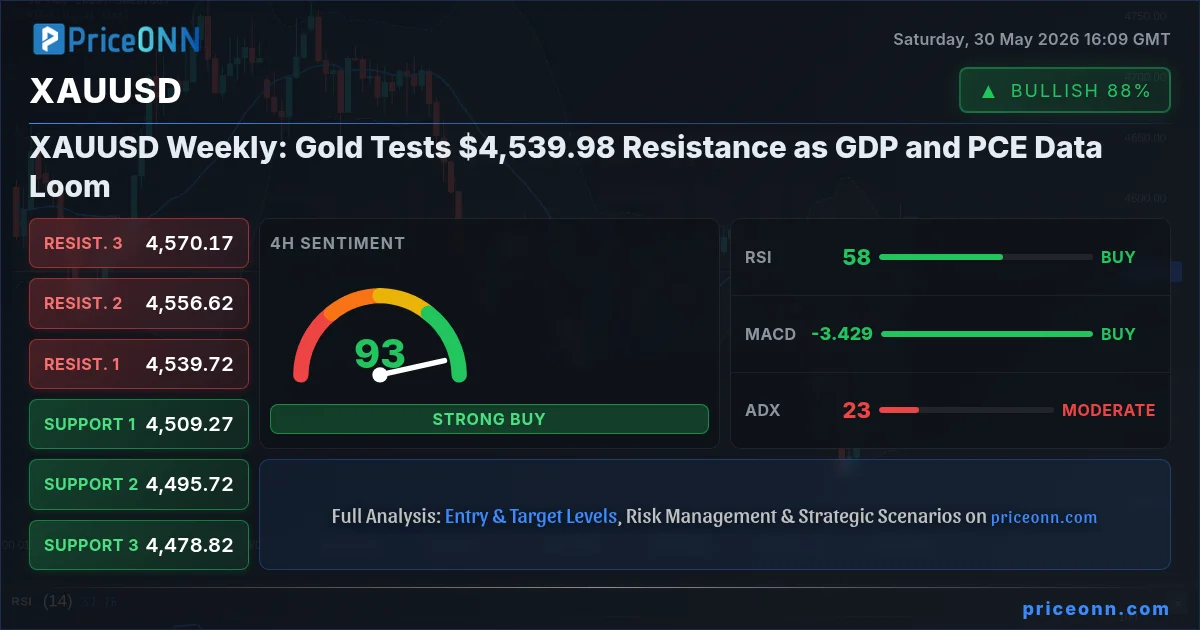
Analysis & Drivers
The Federal Reserve's decision to hold interest rates steady, while not surprising, removed a potential catalyst for further gold appreciation. Central banks globally continue to be significant players in the gold market. In 2022, central banks collectively amassed an unprecedented 1,136 tonnes of gold, a purchase valued at approximately $70 billion, according to industry data. This trend, the largest annual accumulation on record, highlights a strategic diversification by emerging economies like China, India, and Turkey, seeking to bolster their reserves and enhance financial stability. This sustained institutional demand provides a fundamental underpinning for gold prices, acting as a counterbalance to short-term price pressures. Geopolitical tensions, though not explicitly detailed in recent reports, often serve as a significant driver for gold, as investors seek refuge from potential global conflicts or economic fallout. The interplay between gold, the US Dollar, and US Treasuries remains a critical factor. Gold typically moves inversely to the dollar and Treasuries, both of which are also considered safe-haven assets. A softer dollar on Thursday provided a supportive, albeit limited, tailwind for gold.
Trader Implications
Traders should closely monitor the $4,800 level, which has acted as a support zone. A sustained break below this psychological and technical level could signal further downside, potentially targeting the $4,750 mark. Conversely, a rebound above $4,850 could indicate a resumption of the bullish trend, with eyes potentially turning towards $4,900 and beyond. The US Dollar Index (DXY) will be a key indicator to watch; any further weakness could propel gold higher. Additionally, developments in geopolitical hotspots could introduce significant volatility, favoring gold as a safe haven. Traders should consider maintaining a balanced approach, acknowledging both the headwinds from steady Fed rates and the tailwinds from safe-haven demand and currency fluctuations.
Outlook
Looking ahead, gold prices are likely to remain sensitive to the Federal Reserve's forward guidance on interest rates and any escalation in global geopolitical risks. While the recent dip to a one-month low near $4,800 presents a test of support, the underlying demand from central banks and its role as an inflation hedge suggest that significant downward pressure may be limited. Traders will be keenly watching upcoming economic data releases for clues on inflation and economic growth, which will influence future monetary policy decisions and, consequently, gold's trajectory. A sustained period of geopolitical unease could easily see gold reclaim higher ground, potentially challenging resistance levels around $4,950 in the coming weeks.
Frequently Asked Questions
What is the current support level for Gold (XAU/USD)?
The immediate support level for Gold (XAU/USD) is around $4,800. This level was tested on Thursday, and a sustained break below it could lead to further declines towards $4,750.
Why did Gold fall despite the Fed holding rates steady?
While a steady Fed rate might typically support gold, the initial price reaction near $4,830 suggests other factors, such as market anticipation or the absence of dovish signals, were at play. Geopolitical concerns and USD movements also influenced the price action.
What is the outlook for Gold prices in the short term?
The outlook for gold remains mixed, balancing steady interest rates against geopolitical risks. Key resistance lies at $4,850 and $4,900, while support is seen at $4,800. Escalating global tensions could push prices towards $4,950.
Track markets in real-time
Empower your investment decisions with AI-powered analysis, technical indicators and real-time price data.
Join Our Telegram Channel
Get breaking market news, AI analysis and trading signals delivered instantly to your Telegram.
Join Channel PriceONN News
Gold prices experienced a significant decline on Wednesday, falling over 1% as diplomatic optimism surrounding U.S.-Iran talks grew, despite ongoing military actions. The June gold contract settled at $4,444.50.
PriceONN News
Gold futures broke above $4,500 per ounce on Friday, driven by increasing optimism for a de-escalation in the U.S.-Iran conflict and the potential reopening of the Strait of Hormuz. Silver also saw significant gains, reflecting a broader shift towards precious metals as geopolitical tensions ease.
PriceONN News
Gold prices experienced a significant downturn, shedding 2% this week to settle near $4,444.50 per ounce. This decline is attributed to evolving U.S.-Iran diplomatic efforts and concerns over potential central bank rate hikes.
PriceONN News
Gold prices retreated to $4,504.30 per troy ounce despite ongoing geopolitical tensions and the closure of the Strait of Hormuz, suggesting a complex market dynamic beyond typical safe-haven demand. Silver, however, managed a modest gain.
PriceONN News
Gold prices fell on Friday as concerns over crude oil inventories and the prolonged closure of the Strait of Hormuz fueled inflation anxieties, overshadowing U.S.-Iran peace talks. The June Comex Gold contract settled down 0.55% at $4,517.40.
PriceONN News
(RTTNews) - Gold dipped toward $4,500 an ounce on Thursday, weighed down by a firm dollar and higher Treasury yields.
PriceONN News
(RTTNews) - Gold prices have soared on Friday amid rising optimism about an end to the Middle East war with the chances of reopening of the Strait of Hormuz and resumption of oil and energy trade growing stronger.
PriceONN News
(RTTNews) - After moving sharply lower earlier in the day, the price of gold has shown a significant turnaround over the course of the trading session on Thursday.
PriceONN News
Gold prices fell below the $4500 mark on Wednesday, extending previous losses as oil prices tumbled and geopolitical tensions between the US and Iran remained a key market driver. Investors are weighing inflation concerns against hopes of de-escalation.
PriceONN News
(RTTNews) - Extending the losses from yesterday's session, gold prices have slumped on Wednesday as traders watch the ongoing efforts to end the U.S.-Iran standoff with cautious optimism while the blockade on the Strait of Hormuz continues. The rising inflationary pressure weighe
PriceONN News
(RTTNews) - Gold prices traded lower on Wednesday, extending losses from the previous session as investors fretted about oil-driven inflation and the potential impact on interest rates.
PriceONN News
(RTTNews) - Gold prices have edged lower on Tuesday amid renewed concerns of inflationary pressure following fresh U.S. military strikes on Iran yesterday while the Strait of Hormuz remains closed for oil and energy transit.