
Gold falls below $4,850 as Fed holds rates steady
 PriceONN Editorial Desk
Multi-source verification
PriceONN Editorial Desk
Multi-source verification
Gold's Enduring Appeal and Shifting Market Dynamics
For millennia, gold has captivated humanity, serving as a bedrock for value storage and a universally accepted medium of exchange. Beyond its aesthetic appeal and use in adornments, the precious metal is now predominantly recognized as a premier safe-haven asset. This status means it's often sought after as a sanctuary for capital during periods of economic uncertainty and market turmoil.
Furthermore, gold is widely regarded as a potent hedge against the erosive effects of inflation and the devaluation of national currencies. Its intrinsic value is not tethered to any single government or issuer, providing a unique layer of security. This characteristic makes it particularly attractive in an era of fluctuating global economic stability.
Central Banks' Growing Gold Appetite
The most significant accumulation of gold resides with central banks, who strategically bolster their reserves to fortify their currencies and signal economic resilience. By increasing gold holdings, these institutions aim to enhance the perceived strength and stability of their national economies and currencies, especially during volatile times. A substantial gold reserve can serve as a powerful indicator of a nation's financial solvency and trustworthiness in the global marketplace.
Recent data from the World Gold Council reveals a striking trend: central banks collectively acquired a staggering 1,136 tonnes of gold in 2022. This acquisition, valued at approximately $70 billion, represents the highest annual purchase volume since record-keeping began. This surge in demand is particularly pronounced among emerging economies, with nations like China, India, and Turkey actively expanding their gold reserves at an accelerated pace.
Interplay with Global Financial Instruments
Gold's price trajectory often moves in opposition to key global financial benchmarks, most notably the US Dollar and US Treasuries. Both the dollar and Treasuries are themselves considered major safe-haven assets and primary reserve instruments. Consequently, when the US Dollar weakens, gold prices typically see an upward movement, offering investors and central banks a valuable avenue for asset diversification amidst turbulent financial landscapes.
The precious metal also exhibits an inverse correlation with riskier assets, such as equities. A robust rally in the stock market often coincides with a softening of gold prices. Conversely, significant sell-offs in riskier market segments tend to boost the appeal and price of gold, as investors pivot towards perceived safety.
Several factors can influence gold's price. Heightened geopolitical tensions or widespread fears of a severe economic downturn can rapidly drive gold prices higher, a direct consequence of its established safe-haven status. As an asset that generates no yield, gold traditionally performs better in an environment of declining interest rates. Conversely, a rise in the cost of borrowing money typically exerts downward pressure on the yellow metal.
However, the behavior of the US Dollar remains a paramount driver for gold prices, given that the commodity is priced in dollars (XAU/USD). A strong dollar tends to cap gold's upward potential, while a weakening dollar is a potent catalyst for pushing gold prices higher.
Reading Between the Lines
The Federal Reserve's decision to hold interest rates steady, as anticipated, has created a stable backdrop for financial markets. However, this steady stance by the Fed, while predictable, removes a potential catalyst for gold's upside. Gold's inverse relationship with interest rates means that while rates aren't rising, they also aren't falling, which would typically provide a stronger tailwind. The current environment suggests that other macro factors will likely dominate gold's price action in the near term.
Traders will be closely watching the US Dollar Index (DXY) for signs of weakness, which could reignite demand for gold. Additionally, ongoing geopolitical developments and inflation data releases will be critical. Should inflation prove stickier than expected, it could eventually force the Fed's hand or at least increase gold's appeal as an inflation hedge, despite the current steady rate policy. The recent substantial purchases by central banks underscore a long-term structural demand for the metal, providing a supportive floor.
The implications for portfolios are nuanced. While the lack of immediate rate cut catalysts limits aggressive upside, the underlying safe-haven demand, coupled with potential inflation persistence, offers a degree of protection. Investors might consider gold as a diversifier against equity market volatility or currency debasement concerns. Key levels to monitor include the recent highs around $4,850 and potential support near $4,750.
The interconnectedness of gold with the US Dollar, Treasury yields, and global risk sentiment means that movements in these markets will directly impact gold. For instance, a sudden spike in Treasury yields could pressure gold, while a sharp decline in equity markets might see a safe-haven bid return. Keep an eye on emerging market currencies as well, as significant depreciation there could spur further central bank gold buying.
Track markets in real-time
Empower your investment decisions with AI-powered analysis, technical indicators and real-time price data.
Join Our Telegram Channel
Get breaking market news, AI analysis and trading signals delivered instantly to your Telegram.
Join Channel PriceONN News
(RTTNews) - Gold prices traded lower on Friday and headed for a weekly loss despite renewed optimism about U.S.-Iran talks. Both the sides are still at odds over Tehran's uranium stockpile and future control of the Strait of Hormuz.
PriceONN News
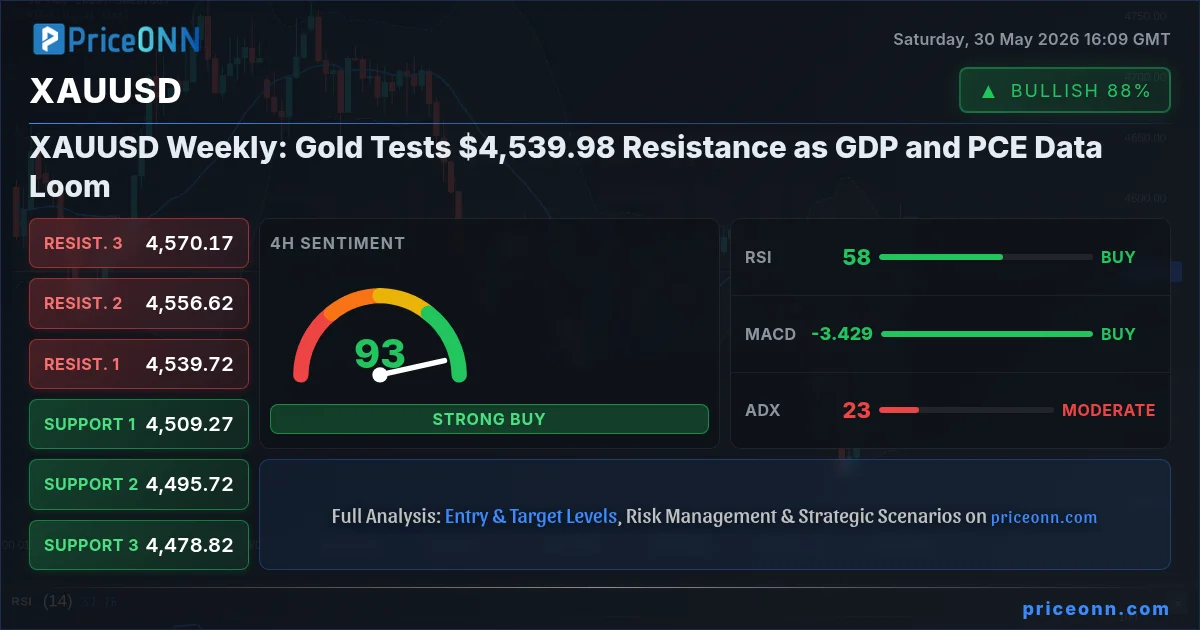
Gold futures broke above $4,500 per ounce on Friday, driven by increasing optimism for a de-escalation in the U.S.-Iran conflict and the potential reopening of the Strait of Hormuz. Silver also saw significant gains, reflecting a broader shift towards precious metals as geopolitical tensions ease.
PriceONN News
Gold prices experienced a significant decline on Wednesday, falling over 1% as diplomatic optimism surrounding U.S.-Iran talks grew, despite ongoing military actions. The June gold contract settled at $4,444.50.
PriceONN News
Gold prices experienced a significant downturn, shedding 2% this week to settle near $4,444.50 per ounce. This decline is attributed to evolving U.S.-Iran diplomatic efforts and concerns over potential central bank rate hikes.
PriceONN News
(RTTNews) - Gold prices traded lower on Wednesday, extending losses from the previous session as investors fretted about oil-driven inflation and the potential impact on interest rates.
PriceONN News
Gold prices retreated to $4,504.30 per troy ounce despite ongoing geopolitical tensions and the closure of the Strait of Hormuz, suggesting a complex market dynamic beyond typical safe-haven demand. Silver, however, managed a modest gain.
PriceONN News
Gold prices are facing intense scrutiny at the critical $4500 per ounce support level, even as industrial metals like copper surge and the US dollar softens amid renewed geopolitical optimism.
PriceONN News
Gold prices are under intense scrutiny as they hover around the critical $4500 per ounce support level. The precious metal faces pressure from a risk-on environment, despite a weaker dollar and strength in industrial commodities like copper.
PriceONN News
Gold prices fell on Friday as concerns over crude oil inventories and the prolonged closure of the Strait of Hormuz fueled inflation anxieties, overshadowing U.S.-Iran peace talks. The June Comex Gold contract settled down 0.55% at $4,517.40.
PriceONN News
(RTTNews) - Gold dipped toward $4,500 an ounce on Thursday, weighed down by a firm dollar and higher Treasury yields.
PriceONN News
(RTTNews) - Gold prices were little changed on Wednesday, recouping early losses despite a stronger dollar and higher U.S. Treasury yields.
PriceONN News
(RTTNews) - Gold prices have soared on Friday amid rising optimism about an end to the Middle East war with the chances of reopening of the Strait of Hormuz and resumption of oil and energy trade growing stronger.