
Is GBP/USD Poised for a Rebound as Market Sentiment Lifts Sterling?

The GBP/USD pair is attempting to regain its footing after a period of volatility, trading marginally higher in Asian sessions on Friday. This modest uptick, which breaks a three-day losing streak, suggests a potential shift in market sentiment towards the British Pound. However, lingering concerns stemming from geopolitical events, particularly those impacting oil markets, continue to introduce uncertainty regarding the Bank of England's future monetary policy decisions.
Market Context
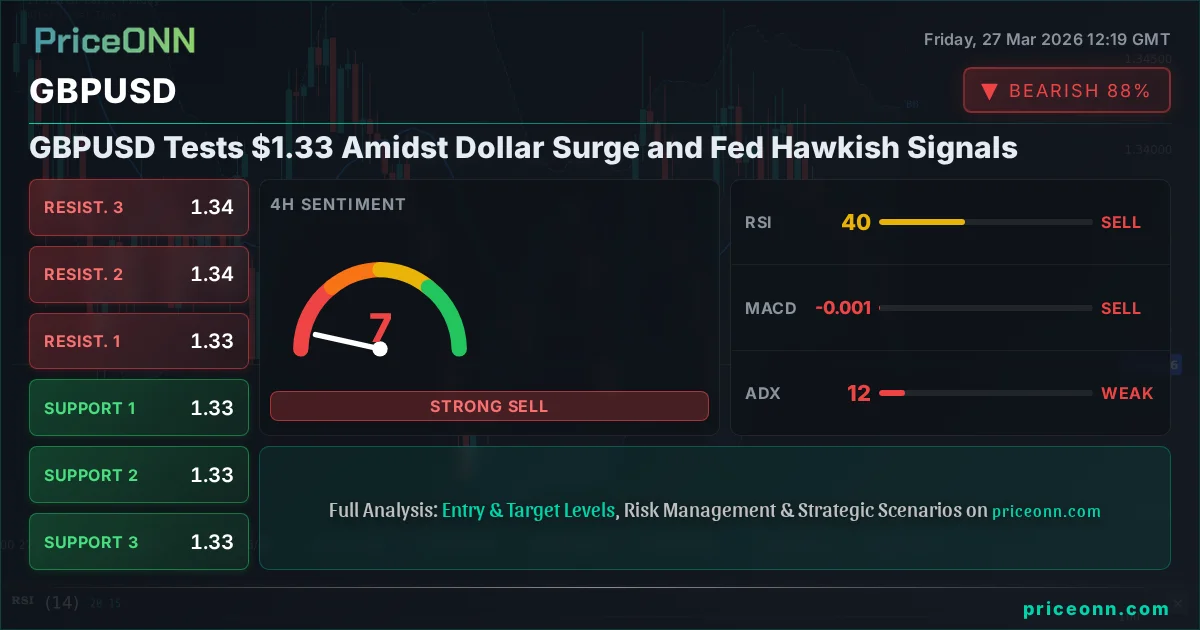
GBP/USD experienced a slight dip of approximately 0.1% on Thursday, closing the session around the 1.3340 level amidst choppy trading conditions. The pair has since managed to claw back some ground, trading about 0.1% higher on Friday near 1.3345. This tug-of-war reflects the delicate balance between improving risk appetite in broader markets and specific headwinds facing the UK economy and its currency. The Pound Sterling, a currency with deep historical roots, remains a significant player in global foreign exchange, consistently ranking as the fourth most actively traded currency. Data from recent years indicates it accounts for roughly 12% of all FX transactions, with daily volumes often exceeding $630 billion. Its most closely watched pairing, 'Cable' with the US Dollar, represents a substantial 11% of this total volume.
Analysis & Drivers
The valuation of the Pound Sterling is primarily dictated by the monetary policy decisions of the Bank of England (BoE). The central bank's core mandate is to maintain price stability, targeting an inflation rate of around 2%. When inflationary pressures rise, the BoE typically tightens monetary policy by increasing interest rates. This action makes borrowing more expensive, potentially slowing economic activity but simultaneously making the UK an attractive destination for international capital seeking higher yields, thus supporting Sterling. Conversely, a cooling economy or inflation falling below target might prompt the BoE to lower rates to stimulate growth.
Recent market dynamics have been influenced by a complex interplay of factors. While improving overall market sentiment has provided some relief, external shocks, such as those emanating from geopolitical tensions affecting oil supplies, introduce significant uncertainty. Such supply-side pressures can fuel inflation, complicating the BoE's decision-making process. Analysts note that the central bank must carefully weigh the risks of persistent inflation against the potential for economic slowdown when considering future rate adjustments. Key economic indicators, including GDP figures, Purchasing Managers' Indexes (PMIs), and employment data, will remain critical in shaping the BoE's outlook and, by extension, the trajectory of GBP/USD.
Trader Implications
For traders monitoring GBP/USD, the immediate focus will be on the 1.3350 resistance level. A sustained break above this point could signal further upside potential, potentially targeting the 1.3400 handle. Conversely, a failure to hold current levels could see the pair retreat towards the 1.3300 support. The overarching risk factor remains the unpredictable nature of geopolitical events impacting energy prices and their knock-on effect on inflation expectations and the BoE's policy path. Traders should closely watch upcoming economic releases from both the UK and the US, as well as any official commentary from BoE officials, for clues on future monetary policy direction. The current environment calls for cautious positioning, with a keen eye on risk management.
Outlook
The outlook for GBP/USD remains cautiously optimistic in the short term, contingent on the continuation of improved market sentiment and the absence of further significant geopolitical shocks. If economic data continues to support a stable, albeit potentially slower, UK economy, and inflation remains manageable, Sterling could find further traction. However, the specter of inflation driven by external supply-side issues presents a persistent risk. Upcoming BoE meetings and key economic data releases will be pivotal in determining whether GBP/USD can sustain its recovery or if it will succumb to renewed selling pressure.
Frequently Asked Questions
What is the current support level for GBP/USD?
The current support level for GBP/USD is being watched around the 1.3300 mark. A breach of this level could signal further downward pressure on the pair.
How does oil price volatility affect GBP/USD?
Oil price volatility, particularly surges driven by geopolitical events, can increase inflation expectations. This complicates the Bank of England's stance on interest rates, potentially leading to uncertainty in GBP/USD as markets weigh the risk of higher inflation against the impact on economic growth.
What is the outlook for GBP/USD if market sentiment deteriorates?
If market sentiment deteriorates, GBP/USD could face renewed selling pressure, potentially falling back towards the 1.3300 support or even lower. This would be exacerbated if geopolitical risks escalate, further clouding the Bank of England's policy outlook.
Track markets in real-time
Empower your investment decisions with AI-powered analysis, technical indicators and real-time price data.
Join Our Telegram Channel
Get breaking market news, AI analysis and trading signals delivered instantly to your Telegram.
Join Channel
PriceONN