
Gold: The Floor Has Been Found, but Where Is the Ceiling?
 PriceONN Editorial Desk
Multi-source verification
PriceONN Editorial Desk
Multi-source verification
Gold's Unlikely Stand
The precious metal gold is demonstrating a surprising tenacity, holding firm above the critical $4,000 per ounce mark. This steadfastness appears to be occurring in defiance of conventional market indicators that would typically pressure its price lower. Factors such as climbing Treasury yields and a robust US dollar are usually significant deterrents for gold, yet the market seems to be looking past these fundamentals.
Geopolitical Currents and Currency Strength
The US dollar has experienced a notable four-day ascent, a move that has been amplified by recent air strikes targeting Iran. While unconfirmed reports of a potential temporary ceasefire have circulated, they have not managed to quell market anxieties. This uncertainty has propelled Brent crude oil prices towards $93 per barrel, simultaneously stoking fears of persistent inflation.
Adding to the complex economic picture, market expectations suggest a 50/50 probability for two Federal Reserve rate hikes by 2026. This outlook inherently supports the dollar. Given this backdrop, the current rally in gold becomes all the more remarkable. Typically, a stronger dollar and rising yields would present substantial headwinds, yet demand appears to be providing a solid foundation for the precious metal.
Shifting Investor Sentiment
A significant shift in investor behavior is becoming evident. Outflows from gold-backed Exchange Traded Funds (ETFs) have reversed, giving way to substantial inflows. On July 21st, specialized ETFs saw a notable increase in holdings, adding 7.4 metric tonnes, marking the largest single-day gain for the month. Concurrently, hedge funds have bolstered their net long positions in gold to a level not seen in five weeks.
This renewed investor interest may stem from the perceived durability of the support level around $4,000 per ounce. Coupled with gold's poor performance in prior periods, many investors might now view the asset as oversold. It is worth recalling that by the close of June, gold had registered its worst monthly performance since the 2008 global financial crisis, experiencing its most rapid decline since 2013.
Historical Pressures and Future Outlook
During that period of sharp decline, persistent rumors suggested that central banks in Gulf states were divesting their bullion holdings through intermediaries, with Turkey being a primary focus. The nation's gold reserves reportedly decreased by 81 tonnes in the first half of the year, a divestment valued at approximately $10.6 billion at current valuations. While a US-Iran agreement in June theoretically aimed to curb such actions, escalating geopolitical tensions could potentially accelerate these sales.
Despite the recent price rebound, the broader external environment remains challenging. Elevated oil prices, particularly Brent crude, heighten the risk of entrenched inflation within the US economy. Simultaneously, the Federal Reserve's transition from detailed communications to more concise statements is creating unease among market participants. This environment increases the possibility of unexpected monetary policy tightening by the central bank.
Market Ripple Effects
The strengthening US dollar's impact is already visible, with USDJPY breaching the 163 level for the first time in four decades. This has triggered increased verbal interventions from Japanese government officials, including Finance Minister Satsuki Katayama, who has indicated readiness to take decisive action if necessary.
Trader Takeaways
The current gold market presents a fascinating dichotomy. While the fundamentals of rising Treasury yields and a strong dollar typically spell trouble for the precious metal, support around the $4,000 level is proving remarkably resilient. This resilience, coupled with increased ETF inflows and a significant build-up in hedge fund net long positions, suggests a market that may be pricing in geopolitical risks more heavily than traditional economic headwinds.
For traders, this suggests that while caution is warranted due to the unfavorable macro backdrop, the technical support and shifting sentiment could provide a floor. Key assets to watch include the US Dollar Index (DXY), which could dictate the pressure on gold, as well as USDJPY, given the heightened sensitivity and verbal interventions from Japanese authorities. The price action in Brent crude oil remains critical, as sustained high levels will continue to fuel inflation concerns, potentially influencing Fed policy and, by extension, gold prices.
The primary risk lies in an unexpected acceleration of Fed tightening or a significant de-escalation of geopolitical tensions, either of which could rapidly alter gold's trajectory. Smart money may be looking beyond the immediate price action, assessing the underlying demand drivers and the potential for a sustained flight to safety if global instability intensifies.
Track markets in real-time
Empower your investment decisions with AI-powered analysis, technical indicators and real-time price data.
Join Our Telegram Channel
Get breaking market news, AI analysis and trading signals delivered instantly to your Telegram.
Join Channel PriceONN News
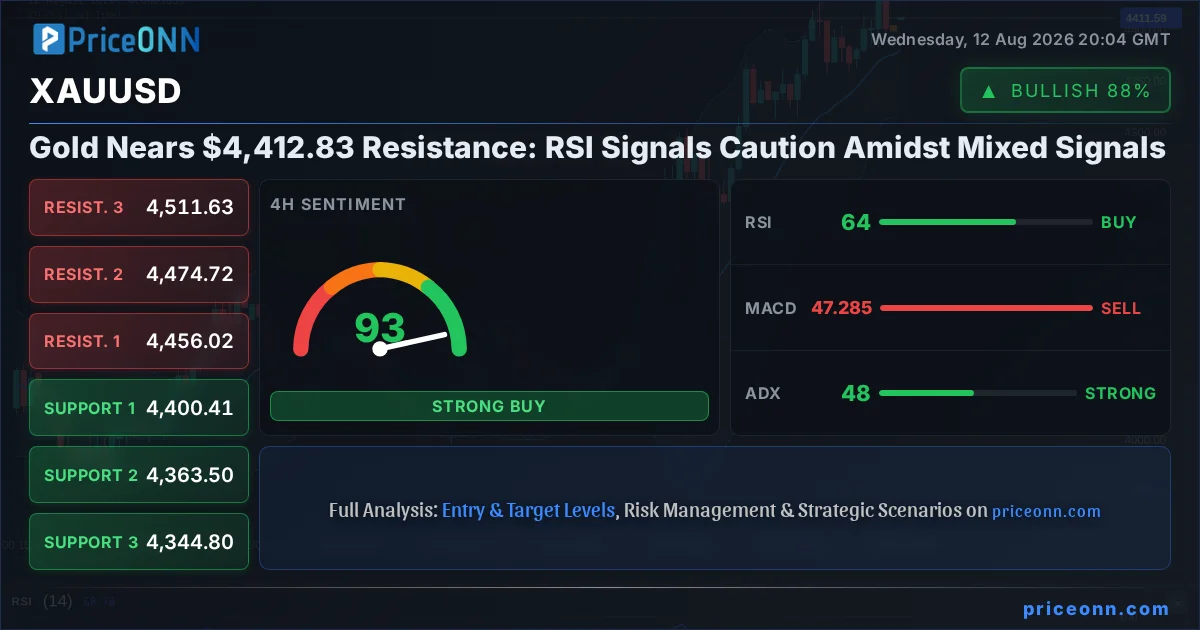
Gold rose to 4,400 USD per ounce on Tuesday, reaching a two-month high. Demand for the precious metal is growing rapidly, even amid heightened inflation risks and expectations of higher interest rates driven by elevated oil prices. Chinese institutional investors continue to build positions in gold as a defensive asset amid heightened volatility in other […] The post Gold Rallies: Long-Awaited Rise and Growing Safe-Haven Demand appeared first on ActionForex.
PriceONN News
Whatever the inflation figures may be, the precious metal will come out on top. Japan and the US don’t want to give the yen’s fate to speculators. The US dollar continues to recover from the blow dealt by the labour market statistics. A rally in Treasury bond yields is driving the rise in the USD […] The post Gold as a Sure-Fire Bet appeared first on ActionForex.
PriceONN News
A deal to reopen the Strait of Hormuz is not inevitable. Oil prices are rising amid growing risks of an escalation of the conflict in the Middle East. The US dollar continued to recover from losses caused by the jobs report, against a backdrop of rising geopolitical tensions in the Middle East with traders squaring […] The post Brent Is Following a Path of Demands Rather Than Commitments appeared first on ActionForex.
PriceONN News
The Consumer Price Index (CPI) rose by 0.1% month-on-month (m/m) in July – in line with expectations. On a twelve-month basis, CPI edged down to 3.4% (from 3.5% in June). Energy costs fell by 1.5% m/m, led by a 2.9% m/m decline in prices at the pump. Food prices rose 0.1% m/m – its softest […] The post US: Inflationary Pressures Remain Subdued in July appeared first on ActionForex.
PriceONN News
Brent oil price rose to the highest in over one week on Tuesday, in extension of Monday’s nearly 5% advance, following the latest verbal escalation by President Trump that quickly changed the sentiment and countered efforts of Iran and Oman to find solution for reopening of strategic Hormuz strait. The latest demands from President Trump […] The post Brent Oil Price Falls After Recovery Failed to Clear Important $90 Barrier appeared first on ActionForex.
PriceONN News
The NFIB’s Small Business Optimism Index rose 2.4 points to 99.8 in July, soundly beating expectations for a roughly flat reading of 97.5. Eight out of the ten index subcomponents improved during the month and two deteriorated. The largest improvement came from the net share of firms planning to increase employment (up 9 points to […] The post US: Small Business Optimism Spiked in July appeared first on ActionForex.
PriceONN News
Overnight, the RBA held its cash rate steady at 4.35%, as widely expected after June’s inflation data came in softer than forecast at 3.8% headline. Yet the accompanying statement struck a notably cautious tone, warning that trimmed mean inflation remains elevated and largely unchanged from the March quarter, with oil and related commodities still trading […] The post EUR/AUD: Two Central Banks on Hold, One Triangle About to Break appeared first on ActionForex.
PriceONN News
RBA on hold as expected, recognising the data has broken against its hawkish narrative. Base case clearly an extended period on hold, but RBA will hike if upside risks to inflation materialise. As widely expected, the RBA Monetary Policy Board (MPB) kept the cash rate on hold at 4.35% at its August meeting. The accompanying […] The post RBA Holds at 4.35%, Narrows Risk of Hikes appeared first on ActionForex.
PriceONN News
Markets Core bonds sold off yesterday with the belly of the curve slightly underperforming in the US while European curves showed more of a bear flattening. Daily changes on the US curve varied between +4.7 bps (2-yr) and +6.4 bps (7-yr). The US 30-yr yield is again within reach of the multi-annual high reached end […] The post Sunrise Market Commentary appeared first on ActionForex.
PriceONN News
RBA accepted that inflation has improved, but refused to turn that improvement into a declaration that rate hikes are finished. Cash rate was left unchanged at 4.35% unanimously, yet Board described policy as only “somewhat restrictive” and explicitly kept another increase on table, saying it could still raise rates “if upside risks materialise.” That is […] The post RBA Accepts Softer Inflation but Still Leaves Scope for One More Hike appeared first on ActionForex.
PriceONN News
The USD index plummeted amid a decline in US employment. Gold is benefiting from the Fed’s reluctance to raise interest rates. The US dollar touched a seven-week low after an unexpected labour market report. Employment in July unexpectedly fell by 23K. The figures for May were revised down from 129K to 63K, and those for […] The post The Dollar Let the Labour Market Down appeared first on ActionForex.
PriceONN News
US inflation eased as expected in July, reinforcing case for Fed to stay on hold while it waits for clearer evidence on both prices and labor market. Headline CPI rose from -0.4% to 0.1% m/m, while annual rate slowed from 3.5% y/y to 3.4%. Core CPI increased from 0.0% to 0.2% m/m, with annual core […] The post US CPI Slows to 3.4% as Core Inflation Eases to 2.5% appeared first on ActionForex.