
Gold Recovers as Geopolitical Tensions Ease, Silver Follows Suit
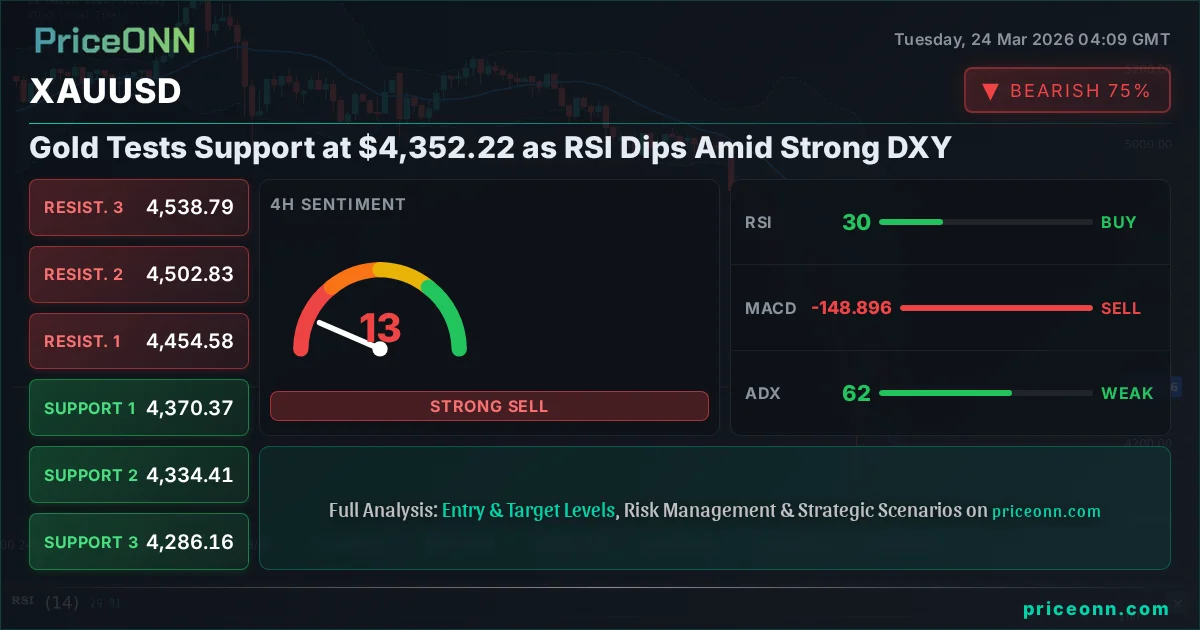
Gold (XAU/USD) experienced a notable recovery on Monday and into Tuesday, bouncing back from recent year-to-date lows. The precious metal found renewed buying interest after news emerged that planned strikes against Iran's energy infrastructure had been postponed, signaling a potential de-escalation in Middle East geopolitical tensions. This shift in sentiment allowed gold to recover towards the $4,440 mark.
Market Context
The precious metals market has been highly sensitive to geopolitical developments. Earlier in the week, both gold and silver had dipped to their lowest points of the year, driven by anxieties surrounding potential conflict escalation in the Middle East. However, a subsequent easing of these fears, stemming from indications of diplomatic restraint, provided a crucial support level for both assets. The rebound in gold, in particular, highlights its enduring role as a safe-haven asset, reacting swiftly to shifts in global risk perception. Silver (XAG/USD) also mirrored this recovery, albeit with its own unique market drivers, after briefly touching its own year-to-date lows during early Asian trading.
Analysis & Drivers
The primary catalyst for the recent price action in gold appears to be the shifting geopolitical landscape. The postponement of potential strikes against Iran's energy sector removed a significant immediate threat, allowing investors to reassess risk premiums. Historically, gold prices tend to escalate during periods of geopolitical instability or fears of deep recession due to its safe-haven status. Conversely, a reduction in such tensions often leads to a pullback as investors rotate back into riskier assets. Market data shows that central banks continue to be significant buyers of gold, adding 1,136 tonnes worth around $70 billion in 2022, the highest on record, indicating a structural demand that provides underlying support.
Furthermore, the price of gold, quoted as XAU/USD, remains intrinsically linked to the performance of the US Dollar. A weakening dollar typically supports gold prices, while a strong dollar tends to cap its gains. While specific dollar movements were not the primary driver in this instance, the inverse correlation remains a constant factor for traders to monitor. For silver, its industrial significance also plays a role. Its conductivity makes it vital for electronics and solar energy, meaning demand from these sectors can also influence its price, alongside its safe-haven appeal.
Trader Implications
Traders should be closely watching the developments in the Middle East for any renewed escalation or de-escalation, as this will likely continue to be a key driver for gold and silver prices in the short term. Key levels to monitor for gold include the recent lows around $4,400 as a potential support zone, with resistance likely to be found near the previous highs. For silver, the recovery from year-to-date lows suggests a potential for further upside if broader market sentiment remains positive, but the underlying bearish outlook indicated by some market participants suggests caution. Traders should also be mindful of upcoming economic data releases and any commentary from central banks regarding interest rates, as these factors can significantly impact the demand for yield-less assets like gold and silver.
Key factors for traders to watch:
- Geopolitical developments in the Middle East.
- US Dollar Index (DXY) performance.
- Interest rate expectations from major central banks.
- Industrial demand for silver.
Outlook
The immediate outlook for gold and silver appears to be cautiously optimistic, contingent on sustained de-escalation in geopolitical hotspots. Should tensions remain subdued, gold may consolidate or attempt further upside, potentially testing higher resistance levels. However, any resurgence of conflict could quickly send prices back towards previous highs. Silver's trajectory may see it benefit from a stable gold price and any signs of improving industrial output. Traders should remain vigilant, ready to adjust positions based on evolving news flow and economic indicators.
Frequently Asked Questions
What is the current price trend for Gold (XAU/USD)?
Gold has recently rebounded from year-to-date lows, recovering to near $4,440 as geopolitical tensions eased. The short-term trend is influenced by news flow from the Middle East, with support seen around $4,400.
Why did Silver (XAG/USD) also recover?
Silver mirrored gold's recovery as the broader market sentiment improved following indications of de-escalation in the Middle East. While it also touched year-to-date lows, the easing of geopolitical risks provided a tailwind for its price rebound.
What are the key risks for Gold traders moving forward?
The primary risk for gold traders is a resurgence of geopolitical tensions in the Middle East, which could quickly drive prices higher. Additionally, shifts in US Dollar strength and central bank monetary policy (interest rates) remain significant factors influencing gold's safe-haven appeal and cost of carry.
Track markets in real-time
Empower your investment decisions with AI-powered analysis, technical indicators and real-time price data.
Join Our Telegram Channel
Get breaking market news, AI analysis and trading signals delivered instantly to your Telegram.
Join Channel

PriceONN