
Gold Rises for Fourth Consecutive Day: Geopolitics and Data Lend Support
 PriceONN Editorial Desk
Multi-source verification
PriceONN Editorial Desk
Multi-source verification
A Fragile Calm Descends on the Strait
The precious metal found fresh upward momentum on Thursday, extending its winning streak to a fourth session and touching the $4,300 per ounce mark. This impressive rally, now accounting for nearly 6% gains since Monday, is largely attributed to a tentative accord aimed at easing passage through the critical Strait of Hormuz. The agreement between Iran and Oman to establish a designated shipping corridor has begun to soothe anxieties surrounding energy supply disruptions from the Middle East.
This de-escalation in a key geopolitical flashpoint has had a palpable effect on broader market sentiment. Specifically, the perceived reduction in immediate energy supply risks has contributed to a softening in oil prices. Consequently, concerns that a rapid surge in energy costs could further fuel inflation have diminished, prompting a notable recalibration of expectations regarding future monetary policy actions by the Federal Reserve.
Shifting Sands of Monetary Policy Expectations
The market's outlook on Fed rate hikes has undergone a dramatic revision. Just a week prior, traders were pricing in the likelihood of two separate interest rate increases before the year's end. However, the current sentiment, shaped by the easing geopolitical tensions and other economic indicators, now suggests that a single rate hike is the more probable outcome. This adjustment reflects a growing belief that inflationary pressures may be moderating.
Adding significant weight to the case for a less aggressive monetary stance was the release of weaker-than-anticipated US employment figures. Data released for July revealed that the private sector in the United States added only 44,000 jobs. This figure represents the lowest monthly gain since January and falls considerably short of the 70,000 jobs economists had forecast. Such a deceleration in job creation points towards a labor market that is indeed cooling, a development that typically puts downward pressure on the value of the US dollar.
Hawkish Whispers Amidst Dovish Data
Despite the encouraging signs of cooling inflation and a softening labor market, a note of caution was sounded by Federal Reserve official Lisa Cook. She reiterated her stance, emphasizing her willingness to support an interest rate increase should inflation fail to show a more decisive trend towards the central bank's 2% target. Cook's remarks served as a reminder that the regulator may not be able to indefinitely postpone necessary actions to curb persistent price pressures.
This duality in market drivers-geopolitical de-escalation and dovish economic data on one side, contrasted with the potential for continued hawkishness from central bankers on the other-creates a complex environment for investors. The dollar has consequently faced pressure, offering underlying support to assets like gold that are often seen as safe-haven or inflation hedges.
Reading Between the Lines
The recent price action in gold, pushing towards $4,300, is a clear signal that geopolitical stability and moderated inflation expectations are currently trumping the possibility of further Fed tightening. The partial reopening of the Strait of Hormuz, while not a complete resolution, has provided enough relief to shift focus away from immediate supply shocks and towards the more nuanced data points emerging from the US economy.
The stark divergence between the headline job creation number and the Fed's inflation mandate is critical. While the 44,000 ADP jobs figure is undeniably weak, suggesting a potential slowdown that could curb demand and inflation, the underlying message from officials like Cook is that the fight against inflation remains paramount. This creates a delicate balancing act for markets; a cooling economy might necessitate fewer rate hikes, but persistent inflation could still force the Fed's hand, creating volatility for interest-rate sensitive assets.
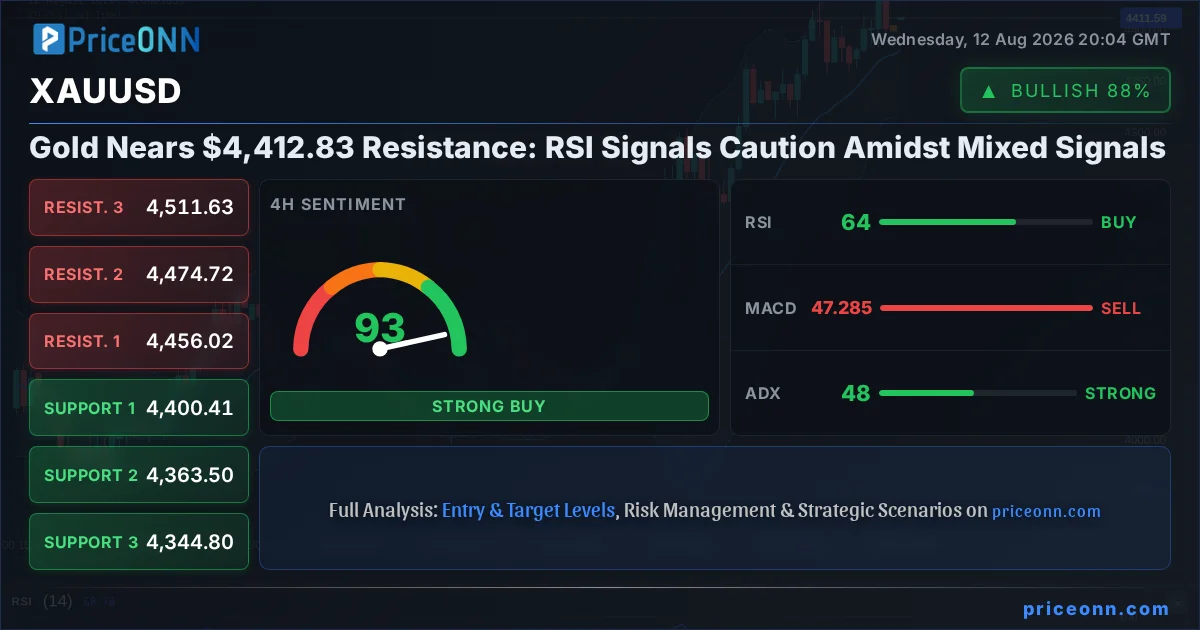
The technical picture, while suggesting a potential short-term pullback towards the $4,100 level, is playing out against a backdrop of significant fundamental shifts. The MACD indicator's bearish signals on the H4 chart and the Stochastic oscillator's downward trend on H1 are classic indicators of potential downward price movement. However, these technical cues must be interpreted within the context of the macro-economic and geopolitical forces at play. A break below $4,100 would require a catalyst, perhaps renewed geopolitical flare-ups or surprisingly sticky inflation data, to fully negate the current bullish undercurrent driven by easing supply fears and a softening labor market.
Market Ripple Effects
This confluence of geopolitical easing and a cooling US labor market has several interconnected implications across asset classes. Firstly, the pressure on oil prices (like Brent Crude) could persist in the short term, potentially impacting energy stocks and related currencies such as the Canadian Dollar (CAD). Secondly, the reduced expectation of Fed tightening directly influences bond yields, with longer-term yields potentially stabilizing or even declining. This environment also tends to support risk assets, although the immediate focus on gold suggests a preference for perceived safe havens amidst ongoing economic uncertainty.
Traders will be closely monitoring incoming US economic data, particularly inflation reports and further labor market statistics, to gauge the Fed's next move. Geopolitical developments in the Middle East also remain a key variable. Any resurgence of tensions could quickly reverse the recent gains in gold and put upward pressure back on oil prices, altering the inflation and rate hike narrative once again.
Track markets in real-time
Empower your investment decisions with AI-powered analysis, technical indicators and real-time price data.
Join Our Telegram Channel
Get breaking market news, AI analysis and trading signals delivered instantly to your Telegram.
Join Channel PriceONN News
Gold rose to 4,400 USD per ounce on Tuesday, reaching a two-month high. Demand for the precious metal is growing rapidly, even amid heightened inflation risks and expectations of higher interest rates driven by elevated oil prices. Chinese institutional investors continue to build positions in gold as a defensive asset amid heightened volatility in other […] The post Gold Rallies: Long-Awaited Rise and Growing Safe-Haven Demand appeared first on ActionForex.
PriceONN News
The Consumer Price Index (CPI) rose by 0.1% month-on-month (m/m) in July – in line with expectations. On a twelve-month basis, CPI edged down to 3.4% (from 3.5% in June). Energy costs fell by 1.5% m/m, led by a 2.9% m/m decline in prices at the pump. Food prices rose 0.1% m/m – its softest […] The post US: Inflationary Pressures Remain Subdued in July appeared first on ActionForex.
PriceONN News
Whatever the inflation figures may be, the precious metal will come out on top. Japan and the US don’t want to give the yen’s fate to speculators. The US dollar continues to recover from the blow dealt by the labour market statistics. A rally in Treasury bond yields is driving the rise in the USD […] The post Gold as a Sure-Fire Bet appeared first on ActionForex.
PriceONN News
A deal to reopen the Strait of Hormuz is not inevitable. Oil prices are rising amid growing risks of an escalation of the conflict in the Middle East. The US dollar continued to recover from losses caused by the jobs report, against a backdrop of rising geopolitical tensions in the Middle East with traders squaring […] The post Brent Is Following a Path of Demands Rather Than Commitments appeared first on ActionForex.
PriceONN News
The USD index plummeted amid a decline in US employment. Gold is benefiting from the Fed’s reluctance to raise interest rates. The US dollar touched a seven-week low after an unexpected labour market report. Employment in July unexpectedly fell by 23K. The figures for May were revised down from 129K to 63K, and those for […] The post The Dollar Let the Labour Market Down appeared first on ActionForex.
PriceONN News
US inflation eased as expected in July, reinforcing case for Fed to stay on hold while it waits for clearer evidence on both prices and labor market. Headline CPI rose from -0.4% to 0.1% m/m, while annual rate slowed from 3.5% y/y to 3.4%. Core CPI increased from 0.0% to 0.2% m/m, with annual core […] The post US CPI Slows to 3.4% as Core Inflation Eases to 2.5% appeared first on ActionForex.
PriceONN News
Brent oil price rose to the highest in over one week on Tuesday, in extension of Monday’s nearly 5% advance, following the latest verbal escalation by President Trump that quickly changed the sentiment and countered efforts of Iran and Oman to find solution for reopening of strategic Hormuz strait. The latest demands from President Trump […] The post Brent Oil Price Falls After Recovery Failed to Clear Important $90 Barrier appeared first on ActionForex.
PriceONN News
The NFIB’s Small Business Optimism Index rose 2.4 points to 99.8 in July, soundly beating expectations for a roughly flat reading of 97.5. Eight out of the ten index subcomponents improved during the month and two deteriorated. The largest improvement came from the net share of firms planning to increase employment (up 9 points to […] The post US: Small Business Optimism Spiked in July appeared first on ActionForex.
PriceONN News
RBA on hold as expected, recognising the data has broken against its hawkish narrative. Base case clearly an extended period on hold, but RBA will hike if upside risks to inflation materialise. As widely expected, the RBA Monetary Policy Board (MPB) kept the cash rate on hold at 4.35% at its August meeting. The accompanying […] The post RBA Holds at 4.35%, Narrows Risk of Hikes appeared first on ActionForex.
PriceONN News
Markets Core bonds sold off yesterday with the belly of the curve slightly underperforming in the US while European curves showed more of a bear flattening. Daily changes on the US curve varied between +4.7 bps (2-yr) and +6.4 bps (7-yr). The US 30-yr yield is again within reach of the multi-annual high reached end […] The post Sunrise Market Commentary appeared first on ActionForex.
PriceONN News
RBA accepted that inflation has improved, but refused to turn that improvement into a declaration that rate hikes are finished. Cash rate was left unchanged at 4.35% unanimously, yet Board described policy as only “somewhat restrictive” and explicitly kept another increase on table, saying it could still raise rates “if upside risks materialise.” That is […] The post RBA Accepts Softer Inflation but Still Leaves Scope for One More Hike appeared first on ActionForex.
PriceONN News
Germany’s benchmark index just made history, breaking above 26,500 for the first time ever, extending a rally that has already delivered close to 10% over the past twelve months. The move came on fresh optimism around a potential resolution to the Iran conflict, though that optimism proved short-lived: President Trump’s latest demands, that Tehran compensate […] The post DAX 40: Record Highs, Real Fundamentals, One Channel Left to Test appeared first on ActionForex.