Gold Soars After Iran Shuts Strait Of Hormuz Despite U.S. Peace Push
Precious Metals Surge on Geopolitical Shockwaves
The yellow metal staged a powerful comeback on Friday, reversing earlier declines as escalating conflict in the Persian Gulf sent investors scrambling for safety. Iran's military declared it had seized complete authority over the strategically critical Strait of Hormuz. This development occurred even as the United States appeared to be pausing its military actions against Iranian energy targets, signaling an attempt to deescalate through diplomatic channels.
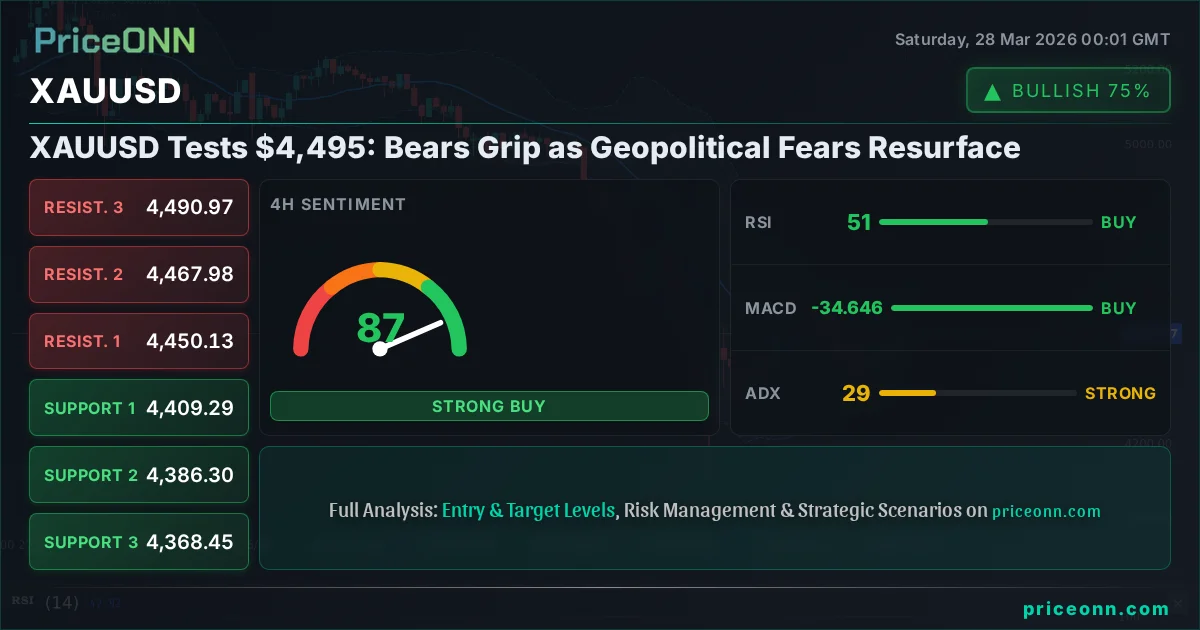
Trading data confirmed a significant uplift for gold. The front-month Comex contract for April delivery rocketed upwards by $136.10, marking a 3.11% gain to settle at $4,512.40 per troy ounce. The momentum extended to silver, with its April Comex contract also experiencing a sharp rise, climbing $3.133 or 4.63% to reach $70.830 per troy ounce.
Diplomatic Maneuvers and Escalating Threats
As the U.S.-Israel confrontation with Iran entered its twenty-eighth day, President Donald Trump publicly renewed his administration's commitment to finding a peaceful resolution. Reports indicated that a 15-point peace proposal had been delivered to Iran through Pakistan. Pakistan's Foreign Minister provided an update, stating that indirect negotiations were underway and that Iran was reviewing the American proposals. Support for these diplomatic efforts was reportedly voiced by Turkey and Egypt, with China welcoming the initiative as a positive sign.
Earlier in the week, President Trump had announced a five-day halt to potential military strikes targeting Iran's energy and power infrastructure. With this initial pause nearing its end, the President announced via his social media platform that the moratorium on strikes would be extended through Monday, April 6. He expressed optimism about the ongoing talks, asserting they were progressing positively, a sentiment seemingly at odds with some media narratives. U.S. Special Envoy Steve Witkoff also noted encouraging signs that Iran might be amenable to negotiations.
Meanwhile, Israel declared it had executed a series of strikes in Tehran early Friday, framing them as responses to attacks on civilian infrastructure. Israel's military operations were also reportedly continuing in Beirut, Lebanon, as part of its ongoing actions against Hezbollah. Adding a stark warning to the volatile situation, Iran's Islamic Revolutionary Guards Corps (IRGC) announced the closure of the Strait of Hormuz. The IRGC asserted full control over the waterway and issued a stern caution that any vessel attempting passage would face severe repercussions.
Further amplifying the threat, Iran indicated that these restrictions could extend to ships associated with nations supporting either the U.S. or Israel. This dramatic escalation underscores the fragile state of regional security and its immediate impact on global commodity flows.
Economic Indicators and Inflationary Concerns
In the United States, freshly released data from the University of Michigan painted a concerning picture of consumer sentiment. The index for March dipped to 53.3, its lowest point in three months, falling short of the anticipated 54.0 and down from February's 56.6. Consumer expectations also weakened, with the relevant index falling to a four-month low of 51.7 in March. Simultaneously, year-ahead inflation expectations surged to 3.8 percent in March, a significant jump from 3.4 percent in February and the largest single-month increase seen since April 2025.
Officials within the Federal Reserve acknowledged the potential inflationary impact of the conflict. Fed Vice Chair for Supervision Philip Jefferson commented that the ongoing war would likely exacerbate inflationary pressures. Fed Governor Lisa Cook had previously stated that the risks had shifted more towards inflation than employment due to the Iranian situation. Despite these concerns, the Federal Reserve maintained its benchmark interest rate at the 3.50%-3.75% target range during its March meeting.
Market Ripple Effects
The potential enforcement of the Strait of Hormuz closure by Iran presents a critical risk to the global economy. Experts are voicing concerns about a severe economic downturn should this vital shipping lane be fully blocked. This heightened uncertainty has reignited demand for safe-haven assets. The recent price decline in gold appears to have spurred a 'buy the dip' mentality among traders, who have now aggressively re-entered the market, seeking refuge in precious metals amidst the turmoil.
Track markets in real-time
Empower your investment decisions with AI-powered analysis, technical indicators and real-time price data.
Join Our Telegram Channel
Get breaking market news, AI analysis and trading signals delivered instantly to your Telegram.
Join Channel