
Why Did Gold Plunge 2.5% as Oil and the Dollar Surged Today?
Gold (XAU/USD) experienced a significant downturn on Thursday, plummeting nearly 2.50% to trade around $4,394. This sharp retreat from a daily high of $4,544 occurred amidst a confluence of market forces, including a surging US Dollar and rising oil prices, as geopolitical uncertainties in the Middle East kept investors on edge.
Market Context
The precious metal, often seen as a safe-haven asset, failed to retain its value as broader market sentiment shifted. The US Dollar Index (DXY) climbed towards 99.90, buoyed by demand for safe-haven currencies and favorable interest rate differentials. Simultaneously, oil prices saw an uptick, influenced by concerns over potential US-Iran diplomatic developments, which in turn added upward pressure on inflation expectations. This environment created headwinds for gold, highlighting its sensitivity to macroeconomic shifts and currency movements.
Analysis & Drivers
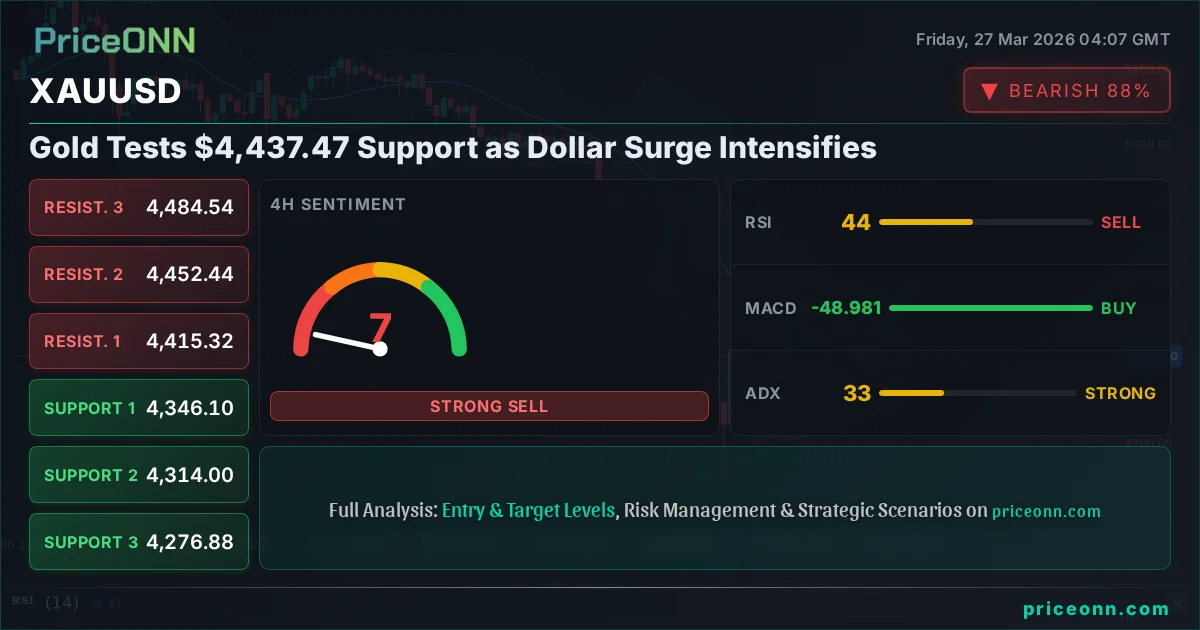
The primary catalysts behind gold's sharp decline appear to be the strengthening US Dollar and rising crude oil prices. A stronger dollar makes gold more expensive for holders of other currencies, typically exerting downward pressure on its price. Market data shows that the dollar's ascent was driven by its safe-haven appeal amid Middle East tensions and attractive interest rate differentials compared to other major economies. The rise in oil prices, often a precursor to broader inflation, also played a role. While higher inflation can sometimes support gold as an inflation hedge, the immediate impact of oil-driven inflation concerns, coupled with a strong dollar, seemed to overshadow this potential benefit. Analysts note that central banks, despite accumulating record amounts of gold in recent years-with over 1,136 tonnes added in 2022 alone-are also sensitive to global financial conditions. The current environment favors assets that offer yield or immediate safety, which the dollar currently represents more strongly than gold.
Trader Implications
Traders should closely monitor the interplay between the US Dollar, oil prices, and upcoming economic data. Key levels to watch for gold include immediate support around $4,350 and resistance at the previous day's high of $4,544. A sustained move above this resistance could signal a reversal, while a break below $4,350 might indicate further downside. The Federal Reserve's stance on interest rates will also be critical; any indication of continued hawkishness due to inflation fears could further pressure gold. For those looking to trade gold, a break below the $4,300 psychological level could present a shorting opportunity, with a target towards the $4,200 mark. Conversely, a decisive move back above $4,450 could signal a potential retest of higher levels.
Outlook
The immediate outlook for gold remains cautious. Geopolitical tensions in the Middle East are likely to persist, supporting the US Dollar and potentially capping gold's upside. However, any de-escalation in tensions or a shift in central bank rhetoric towards a more dovish stance could provide relief for the precious metal. Traders will be keenly watching inflation reports and central bank commentary in the coming weeks to gauge the direction of monetary policy and its impact on safe-haven assets.
Frequently Asked Questions
What caused the sharp drop in gold prices today?
Gold prices fell nearly 2.50% today, primarily driven by a surging US Dollar and rising oil prices. Geopolitical tensions and inflation concerns also contributed to the sell-off, pushing investors towards dollar-denominated assets.
What is the current price level for gold (XAU/USD)?
At the time of reporting, gold (XAU/USD) was trading around $4,394, significantly down from its daily high of $4,544. Key support is noted near $4,350, with resistance at $4,544.
What should traders watch for in the gold market moving forward?
Traders should monitor geopolitical developments, US Dollar strength, and central bank policy shifts. Key price levels to watch are support at $4,350 and resistance at $4,544. A break below $4,300 could signal further declines.
Track markets in real-time
Empower your investment decisions with AI-powered analysis, technical indicators and real-time price data.
Join Our Telegram Channel
Get breaking market news, AI analysis and trading signals delivered instantly to your Telegram.
Join Channel
PriceONN