
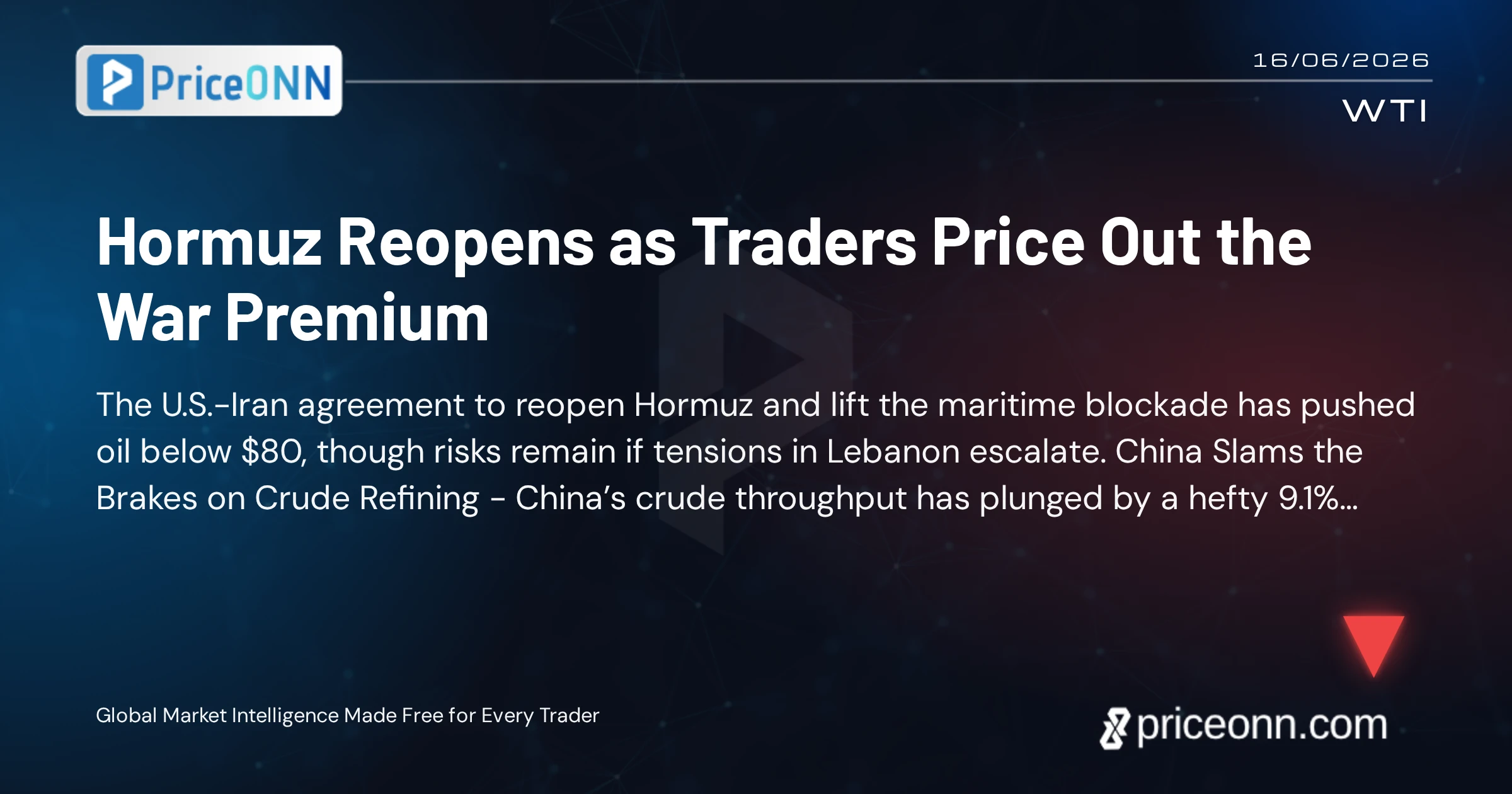
Hormuz Reopens as Traders Price Out the War Premium
 PriceONN Editorial Desk
Multi-source verification
PriceONN Editorial Desk
Multi-source verification
Global Oil Flows Resume as Geopolitical Tensions Ease
The critical Strait of Hormuz is once again navigable, a development that has significantly cooled crude oil prices, pushing benchmarks like Brent futures below the $80 per barrel threshold for the first time in over four months. This dramatic shift follows a pivotal agreement between the United States and Iran to reopen the vital waterway and dismantle the maritime blockade. The market appears to be rapidly pricing out the war risk premium that had inflated prices in recent weeks. Yet, the fragile peace could be shattered should tensions in Lebanon escalate, a scenario that analysts are closely monitoring.
This easing of supply-side fears, however, is juxtaposed with a stark contraction in Chinese refining activity. Data from China's National Bureau of Statistics reveals a significant year-over-year drop of 9.1% in crude throughput, bringing daily runs down to 12.7 million barrels per day. This represents one of the most pronounced instances of demand destruction observed recently, occurring in the wake of the US-Iran conflict. Refinery operations across China have consequently fallen to their lowest levels since April 2022. This downturn is attributed to persistently negative refining margins and an ongoing ban on product exports, even after Beijing issued a new export quota last week in an attempt to stimulate the sector.
Further indicators from China point to a continued slowdown. Seaborne crude imports in June, to date, suggest that the multi-year lows seen in May might not be the bottom. Inflows to Chinese ports have declined by an additional 600,000 barrels per day month-over-month, settling at 6 million barrels per day. Despite this reduced import flow, China has commenced drawing down its substantial crude inventory, estimated at 1.3 billion barrels. Kpler data indicates that current stock levels are nearly 20 million barrels lower than they were two months ago. This inventory reduction signals a shift in China's energy strategy, moving from stockpiling to consumption, though domestic demand remains a concern.
The broader Chinese economic landscape also presents a challenging picture. Retail sales contracted by 0.6% in the latest reporting period compared to the previous year, marking the first such decline since the initial COVID-19 pandemic lockdowns. This contraction suggests that Chinese consumer spending is sensitive to fluctuations in energy prices, which have been volatile due to geopolitical events.
Market Movers and Global Energy Deals
Beyond the headline news of Hormuz, several significant developments are shaping the global energy landscape. In the United States, LNG developer Venture Global has submitted an application to the Federal Energy Regulatory Commission for an 11.7 million tonnes per annum expansion at its Calcasieu Pass 2 terminal in Louisiana. This move signals continued investment in US liquefied natural gas export capacity.
Libya's National Oil Corporation is actively pursuing upstream opportunities, having finalized three exploration deals with Spain's Repsol and Italy's ENI. These agreements focus on offshore Block 07 and onshore Blocks 01 and 07, indicating a push to boost the North African nation's oil production potential.
Norway's state-owned energy giant Equinor is set to double its share buyback program, increasing the projected amount from $1.5 billion to a target of $3 billion by 2026. This decision is directly linked to significant profits generated from the current energy market dynamics, partly influenced by the US-Iran conflict.
In the downstream sector, US oil major Chevron has agreed to acquire a 70% stake in Greece's Block 10 offshore hydrocarbon block from Helleniq Energy. This acquisition expands Chevron's exploration footprint in the Mediterranean.
Meanwhile, Hungary's national oil firm MOL is working to finalize its agreement to purchase Serbia's national oil company, NIS. The deal, involving Russia's Gazprom Neft, has received a 15-day approval extension from OFAC.
Broader Market Reactions and Outlook
The implications of the US-Iran deal have rippled across various commodities and markets. Aluminium prices have succumbed to the news, falling to a two-month low. The benchmark LME three-month contract dipped by 5% to $3,350 per metric tonne as the prospect of Bahraini and UAE aluminium re-entering global markets increases supply potential.
Major financial institutions have adjusted their price forecasts accordingly. Goldman Sachs now anticipates Brent crude to average $80 per barrel in the fourth quarter of 2026, a downward revision of $10 per barrel from its prior estimate. Morgan Stanley has issued a similar forecast, reflecting the market's recalibration.
Russia's seaborne crude exports have maintained record levels, with a four-week average reaching 3.83 million barrels per day. This resilience in exports occurs despite Ukrainian attacks on Russian refineries, which have redirected more crude towards export terminals.
In Australia, industrial action at the Ichthys LNG facility continues, with a court rejecting Inpex's attempt to block the strike, which is now extended until July 6. This ongoing dispute is being closely watched for its potential impact on global LNG supply.
The United Kingdom is set to receive its first tanker of Indian jet fuel since January, following a government decision to temporarily lift a ban on fuels derived from Russian crude. The tanker, carrying 500,000 barrels of kerosene, highlights shifting trade routes for refined products.
Qatar is preparing for a full restart of its liquefied natural gas production at the Ras Laffan LNG plant. QatarEnergy anticipates that 12 of its 14 LNG trains, undamaged by previous drone strikes, could reach full capacity within the next month.
US spot natural gas prices at the Waha hub have turned positive, reaching $0.42 per MMBtu for the first time since early February 2026. This rebound is driven by increased cooling demand and the conclusion of spring pipeline maintenance.
India has increased export levies on diesel and jet fuel to $24 per barrel and $21 per barrel, respectively. This move occurs even amid hopes of the Hormuz Strait reopening, reflecting strong domestic transportation fuel demand in the country.
Reading Between the Lines
The immediate market reaction to the reopening of the Strait of Hormuz underscores how swiftly geopolitical risk premiums can be unwound when major supply routes are secured. Oil prices falling below $80 is a significant psychological and technical level, signaling a potential shift from a supply-constrained market to one where demand dynamics are reasserting their influence. The sharp drop in Chinese refining activity, however, presents a critical counterpoint. A 9.1% decline in throughput, leading to the lowest runs since April 2022, points to underlying weakness in global demand, particularly from a major consumer like China. This suggests that while supply disruptions can cause sharp price spikes, sustained price recovery hinges on robust demand, which appears to be faltering.
Traders will be closely watching the economic data emanating from China, especially retail sales figures and consumer spending trends, as these will be key indicators of future crude import requirements. The drawdowns from China's massive crude inventories, while currently positive for market sentiment, are not a sustainable solution for absorbing excess supply if demand does not rebound. The situation in Lebanon also remains a significant wildcard; any escalation there could quickly reintroduce geopolitical premiums into oil prices, demonstrating the market's sensitivity to regional instability.
The broader energy sector sees continued strategic investments and consolidations. The US LNG expansion plans, new upstream deals in Libya, and acquisitions in Greece highlight ongoing capital allocation in exploration and production. Norway's Equinor doubling its buybacks, fueled by windfall profits, illustrates the profitability currently available in the energy sector, even amidst demand concerns. The market must now balance the de-escalation of immediate supply risks with the less certain outlook for global demand, especially considering the economic headwinds in China and elsewhere.
Track markets in real-time
Empower your investment decisions with AI-powered analysis, technical indicators and real-time price data.
Join Our Telegram Channel
Get breaking market news, AI analysis and trading signals delivered instantly to your Telegram.
Join Channel PriceONN News
The IEA has slashed its 2026 global oil supply forecast, with output now expected to plunge 4.3 million barrels per day this year as the failure to reopen the Strait of Hormuz pushes the market deeper into deficit. The latest forecast is considerably worse than the 3.7-million-bpd decline the agency projected just last month and would leave global supply at 102.02 million bpd, its lowest forecast for 2026 yet. Supply is now expected to fall 1.27 million bpd short of demand for the year,...
PriceONN News
Brent Crude oil prices rose above $89 per barrel in early trade in Europe on Wednesday as Iran and the United States offered contrasting claims about who controls the Strait of Hormuz. Brent Crude prices were up by 0.64% at $89.60 in the morning in Europe, and WTI Crude was rising by 0.94% at $83.90, amid persistent supply concerns and risks despite claims from the U.S. that traffic at Hormuz had normalized. Iran, for its part, said on Tuesday that the Strait of Hormuz will remain closed unless...
PriceONN News
Oil flows from the Middle East have normalized, with Sunday traffic alone above pre-conflict averages, U.S. Secretary of Energy Chris Wright said on Tuesday in a claim that appears not to be backed by ship-tracking data. On Tuesday, Secretary Wright posted on X that “Thanks to the coordinated efforts of the U.S. military and our gulf allies, the seven-day average for oil leaving the Strait of Hormuz is currently up to almost 9 million barrels per day.” He went on to add that “When combined with...
PriceONN News
The latest Bloomberg data show that shipping transits through the Strait of Hormuz remained largely disrupted Monday morning, even as Iran and Oman reportedly moved closer to a deal. Brent crude futures traded near $85 a barrel as markets priced in the possibility that a deal to reopen the maritime chokepoint could be imminent. Yet global supply-chain stress remains near its highest level since the pandemic, and any normalization could take months, even if shipping traffic resumes. UBS senior...
PriceONN News
Indian state-controlled oil refiners continue to search the market for spot crude supply as term deliveries are constrained by the ongoing crisis in the Middle East and its key oil chokepoint, the Strait of Hormuz. Mangalore Refinery and Petrochemicals Limited (MRPL) and Hindustan Petroleum Corporation Limited (HPCL) are looking to buy a combined 6 million barrels of crude oil via spot tenders, Reuters reported on Wednesday, citing tender documents it has seen. HPCL is seeking up to 4 million...
PriceONN News
A drone has struck a power station at the Zawiya oil export terminal in Libya, suggesting continued attacks on one of the country’s main oil hubs. The power plant is in close proximity to the largest oil refinery in Libya, the AP noted in a report on the news. The attack follows earlier ones that caused an explosion at an oil storage tank. No one has claimed responsibility for the drone attacks, the AP also reported. The tank, according to the company operating the facility, had 4.5 million...
PriceONN News
Whatever officially occurs next in the on-again/off-again negotiations towards a peace deal between the U.S. and Iran, unofficially Tehran knows that it has established de facto control over both the world’s two key maritime energy transit routes -- the Strait of Hormuz and the Bab el-Mandeb Strait -- for at least as long as the Islamic regime remains in place in Iran. Washington, London, Brussels, Beijing, and Moscow know it too. The Strait of Hormuz remains effectively controlled by vast...
PriceONN News
The Middle East conflict and the heightened threats to shipping in the Red Sea have prompted China to boost the use of the Arctic to move containers from the Chinese east coast to Europe. The fast-melting Arctic ice offers an alternative shipping route in the summer as the Houthi threats to shipping in the Red Sea and the Bab el-Mandeb Strait make cargo operators more cautious in transiting the key chokepoints in the Middle East. Shipping through the Arctic is not something new, but this time...
PriceONN News
(RTTNews) - Crude oil prices have surged on Tuesday, extending the gains from the two previous sessions as the U.S.-Iran stalemate over new demands for compensation for war-related damages continued, diminishing the expectations of an early reopening of the Strait of Hormuz.
PriceONN News
Five months after the U.S. and Israel opened a war with Iran, global fuel markets still haven't settled down, and the latest IEA data prove it. The IEA's monthly end-use price tracker, updated Aug. 7 and covering prices through July, shows the average per-liter cost of automotive diesel across the countries it tracks sitting near $1.94 in U.S. dollar terms. That's roughly 14% above where it stood in February, before the war started, and it's actually higher than June, even as crude oil kept...
PriceONN News
Hormuz tensions are flaring again as Iranian exports collapse, pushing Brent toward $87 and raising the risk of another run toward $100. China’s Crude Drawdown Puts Iranian Barrels Back in Demand - Shrinking crude inventories in China might spur a buying spree over the upcoming weeks, particularly for Russian and Iranian crude, buoyed by a record-high July stock draw in Shandong. - Chinese teapots are expected to boost their purchases of Iranian oil in the upcoming days as stockpiles in the...
PriceONN News
Ukraine’s military claimed another drone attack on an oil refinery in Russia in the early hours on Tuesday as Ukrainian forces continue to target Russia’s energy producing and exporting infrastructure in an escalation of drone attacks at key oil refining hubs. The Ukrainian military on Tuesday said it had struck the Orsknefteorgsintez oil refinery in Orsk, in the Orenburg region. Orsk is about 1,500 kilometers (930 miles) from the frontline. “Fire was recorded. Damages are being ascertained,”...