
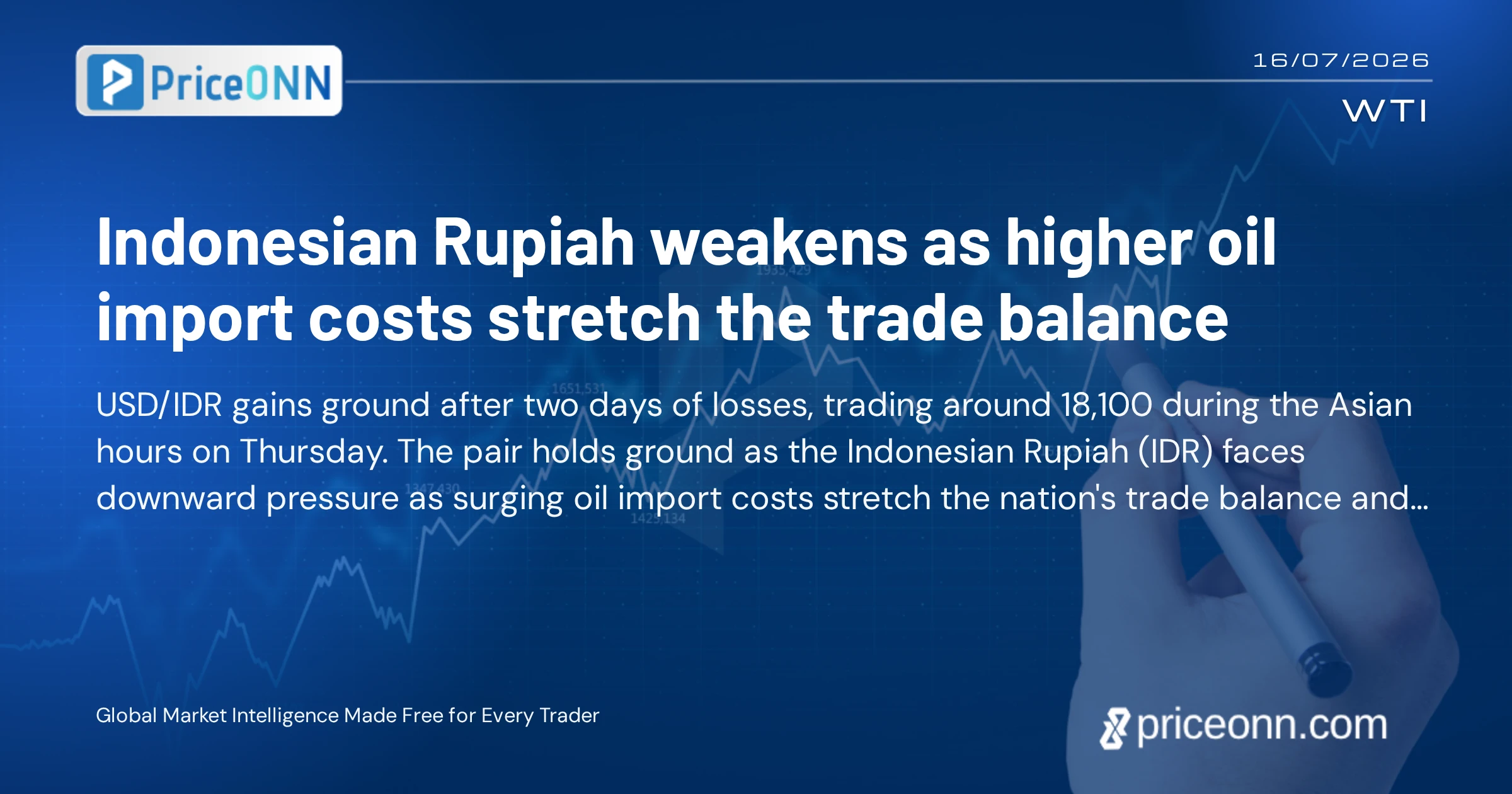
Indonesian Rupiah weakens as higher oil import costs stretch the trade balance
 PriceONN Editorial Desk
Multi-source verification
PriceONN Editorial Desk
Multi-source verification
Rupiah Under Fire Amidst Rising Import Costs
The Indonesian Rupiah (IDR) found itself on the back foot Thursday, reversing recent gains and hovering around the 18,100 level against the US Dollar (USD). This weakening trend emerges as the country grapples with escalating costs for its oil imports, a situation that is significantly straining its trade balance and contributing to inflationary pressures.
This development marks a critical juncture for Southeast Asia's largest economy. The delicate equilibrium of the nation's external accounts is being tested by the global energy price surge. When a country imports more goods than it exports, it runs a trade deficit. For Indonesia, a significant portion of its imports consists of oil, making it particularly vulnerable to fluctuations in international crude prices.
Understanding Inflation's Currency Connection
Inflation, at its core, represents the general increase in the cost of goods and services over time. Economists often differentiate between headline inflation, which captures all price changes, and core inflation. Core inflation strips out the more volatile components like food and energy prices, which can swing due to seasonal or geopolitical events.
Central banks worldwide typically target a specific inflation rate, often around 2%, as a benchmark for economic stability. This target is usually focused on core inflation. When core inflation deviates significantly from this target, central banks may adjust monetary policy, most commonly by altering interest rates. A rise in core inflation above the target often prompts higher interest rates, while a fall below may lead to rate cuts.
The relationship between inflation and a nation's currency can appear counterintuitive. Higher inflation, by prompting central banks to raise interest rates, can actually lead to a stronger currency. This is because elevated interest rates make the country a more attractive destination for global capital seeking higher returns. Investors are drawn to the prospect of earning more on their money, increasing demand for the nation's currency.
Conversely, periods of low inflation might lead to lower interest rates, potentially weakening the currency as the allure for international capital diminishes. This dynamic highlights how monetary policy responses to inflation significantly influence currency valuations.
Gold's Shifting Role in Inflationary Climates
Historically, Gold was the go-to asset for investors looking to preserve wealth during inflationary periods. Its inherent value proposition meant it often held its purchasing power when fiat currencies were eroding.
However, the modern investment landscape has seen a shift. While gold retains its safe-haven appeal during extreme market turmoil, its performance during typical high-inflation scenarios is now closely tied to central bank reactions. When inflation rises and central banks hike interest rates, the opportunity cost of holding non-yielding assets like gold increases significantly. Investors may opt for interest-bearing accounts or bonds that offer competitive returns, making gold less attractive.
On the other hand, periods of lower inflation, which typically correlate with lower interest rates, can make gold a more appealing investment. The reduced returns from traditional interest-bearing assets make the allure of holding a store of value like gold more prominent.
Market Ripple Effects
The pressure on the Indonesian Rupiah due to elevated oil import costs has broader implications for several interconnected markets. The immediate effect is seen in the USD/IDR currency pair, which is likely to remain sensitive to oil price movements and Indonesia's trade balance data.
Furthermore, rising energy import bills can contribute to broader inflationary pressures within Indonesia. This could prompt the Bank Indonesia to consider tighter monetary policy, potentially involving interest rate hikes. Such a move could influence Indonesian government bond yields, making them more attractive to investors seeking higher returns, but also potentially slowing domestic economic growth.
Globally, sustained high oil prices have implications for inflation expectations across major economies. This could influence the policy decisions of other central banks, such as the US Federal Reserve. A persistent inflationary environment globally might lead to a stronger US Dollar as the Fed maintains a hawkish stance, further pressuring emerging market currencies like the IDR. The increased cost of energy also impacts global growth prospects, potentially affecting demand for commodities and the performance of equity markets, particularly in energy-intensive sectors.
Track markets in real-time
Empower your investment decisions with AI-powered analysis, technical indicators and real-time price data.
Join Our Telegram Channel
Get breaking market news, AI analysis and trading signals delivered instantly to your Telegram.
Join Channel PriceONN News
Unlike most central banks, the MAS manages medium-term price stability by managing the Singapore dollar exchange rate against a trade-weighted basket of currencies.
PriceONN News
Readings for July on the prices consumers pay for goods and services came in pretty much on target.
PriceONN News
The consumer price index was expected to increase 0.1% in July, with an annual rate of 3.4%.
PriceONN News
The consumer price index is expected to show only a modest increase for July.
PriceONN News
Gold pushed toward $4,450 an ounce Tuesday, its best level in about two months, as a stalled U.S.-Iran deal to reopen the Strait of Hormuz kept oil elevated and traders braced for a Wednesday inflation report that could decide whether a September Fed rate hike is really off the table. Silver pushed above $65 for a second straight session, extending its climb to a seven-week high. The rally traces back to Friday's jobs report, which showed the U.S. economy shed 23,000 positions in July. That...
PriceONN News
The metal prices retreated from a seven-week high as traders lock in gains before US inflation data comes out.
PriceONN News
Nonfarm payrolls are expected to post a gain of just 83,000 with an unchanged unemployment rate at 4.2%.
PriceONN News
The commentary pointed to a highly volatile environment in which purchasing managers were struggling to stay ahead
PriceONN News
The June Consumer Price Index (CPI) fell 0.4% on the month against consensus for a 0.1% decline, following May's 0.5% increase, and the annual rate dropped to 3.5% from 4.2%, well under the 3.8% forecast. Core prices were flat MoM and eased to 2.6% YoY versus 2.8% expected.
PriceONN News
The consumer price index in June was expected to increase 3.8% from a year ago.
PriceONN News
Tech leaders say AI will drive down costs. But slow corporate adoption and the data center buildout create inflation pressures that complicate the Fed’s job.
PriceONN News
This year’s heat waves and related productivity declines and lower agricultural output could erase as much as 1% of the gross domestic product of the European Union, wiping out most of the EU’s economic growth expected for 2026, according to Dutch bank Triodos. The bank and wealth manager, which focuses on financing environmentally and socially sustainable projects, expects labor productivity losses due to the extreme heat waves to reduce the European Union’s GDP by some 0.6% this year....