
Iran's Retaliation Threat Sends Oil Prices Soaring Despite Inventory Build

Global energy markets experienced a sharp upward movement today, with both crude oil and natural gas prices climbing significantly on escalating geopolitical tensions in the Middle East. Reports of an alleged strike on Iran's critical South Pars gas field, coupled with Tehran's stern warning of retaliation against energy assets across the region, triggered a surge in prices.
Market Context: Geopolitical Fears Trump Inventory Data
Brent crude futures soared as much as 6% to reach $10.56 per barrel, while Europe's benchmark natural gas contract jumped nearly 8%. These moves underscore the growing anxiety among traders regarding potential supply disruptions stemming from the Middle East. Tehran has accused United States and Israeli forces of targeting the South Pars gas field and its associated facilities in Asaluyeh. This incident marks a significant escalation, representing the first direct attack on Iran's upstream energy production capabilities amidst the current regional instability.
The South Pars field, a vital reservoir shared with Qatar and recognized as the world's largest natural gas accumulation, is fundamental to Iran's energy output. Its production capacity is substantial, having reached a record high of 730 million cubic meters daily in 2025. In a direct warning, Iran's Islamic Revolutionary Guard Corps (IRGC) stated that major energy installations throughout the Persian Gulf region are now considered "legitimate targets." This threat has been amplified by reports from Iranian semi-official media outlets detailing a list of potential retaliatory targets, including key energy hubs in neighboring Gulf states such as Qatar's Ras Laffan refinery and Saudi Arabia's Samref oil refinery and Jubail petrochemical complex.
Conversely, fresh data from the U.S. Energy Information Administration (EIA) revealed an unexpected increase in domestic crude oil inventories. For the week ending March 13, U.S. stockpiles climbed by 6.2 million barrels, bringing total commercial reserves to 449.3 million barrels. While this represents a build, these levels remain 1% below the five-year average for this time of year, suggesting underlying supply or demand dynamics are still at play. This data followed a larger reported build of 6.556 million barrels from the American Petroleum Institute (API) a day earlier.
Analysis & Drivers: Supply Fears Dominate
The primary driver for the current price surge is undoubtedly the heightened geopolitical risk. The threat of direct conflict impacting major oil and gas producing and transit regions, particularly the Persian Gulf and the Strait of Hormuz, is a potent force in the market. Traders are factoring in the possibility of significant supply outages, with estimates suggesting upwards of 8 million barrels per day could be offline globally due to various geopolitical and operational challenges, including production issues in Iraq, the UAE, and Saudi Arabia.
Despite the substantial build in U.S. crude inventories, the market's focus remains firmly on the potential for supply disruptions. The EIA's data, while indicating a domestic surplus, did little to dampen the bullish sentiment driven by external threats. The ongoing closure of the Strait of Hormuz for over two weeks has severely impacted Iraq's export capacity, forcing it to slash production from fields outside Kurdistan to 1.3 million barrels daily due to storage limitations. Prior to this, Iraq was producing over 4 million barrels per day.
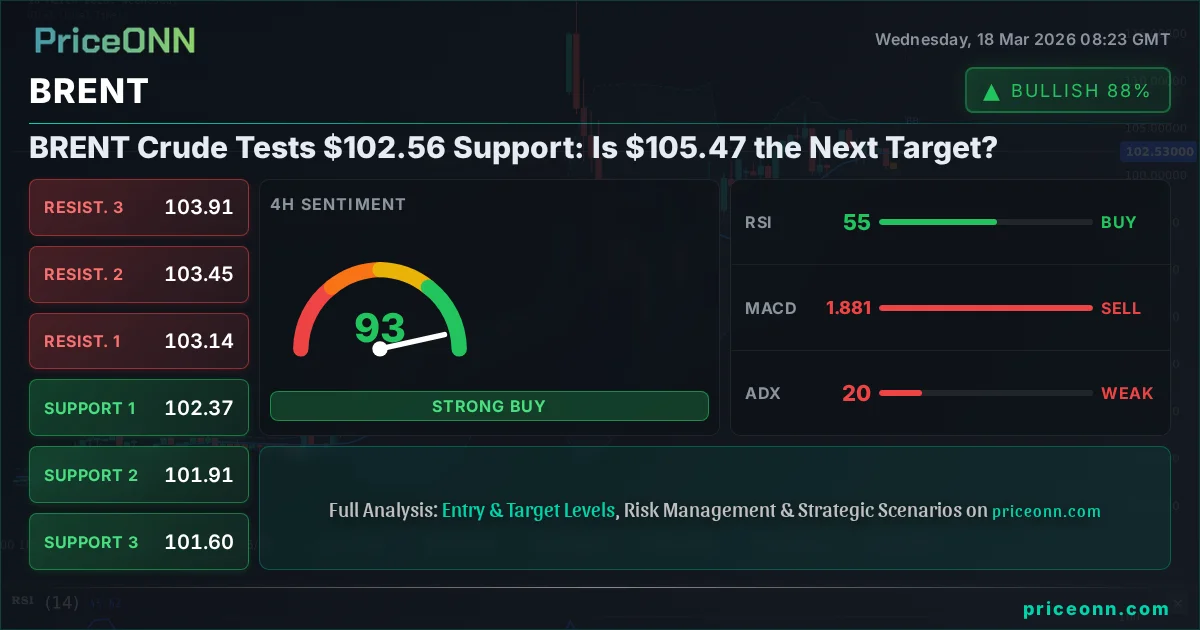
The recent agreement between Iraq and the Kurdistan region to restart the Kirkuk-Ceyhan oil pipeline, with a capacity of up to 250,000 barrels daily, offers a minor reprieve. However, market participants largely view this as insufficient to offset broader supply concerns, especially given the current geopolitical climate. Brent crude, trading at over $101 per barrel following the news, saw its price dip slightly before the renewed geopolitical fears pushed it higher.
Trader Implications: Volatility Ahead
Traders should brace for continued volatility in the energy markets. The immediate focus will be on any further escalation from Iran or responses from other regional powers. Key levels to watch for Brent crude include immediate resistance around the recent highs near $106 per barrel, with support potentially forming near the $100 mark if tensions de-escalate. For WTI, resistance lies around $96.16 and support near $90.
The risk of supply disruptions remains the dominant factor. Any confirmation of attacks on energy infrastructure or further threats could send prices significantly higher. Conversely, a swift de-escalation of rhetoric or a diplomatic resolution could lead to a sharp correction, especially given the current U.S. inventory levels. Traders should closely monitor news flow from the Middle East and official statements from OPEC+ nations regarding production adjustments.
Outlook: Tensions to Keep Prices Elevated
The outlook for oil and gas prices remains heavily influenced by geopolitical developments. While the U.S. inventory data suggests ample supply domestically, the specter of significant supply disruptions in the Middle East is likely to keep prices elevated. The effectiveness of Iran's potential retaliation and the response from international actors will be critical in determining the market's direction in the short to medium term. Traders should remain cautious, prioritizing risk management amidst the heightened uncertainty.
Frequently Asked Questions
What is the immediate impact of Iran's threat on oil prices?
Iran's threat to target regional energy sites following an alleged strike on its South Pars gas field caused Brent crude to surge by up to 6%, reaching $10.56 per barrel. This highlights the market's sensitivity to supply disruption fears.
How significant is the increase in U.S. crude oil inventories?
U.S. crude inventories rose by 6.2 million barrels for the week ending March 13, bringing total stocks to 449.3 million barrels. While a substantial build, this level is still 1% below the five-year average, suggesting underlying market tightness.
What is the outlook for oil prices given current geopolitical tensions?
The outlook remains bullish due to significant geopolitical risks in the Middle East. Potential supply disruptions from Iran's threats could keep prices elevated, with Brent crude facing resistance near $106 and support around $100.
Track markets in real-time
Empower your investment decisions with AI-powered analysis, technical indicators and real-time price data.
Join Our Telegram Channel
Get breaking market news, AI analysis and trading signals delivered instantly to your Telegram.
Join Channel

PriceONN