
Is NZD/USD Poised for a Rebound as Middle East Tensions Ease?

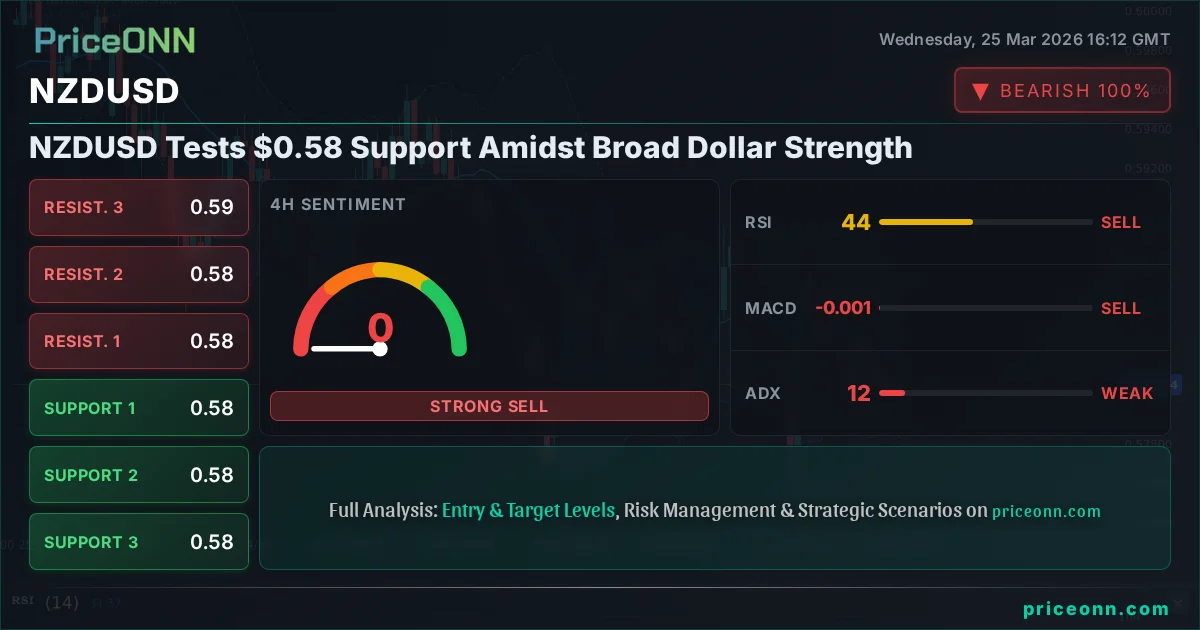
The NZD/USD pair experienced a downward drift in early Wednesday trading, dipping to approximately 0.5830. This move comes as global markets react to lingering geopolitical tensions in the Middle East, prompting a flight to safety in the US Dollar and weighing on the risk-sensitive New Zealand Dollar.
Market Context
The New Zealand Dollar has been under pressure as traders seek refuge in safer assets. The pair's decline to levels not seen in recent trading sessions underscores the market's sensitivity to global instability. While domestic factors and China's economic health are always relevant for the Kiwi, the immediate catalyst for this move appears to be external geopolitical developments. The ongoing uncertainty in the Middle East has fostered a 'risk-off' sentiment, which typically benefits the US Dollar at the expense of currencies like the NZD.
Analysis & Drivers
The performance of the NZD/USD is intrinsically linked to several key drivers. Beyond the immediate geopolitical concerns, the economic health of China, New Zealand's largest trading partner, remains a critical factor. Any signs of slowdown in the Chinese economy can directly impact demand for New Zealand's exports, particularly dairy products, a cornerstone of the nation's export revenue. Furthermore, the Reserve Bank of New Zealand's (RBNZ) monetary policy plays a crucial role. The central bank's mandate to keep inflation within its 1% to 3% target range dictates its approach to interest rates. Higher interest rates generally support the Kiwi by increasing the attractiveness of New Zealand government bonds to international investors. The interest rate differential between New Zealand and the United States is a significant determinant of the pair's trajectory. Meanwhile, the US Dollar's strength is being bolstered by its safe-haven status amid global uncertainties, including the Middle East situation. The perception of the USD as a stable store of value during times of geopolitical stress often leads to increased demand.
Trader Implications
Traders are closely monitoring developments in the Middle East for any signs of de-escalation, which could trigger a reversal in the current risk-off sentiment. A sustained improvement in geopolitical stability could lead to a pullback in the US Dollar and a corresponding rally in the NZD/USD. Key levels to watch include the 0.5850 resistance level, which acted as a floor previously, and the 0.5800 support. A decisive break above 0.5850 could signal a shift in momentum, while a fall below 0.5800 might indicate further downside. Investors should also keep an eye on upcoming economic data from both New Zealand and the United States, as well as any statements from central bank officials regarding monetary policy. The price of crude oil, which steadied around $88.00 for WTI, also indirectly influences market sentiment and risk appetite, although its direct impact on NZD/USD is less pronounced than its effect on other currencies.
Outlook
The immediate outlook for NZD/USD hinges on the evolving geopolitical landscape in the Middle East. Should diplomatic efforts yield a ceasefire, the pair could see a significant recovery as risk appetite returns to markets. Conversely, any escalation of tensions would likely see the pair continue its downward trend, testing lower support levels. The interplay between global risk sentiment, commodity prices, and central bank policies will continue to shape the currency pair's movements in the coming days and weeks.
Frequently Asked Questions
What is the current trading level for NZD/USD and why is it moving?
The NZD/USD pair is currently trading around 0.5830. Its downward movement is primarily driven by increased geopolitical tensions in the Middle East, which are causing investors to seek the safety of the US Dollar.
What domestic factors influence the New Zealand Dollar?
Key domestic influences include the Reserve Bank of New Zealand's monetary policy decisions, particularly interest rates, aimed at managing inflation within the 1% to 3% target. Economic data and trade relations, especially with China, also play a significant role.
What could cause NZD/USD to rebound?
A significant rebound for NZD/USD could be triggered by a de-escalation of tensions in the Middle East, leading to improved global market sentiment and a decrease in demand for the safe-haven US Dollar. Traders will be watching for a potential break above the 0.5850 resistance level.
Track markets in real-time
Empower your investment decisions with AI-powered analysis, technical indicators and real-time price data.
Join Our Telegram Channel
Get breaking market news, AI analysis and trading signals delivered instantly to your Telegram.
Join Channel



PriceONN