
Is the US Dollar Poised for Further Gains as Geopolitical Fears Linger?


The US Dollar is exhibiting strength across currency markets in early Wednesday trading, buoyed by persistent geopolitical tensions in the Middle East. This 'flight to safety' is weighing on riskier assets, with the New Zealand Dollar (NZD) weakening notably against its US counterpart, while the Indian Rupee (INR) sees a slight retracement after hitting record highs.
Market Context
The NZD/USD pair experienced a significant dip, trading as low as 0.5830 during the Asian session. This move underscores a broader market sentiment favoring the US Dollar as investors seek refuge from escalating global uncertainties. Concurrently, the USD/INR pair retreated to approximately 94.30, pulling back from its previous day's all-time peak of 94.75. This suggests that while the dollar remains a preferred safe-haven, hopes for a de-escalation in the Middle East are providing some relief to emerging market currencies.
In the commodities space, West Texas Intermediate (WTI) crude oil has found a temporary equilibrium, trading around $88.00 per barrel. This stabilization follows a two-day sell-off, indicating that while supply-demand fundamentals are at play, the recent focus on diplomatic efforts in the Middle East is tempering immediate price volatility, at least for now.
Analysis & Drivers
The primary catalyst for the US Dollar's strength is the ongoing geopolitical friction in the Middle East. Uncertainty surrounding potential US-Iran talks and broader regional stability creates an environment where capital tends to flow towards perceived safe havens, with the USD at the forefront. This dynamic often overshadows domestic economic data or central bank policy expectations in the short term.
For the New Zealand Dollar, its sensitivity to global risk appetite is amplified by its reliance on China's economic health and commodity prices, particularly dairy. Any slowdown in Chinese demand or a significant drop in dairy prices would further pressure the NZD. The Reserve Bank of New Zealand's (RBNZ) monetary policy, aimed at keeping inflation between 1% and 3%, also plays a crucial role. Higher interest rates typically support the currency, but current global risk aversion is negating potential positive domestic influences.
The Indian Rupee's recent volatility highlights its sensitivity to global crude oil prices, a major import for India. A surge in oil prices directly impacts the nation's trade deficit and can weaken the INR. However, the recent pullback in USD/INR suggests that improving market sentiment due to potential Middle East peace talks is offering some respite. Foreign capital inflows into India, both FDI and FII, remain a critical factor underpinning the Rupee's long-term stability.
The stabilization in WTI oil prices, despite the underlying geopolitical risks, indicates that market participants are weighing the potential for diplomatic breakthroughs against the physical supply concerns. The Organization of the Petroleum Exporting Countries' (OPEC) production decisions and global economic growth forecasts will continue to be key determinants of oil prices.
Trader Implications
Traders should closely monitor developments in the Middle East. Any significant escalation of conflict could see the US Dollar extend its gains, potentially pushing NZD/USD below 0.5800 and USD/INR towards new highs above 94.75. Conversely, positive news regarding a ceasefire or de-escalation could lead to a reversal, with USD/INR potentially testing support around 94.00 and NZD/USD looking to reclaim levels above 0.5850.
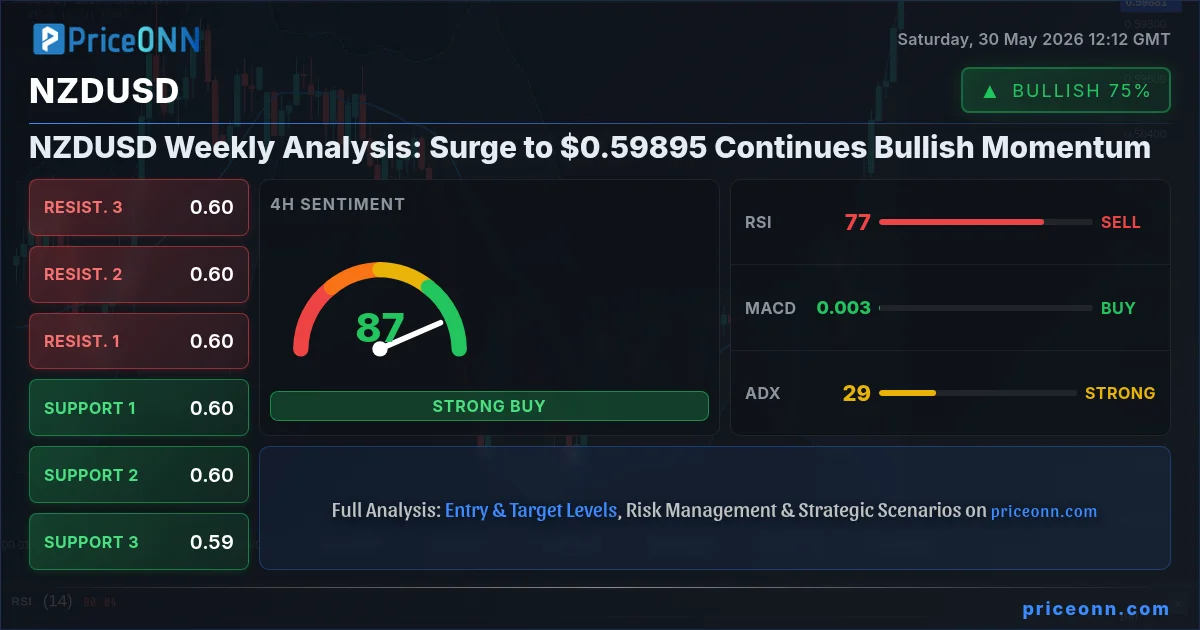
Key levels to watch for NZD/USD include immediate support at 0.5820 and resistance at 0.5850. For USD/INR, immediate resistance lies at the recent high of 94.75, with support found at 94.30 and then 94.00. The price of WTI crude oil, currently around $88.00, will also be a key indicator of risk sentiment, with a sustained move below $87.00 potentially signaling increased risk aversion, which would further benefit the US Dollar.
The interest rate differential between the US and New Zealand remains a background factor, but geopolitical risk is currently the dominant driver. Traders should maintain a cautious approach, as sudden geopolitical shifts can lead to rapid price movements. A sustained 'risk-off' environment would favor further upside for the US Dollar against most currencies.
Outlook
The immediate outlook suggests the US Dollar may continue to find support as long as geopolitical tensions in the Middle East remain elevated. However, any tangible signs of diplomatic progress could trigger a swift reassessment of risk, leading to a retracement in the dollar and a recovery in riskier currencies and commodities. Traders will be looking for confirmation from central banks and economic data to support longer-term directional moves, but for now, geopolitical headlines are dictating market direction.
Frequently Asked Questions
What is the current key price level for NZD/USD?
The NZD/USD pair has weakened below 0.5850, trading around 0.5830 as of early Wednesday trading. Immediate support is seen at 0.5820.
Why is the US Dollar strengthening against the Indian Rupee?
The US Dollar is strengthening due to its safe-haven status amid Middle Eastern geopolitical tensions. While hopes for a ceasefire are easing some pressure, the USD/INR pair is still elevated near 94.30 after hitting a record high of 94.75.
What is the outlook for oil prices amidst these geopolitical events?
WTI crude oil has stabilized around $88.00 per barrel after recent losses. While geopolitical risks support prices, potential diplomatic progress could lead to further declines. A move below $87.00 would signal increased risk aversion.
Track markets in real-time
Empower your investment decisions with AI-powered analysis, technical indicators and real-time price data.
Join Our Telegram Channel
Get breaking market news, AI analysis and trading signals delivered instantly to your Telegram.
Join Channel PriceONN News
Markets are pricing in a potential de-escalation in the US-Iran conflict, leading to a significant drop in crude oil prices and a weakening US Dollar as diplomatic efforts appear to be gaining traction.
PriceONN News
EUR/USD stalled below 1.1660 as the US Dollar defied expectations, refusing to weaken despite reports of a US-Iran ceasefire extension. Market participants remain cautious, awaiting concrete confirmation and assessing lingering inflationary pressures.
PriceONN News
EUR/USD closed at 1.1640, showing resilience amid mixed signals. Easing US-Iran tensions initially pressured the dollar, but persistent inflation concerns and political ratification hurdles are keeping the greenback surprisingly steady.
PriceONN News
EUR/USD stabilized around 1.1640 as reports of a US-Iran ceasefire extension and potential Strait of Hormuz reopening eased inflation fears. However, the US Dollar's resilience suggests lingering caution among forex traders.
PriceONN News
USDJPY has returned to the area of previous interventions. The ECB is moving towards a rate hike in June. The US dollar retreated on Friday amid new record highs for stock indices and rumours of amendments to the US-Iran agreement. However, tit-for-tat exchanges between the adversaries pushed the dollar index back into the support zone […] The post Yen Braces for a New Storm appeared first on ActionForex.
PriceONN News
The USD/JPY pair is flirting with the 160 level as stalled US-Iran negotiations and hawkish Federal Reserve rhetoric fuel inflation concerns. Traders are closely watching upcoming US Non-Farm Payrolls and Eurozone CPI data.
PriceONN News
The EUR/USD faces headwinds as core US PCE inflation unexpectedly rose to 3.3% year-over-year, reinforcing a 'higher for longer' interest rate narrative. Meanwhile, a US-Iran ceasefire extension boosted global risk appetite, potentially drawing capital away from safe-haven currencies.
PriceONN News
The US Dollar experienced a notable decline last week as markets priced in a potential diplomatic resolution to the US-Iran conflict, leading to a drop in oil prices and Treasury yields. This shift in sentiment suggests a move away from stagflation fears towards a more stable economic outlook.
PriceONN News
USD/CAD faces pressure as Canada's economy shows signs of stalling, with Q1 GDP contracting 0.1% and domestic demand weakening. This comes as trade negotiations and geopolitical shifts add layers of uncertainty.
PriceONN News
AUD/USD’s late break of 0.7183 resistance suggests that pullback from 0.7277 has already completed at 0.7076, after defending 55 D EMA. Initial bias is back on the upside this week for retesting 0.7277 high first. Firm break there will resume larger up trend. For now, risk will stay on the upside as long as 0.7076 […] The post AUD/USD Weekly Report appeared first on ActionForex.
PriceONN News
USD/CAD is showing signs of potential upward movement as Canada's economy grapples with a significant slowdown, marked by weak domestic demand and stalled investment, while trade negotiations loom large.
PriceONN News
USD/JPY is testing the critical 160 level as stalled US-Iran negotiations and hawkish Federal Reserve rhetoric fuel inflation concerns and a potential for further rate hikes. Traders are closely watching upcoming US Non-Farm Payrolls and Eurozone CPI data for direction.