
Oil Extends Losses After US, Qatar Signal Progress on Iran Draft Deal
 PriceONN Editorial Desk
Multi-source verification
PriceONN Editorial Desk
Multi-source verification
Global Oil Markets React to Diplomatic Signals
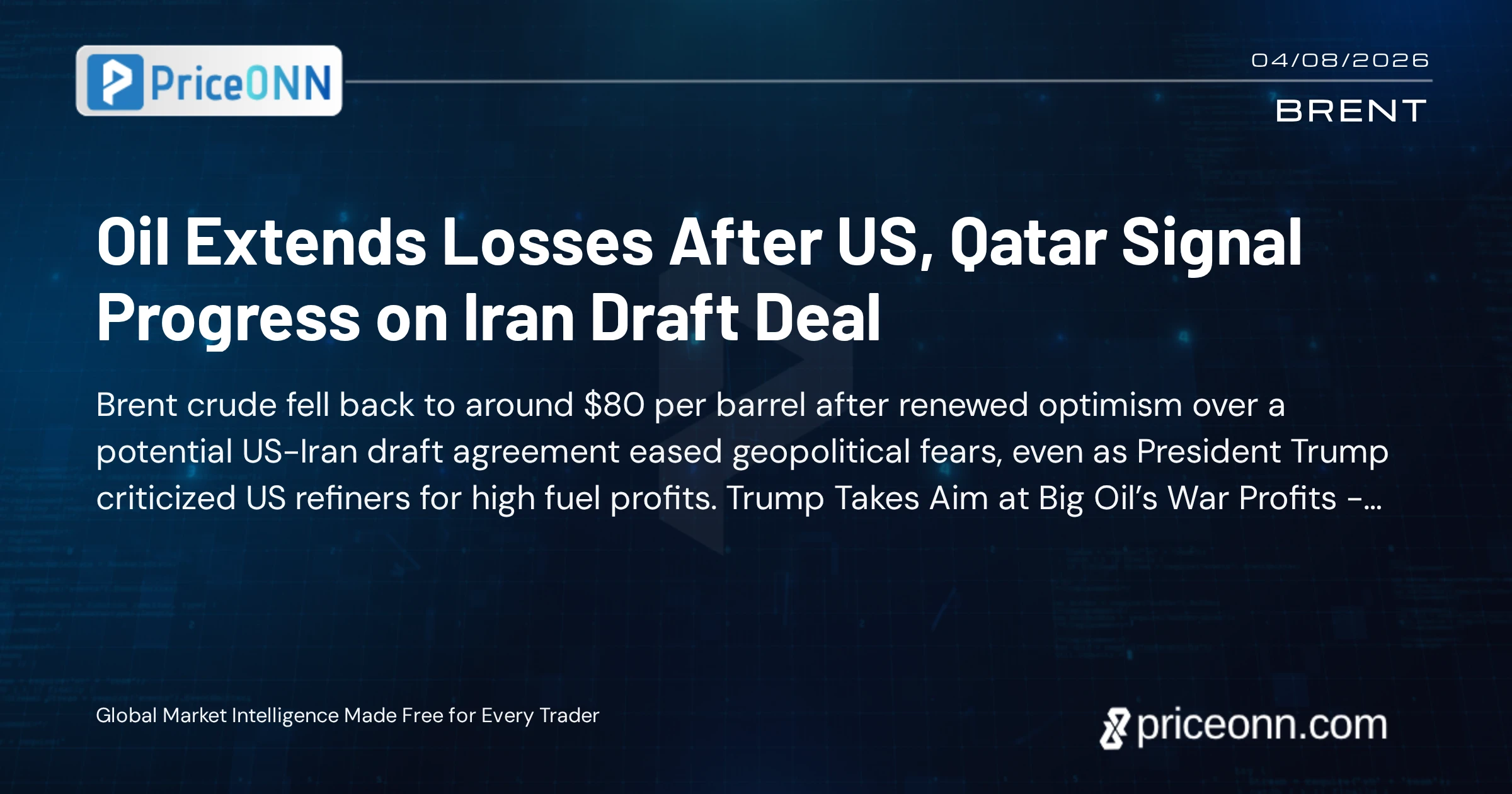
The international benchmark for crude oil, Brent crude, has retreated to approximately $80 per barrel. This downward movement follows a renewed sense of optimism regarding a potential draft agreement between the United States and Iran. Whispers of diplomatic progress have helped to quell immediate geopolitical anxieties that have underpinned oil prices in recent weeks.
This shift in market sentiment arrives as US President Trump has publicly admonished domestic oil refiners. The focus of his criticism centers on what he terms 'war profits,' highlighting the significant earnings reported by major energy companies in the second quarter. The President has explicitly instructed retailers to expedite the reduction of consumer fuel prices.
Specifically, President Trump directed accusations at industry giants like ExxonMobil and Chevron, suggesting they are profiting excessively and should 'give some of that money back to the public.' He also took issue with the companies for not acknowledging the administration's prior efforts to support the oil sector.
While both ExxonMobil and Chevron have experienced operational challenges, including impacts from closures in the Middle East for ExxonMobil and struggles with CPC disruptions in Kazakhstan for Chevron, their refining operations have demonstrated remarkable strength. Their refining margins have been exceptionally robust, particularly since the conflict in March escalated.
The economic metric known as the 3-2-1 spread, which represents the value derived from processing three barrels of crude into two barrels of gasoline and one barrel of distillates, has seen a dramatic increase. This spread has doubled since early March, reaching $60 per barrel. This surge stands in stark contrast to the more modest $11 per barrel increase in crude oil prices observed over the same period, particularly following the recent diplomatic overtures.
Amidst these developments, the average price for gasoline at US pumps has seen a slight decrease, settling at $4.08 per gallon as of August 4th. Nevertheless, this figure still represents a substantial 30% increase compared to prices recorded a year ago.
Corporate Portfolio Adjustments and Emerging Markets
In a significant portfolio move, UK-based energy powerhouse Shell has agreed to divest its European onshore renewable energy assets. The buyer is its peer major, TotalEnergies, in a transaction with an undisclosed value. This deal encompasses 0.5 GW of operational assets and a development pipeline of 3.5 GW.
Similarly, UK oil major BP has finalized the sale of its Gelsenkirchen refinery in Germany to the investment firm Klesch Group. This divestment leaves BP with a streamlined operation of five refineries, two located in the United States and three in Europe.
From the Caspian region, Azerbaijan's state oil company SOCAR has acquired the 3.65% operating stake previously held by Japanese trading firm Itochu in the significant Azeri-Chirag-Guneshli offshore field. This marks the fourth company to exit this prolific project.
Looking towards Africa, Nigeria's Dangote oil refinery is reportedly preparing for its initial public offering, anticipated to be the largest listing in the continent's history. Owner Aliko Dangote is actively encouraging regional capital markets to participate in this substantial IPO, slated for October.
Broader Energy Landscape Shifts
The recent diplomatic developments involving the US and Iran have significantly influenced crude oil prices. Statements from US Treasury Secretary Scott Bessent and Qatar's Foreign Ministry, indicating progress on a draft agreement, have bolstered hopes for a peaceful resolution. This has effectively pushed ICE Brent crude back down to the $80 per barrel level, just as President Trump intensified his critique of US refiners' profitability.
Seven member nations within OPEC+ have reached an agreement to collectively increase their output targets by 188,000 barrels per day for September. This move signifies the completion of the gradual unwinding of 1.65 million barrels per day in voluntary production cuts initially implemented in 2023. While the official figures reflect this adjustment, the actual market impact remains to be fully observed.
Saudi Aramco, the Kingdom's national oil company, reported a substantial 33% surge in its second-quarter profits, reaching $33.4 billion. This impressive financial performance was driven by elevated oil prices, which offset a decrease in production volumes. Aramco's average barrel sold fetched a significant $108.10.
In a notable pricing shift, Abu Dhabi's state oil company, ADNOC, will transition to pricing all its crude grades against Platts Dubai starting November 1. This change abandons its previous futures-based IFAD Murban mechanism, a move influenced by buyer demand for more immediate pricing amidst disruptions in the Strait of Hormuz.
Mexico's state oil company, PEMEX, has ceased operations at its Krem-1 exploratory well approximately five months after an accident caused a fire and significant gas flaring. Environmental monitoring of the incident, which may have released 300 million cubic meters of gas, is ongoing.
Iran and Oman are reportedly collaborating on establishing a unified shipping corridor through the Strait of Hormuz. This corridor would feature distinct lanes for entry and exit, a development that could potentially reshape maritime traffic management in the crucial waterway.
Brazil's state oil firm Petrobras has revised the timeline for its Morpho well exploration in the Foz do Amazonas basin, now expecting completion in September instead of the original May deadline. This area holds potential for a vast untapped oil reserve estimated at 30 billion barrels.
Indonesia has lifted restrictions on mineral exports, including those containing rare earth by-products, following complaints from sellers about testing delays impacting nickel exports. The immediate effect was a slide in the three-month LME nickel contract to $17,000 per metric tonne.
Record auction costs for Neopanamax slots in the Panama Canal, averaging $2.5 million and reaching bids as high as $3.8 million, are disrupting the economics of Very Large Gas Carrier (VLGC) transport. This surge in transit fees, occurring alongside disruptions elsewhere, is impacting the arbitrage for LPG from the US Gulf Coast to Asia.
Russia's weekly seaborne crude oil exports have fallen below 4 million barrels per day, reaching 3.9 million barrels per day. This dip follows a rebound in refinery throughputs to 4 million barrels per day, likely due to a decrease in Ukrainian drone strikes on refining facilities.
Iraq and Turkey have formalized a one-year agreement to maintain crude exports via the Kirkuk-Ceyhan pipeline. The deal includes provisions for quadrupling export flows to 750,000 barrels per day, enhancing the capacity for moving Iraqi crude to the Mediterranean.
The Syrian government has agreed to significantly reduce its imports of Russian crude, which averaged around 60,000 barrels per day in 2026. This reduction is part of ongoing discussions with the US administration aimed at lifting comprehensive sanctions.
Transits through the Strait of Hormuz have plummeted to a two-month low. This decline follows the targeting of the dry bulk tanker Minoan Pioneer, which resulted in the loss of one seafarer and the abandonment of the vessel. This incident occurred just two days after a very large crude carrier (VLCC) transporting Iraqi oil was attacked.
Qatar's energy expansion projects continue, with contractors Chiyoda and Technip Energies resuming work on the North Field East expansion. The first phase is undergoing commissioning, and the second is complete, with initial volumes anticipated by summer 2027.
The ongoing conflict involving Iran has inflicted substantial losses on global oil supply. Amin Nasser, CEO of Aramco, stated that lost output since February equates to 2.6 billion barrels, a full month of global crude production. Replenishing this volume is estimated to take 18 months at a rate of 2.1 million barrels per day, even if the Strait of Hormuz were to reopen immediately.
Reading Between the Lines
The dual narrative of easing Iran tensions and intense scrutiny on US refiner margins creates a complex environment for oil traders. While diplomatic breakthroughs can cap crude price upside, the underlying supply concerns, particularly those stemming from the Strait of Hormuz, remain a significant factor. The $80 per barrel level for Brent crude now represents a critical psychological and technical threshold.
The substantial refining margins, exemplified by the doubling of the 3-2-1 spread to $60 per barrel, indicate that while crude costs have fluctuated, the value derived from turning crude into refined products like gasoline and distillates has soared. This disconnect highlights potential profit-taking opportunities but also invites further regulatory attention. Traders will be watching closely for any official actions or policy changes stemming from President Trump's comments.
The market connections here are multifaceted. The potential de-escalation with Iran could ease pressure on the US Dollar Index (DXY), as geopolitical risk premiums often support the dollar. Conversely, sustained high refining margins could bolster the earnings of integrated energy companies like ExxonMobil (XOM) and Chevron (CVX), despite political headwinds. The broader energy sector, including related equities and futures contracts, will be sensitive to any shifts in geopolitical risk and domestic policy pronouncements. Investors might also re-evaluate the performance of emerging market energy plays, such as the potential IPO of Nigeria's Dangote refinery, in light of these global price dynamics.
Key risks include a sudden breakdown in diplomatic talks or an escalation of tensions in the Strait of Hormuz, which could rapidly reverse recent price declines. On the opportunity side, sustained high refining margins, if they persist despite political pressure, could offer continued support for specific segments of the energy market. Smart money is likely monitoring options markets for indications of sentiment shifts and closely tracking inventory data for both crude and refined products, which often precede major price moves.
Track markets in real-time
Empower your investment decisions with AI-powered analysis, technical indicators and real-time price data.
Join Our Telegram Channel
Get breaking market news, AI analysis and trading signals delivered instantly to your Telegram.
Join Channel PriceONN News
The IEA has slashed its 2026 global oil supply forecast, with output now expected to plunge 4.3 million barrels per day this year as the failure to reopen the Strait of Hormuz pushes the market deeper into deficit. The latest forecast is considerably worse than the 3.7-million-bpd decline the agency projected just last month and would leave global supply at 102.02 million bpd, its lowest forecast for 2026 yet. Supply is now expected to fall 1.27 million bpd short of demand for the year,...
PriceONN News
Indian state-controlled oil refiners continue to search the market for spot crude supply as term deliveries are constrained by the ongoing crisis in the Middle East and its key oil chokepoint, the Strait of Hormuz. Mangalore Refinery and Petrochemicals Limited (MRPL) and Hindustan Petroleum Corporation Limited (HPCL) are looking to buy a combined 6 million barrels of crude oil via spot tenders, Reuters reported on Wednesday, citing tender documents it has seen. HPCL is seeking up to 4 million...
PriceONN News
Brent Crude oil prices rose above $89 per barrel in early trade in Europe on Wednesday as Iran and the United States offered contrasting claims about who controls the Strait of Hormuz. Brent Crude prices were up by 0.64% at $89.60 in the morning in Europe, and WTI Crude was rising by 0.94% at $83.90, amid persistent supply concerns and risks despite claims from the U.S. that traffic at Hormuz had normalized. Iran, for its part, said on Tuesday that the Strait of Hormuz will remain closed unless...
PriceONN News
Oil flows from the Middle East have normalized, with Sunday traffic alone above pre-conflict averages, U.S. Secretary of Energy Chris Wright said on Tuesday in a claim that appears not to be backed by ship-tracking data. On Tuesday, Secretary Wright posted on X that “Thanks to the coordinated efforts of the U.S. military and our gulf allies, the seven-day average for oil leaving the Strait of Hormuz is currently up to almost 9 million barrels per day.” He went on to add that “When combined with...
PriceONN News
(RTTNews) - Crude oil prices have surged on Tuesday, extending the gains from the two previous sessions as the U.S.-Iran stalemate over new demands for compensation for war-related damages continued, diminishing the expectations of an early reopening of the Strait of Hormuz.
PriceONN News
The American Petroleum Institute (API) estimated that crude oil inventories in the United States rose by 9.072 million barrels in the week ending August 7, compared to analyst expectations for a 500,000-barrel draw. In the week prior, U.S. crude oil inventories rose by 2.69 million barrels. The larger-than-expected build was driven in part by higher crude imports relative to exports during the week. Commercial crude oil inventories excluding the SPR have lost just over 49 million barrels over...
PriceONN News
Five months after the U.S. and Israel opened a war with Iran, global fuel markets still haven't settled down, and the latest IEA data prove it. The IEA's monthly end-use price tracker, updated Aug. 7 and covering prices through July, shows the average per-liter cost of automotive diesel across the countries it tracks sitting near $1.94 in U.S. dollar terms. That's roughly 14% above where it stood in February, before the war started, and it's actually higher than June, even as crude oil kept...
PriceONN News
The national oil company of the United Arab Emirates has issued its eighth spot tender since June, trade sources told Reuters on Tuesday, as the Gulf producer that has just left OPEC pushes to sell increased crude volumes to international markets. Abu Dhabi National Oil Company (ADNOC) is offering in the latest spot tender cargoes of the Upper Zakum, Umm Lulu, and Das crude grades for loading in October and November’ sources. These crudes are produced within the Persian...
PriceONN News
OPEC’s total oil production jumped by 1.17 million barrels per day in July from June as many Gulf producers restored some output that was shut in for three months due to the closed Strait of Hormuz. Output at the 11-member OPEC rose to 19.85 million bpd in July, extending the monthly increases for the second consecutive month, according to a based on ship-tracking data and information provided by sources at OPEC, oil companies, and consultants. In May, when major Gulf producers...
PriceONN News
Libya’s National Oil Corporation may declare force majeure on exports from the Zawya oil terminal as a result of drone attacks on the facility. The Zawya terminal has a daily capacity of 120,000 barrels, sourced from the country’s largest oil field, Sharara, which can produce up to 300,000 barrels daily, Reuters noted in a report on the possibility of a force majeure declaration. According to reports, a drone strike had destroyed a storage tank and another drone had targeted an oil blending...
PriceONN News
The latest Bloomberg data show that shipping transits through the Strait of Hormuz remained largely disrupted Monday morning, even as Iran and Oman reportedly moved closer to a deal. Brent crude futures traded near $85 a barrel as markets priced in the possibility that a deal to reopen the maritime chokepoint could be imminent. Yet global supply-chain stress remains near its highest level since the pandemic, and any normalization could take months, even if shipping traffic resumes. UBS senior...
PriceONN News
Crude oil inventories in the United States saw a massive increase of 17.4 million barrels during the week ending August 7, according to new data from the U.S. Energy Information Administration (EIA) released on Wednesday. The increase brings commercial stockpiles to 424.4 million barrels, according to government data, which are now just 2% below the five-year average for this time of year. The EIA’s data release follows API’s figures that were released a day earlier, which reported that crude...