
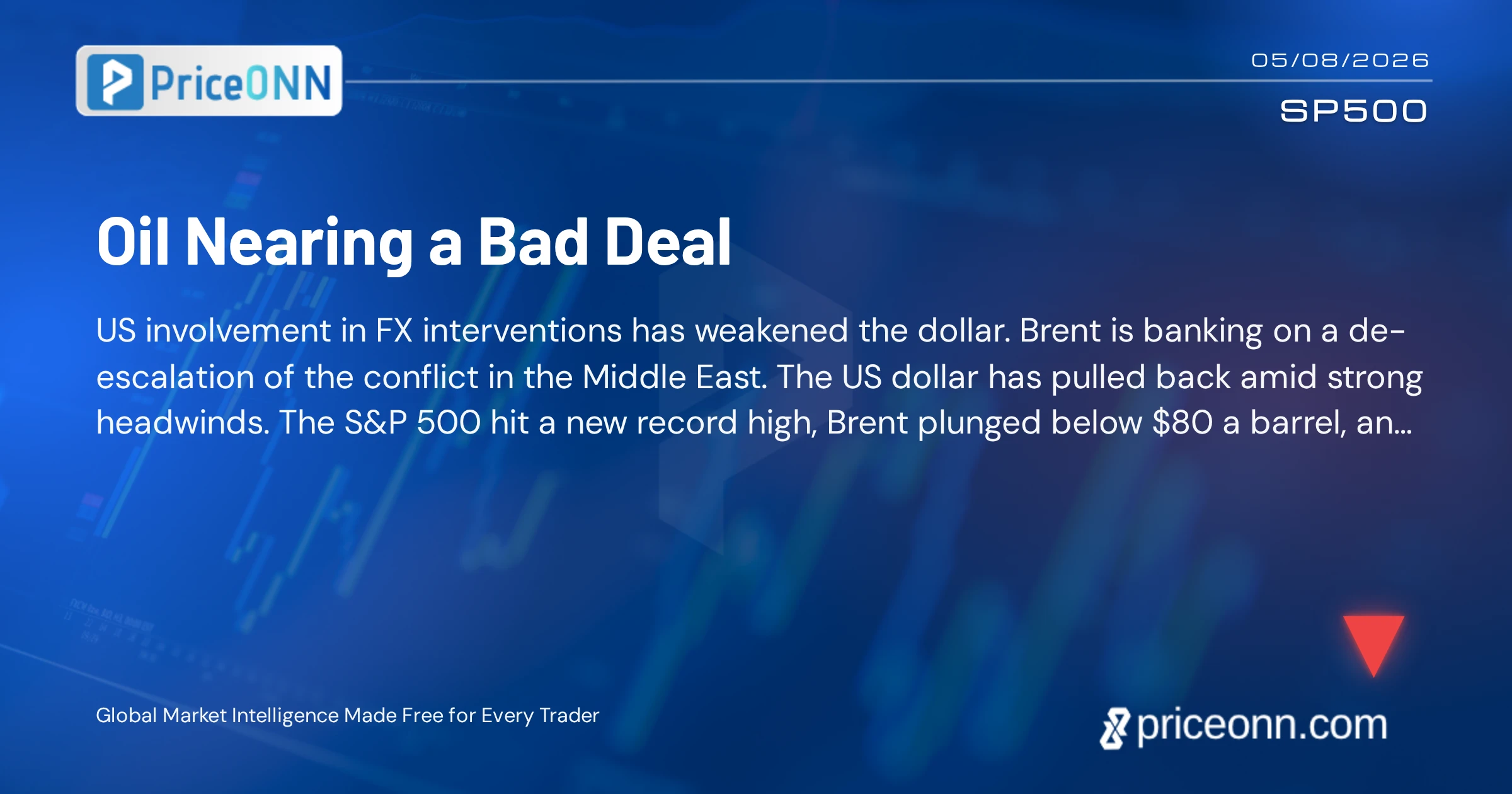
Oil Nearing a Bad Deal
 PriceONN Editorial Desk
Multi-source verification
PriceONN Editorial Desk
Multi-source verification
Global Markets React to Shifting Geopolitical Tides
A significant shift in market sentiment is underway, with the US dollar facing considerable headwinds and crude oil prices experiencing a sharp downturn. The S&P 500 achieved a new record high, while Brent crude futures dropped below the $80 per barrel mark for the first time since mid-July. Concurrently, yields on US Treasury bonds have retreated. These synchronized movements suggest a palpable increase in global risk appetite, putting pressure on traditional safe-haven assets, most notably the greenback.
Recent commentary from Scott Bessent regarding US engagement in foreign exchange interventions, coordinated with Japan, has further pressured the USD index. Treasury Secretary remarks indicated that unchecked yen depreciation could provoke a cascade of currency weakening against the dollar, potentially harming US export competitiveness. Historically, a weaker yen has been linked to global economic instability, as seen during the 1990s Asian financial crisis. This context frames the US interventions as a potential move to curb competitive devaluation, thereby reducing the dollar's safe-haven appeal by stabilizing perceived economic risks.
The Iran Deal Factor and Oil's Plunge
However, the dollar's slide appears to be more acutely influenced by Bessent's remarks hinting at an imminent deal with Iran. This, coupled with positive signals from Qatar on mediation efforts and Saudi Arabia's apparent pivot towards diplomatic engagement with the Houthis, has significantly impacted oil markets. Reports from Axios suggesting a potential agreement between Iran and Oman to reopen the Strait of Hormuz further fueled this sentiment, sending Brent crude prices to their lowest point in weeks.
Industry analysts are weighing the implications of a potential deal. Mizuho suggests that any agreement might be unfavorable to US interests and could leave several critical issues unresolved. A primary point of contention highlighted by IG is the transit fee for the Strait of Hormuz, with Tehran reportedly seeking compensation for war-related losses. The crucial question remains whether Washington will assent to such terms.
Meanwhile, the practical impact on oil transit remains stark. Data from Kpler indicates that only nine vessels have navigated the Strait of Hormuz, a dramatic decrease from the 130-140 passages typically seen before the regional conflict escalated. The American Petroleum Institute estimates a corresponding drop in daily oil traffic from 20 million to 6 million barrels.
Reading Between the Lines
The confluence of geopolitical developments and currency market interventions paints a complex picture for traders. The dollar's weakness, driven by both official actions and perceived diplomatic breakthroughs, is creating an environment where riskier assets can flourish. The sharp decline in oil prices, while seemingly a positive for consumers and inflation outlooks, carries significant implications for energy producers and geopolitical stability.
The market is now focused on the specifics of any potential Iran deal and the US response to its terms. A failure to reach a satisfactory agreement, or a breakdown in ongoing negotiations, could swiftly reverse the current bearish trend in oil, empowering 'bulls' to regain control. This highlights the delicate balance of risk and reward in play, where diplomatic progress is directly tethered to commodity prices and broader market sentiment.
Key indicators to watch include the ongoing transit volumes through the Strait of Hormuz and any official statements from the US Treasury regarding currency policy or the Iran negotiations. The market's reaction to these developments will be critical in determining the short-to-medium term trajectory for both the dollar and crude oil.
Track markets in real-time
Empower your investment decisions with AI-powered analysis, technical indicators and real-time price data.
Join Our Telegram Channel
Get breaking market news, AI analysis and trading signals delivered instantly to your Telegram.
Join Channel PriceONN News
Brent oil price rose to the highest in over one week on Tuesday, in extension of Monday’s nearly 5% advance, following the latest verbal escalation by President Trump that quickly changed the sentiment and countered efforts of Iran and Oman to find solution for reopening of strategic Hormuz strait. The latest demands from President Trump […] The post Brent Oil Price Falls After Recovery Failed to Clear Important $90 Barrier appeared first on ActionForex.
PriceONN News
A deal to reopen the Strait of Hormuz is not inevitable. Oil prices are rising amid growing risks of an escalation of the conflict in the Middle East. The US dollar continued to recover from losses caused by the jobs report, against a backdrop of rising geopolitical tensions in the Middle East with traders squaring […] The post Brent Is Following a Path of Demands Rather Than Commitments appeared first on ActionForex.
PriceONN News
The USD index plummeted amid a decline in US employment. Gold is benefiting from the Fed’s reluctance to raise interest rates. The US dollar touched a seven-week low after an unexpected labour market report. Employment in July unexpectedly fell by 23K. The figures for May were revised down from 129K to 63K, and those for […] The post The Dollar Let the Labour Market Down appeared first on ActionForex.
PriceONN News
The Consumer Price Index (CPI) rose by 0.1% month-on-month (m/m) in July – in line with expectations. On a twelve-month basis, CPI edged down to 3.4% (from 3.5% in June). Energy costs fell by 1.5% m/m, led by a 2.9% m/m decline in prices at the pump. Food prices rose 0.1% m/m – its softest […] The post US: Inflationary Pressures Remain Subdued in July appeared first on ActionForex.
PriceONN News
US inflation eased as expected in July, reinforcing case for Fed to stay on hold while it waits for clearer evidence on both prices and labor market. Headline CPI rose from -0.4% to 0.1% m/m, while annual rate slowed from 3.5% y/y to 3.4%. Core CPI increased from 0.0% to 0.2% m/m, with annual core […] The post US CPI Slows to 3.4% as Core Inflation Eases to 2.5% appeared first on ActionForex.
PriceONN News
Whatever the inflation figures may be, the precious metal will come out on top. Japan and the US don’t want to give the yen’s fate to speculators. The US dollar continues to recover from the blow dealt by the labour market statistics. A rally in Treasury bond yields is driving the rise in the USD […] The post Gold as a Sure-Fire Bet appeared first on ActionForex.
PriceONN News
Germany’s benchmark index just made history, breaking above 26,500 for the first time ever, extending a rally that has already delivered close to 10% over the past twelve months. The move came on fresh optimism around a potential resolution to the Iran conflict, though that optimism proved short-lived: President Trump’s latest demands, that Tehran compensate […] The post DAX 40: Record Highs, Real Fundamentals, One Channel Left to Test appeared first on ActionForex.
PriceONN News
Hello fellow traders. In this technical article we’re going to take a look at the Elliott Wave charts charts of Copper (HG_F) commodity published in members’ area of the website. As our members know, Copper Futures recently completed a pullback that provided a high-probability trading setup. The decline unfolded as a clear Elliott Wave Zig […] The post Copper (Hg_F) Elliott Wave: Targeting a Buy at the Blue Box appeared first on ActionForex.
PriceONN News
The NFIB’s Small Business Optimism Index rose 2.4 points to 99.8 in July, soundly beating expectations for a roughly flat reading of 97.5. Eight out of the ten index subcomponents improved during the month and two deteriorated. The largest improvement came from the net share of firms planning to increase employment (up 9 points to […] The post US: Small Business Optimism Spiked in July appeared first on ActionForex.
PriceONN News
Overnight, the RBA held its cash rate steady at 4.35%, as widely expected after June’s inflation data came in softer than forecast at 3.8% headline. Yet the accompanying statement struck a notably cautious tone, warning that trimmed mean inflation remains elevated and largely unchanged from the March quarter, with oil and related commodities still trading […] The post EUR/AUD: Two Central Banks on Hold, One Triangle About to Break appeared first on ActionForex.
PriceONN News
Gold rose to 4,400 USD per ounce on Tuesday, reaching a two-month high. Demand for the precious metal is growing rapidly, even amid heightened inflation risks and expectations of higher interest rates driven by elevated oil prices. Chinese institutional investors continue to build positions in gold as a defensive asset amid heightened volatility in other […] The post Gold Rallies: Long-Awaited Rise and Growing Safe-Haven Demand appeared first on ActionForex.
PriceONN News
RBA on hold as expected, recognising the data has broken against its hawkish narrative. Base case clearly an extended period on hold, but RBA will hike if upside risks to inflation materialise. As widely expected, the RBA Monetary Policy Board (MPB) kept the cash rate on hold at 4.35% at its August meeting. The accompanying […] The post RBA Holds at 4.35%, Narrows Risk of Hikes appeared first on ActionForex.