
Silver Risks Falling to $50 as Dollar Holds Firm and Solar Demand Shifts
 PriceONN Editorial Desk
Multi-source verification
PriceONN Editorial Desk
Multi-source verification
Silver's Rally Stalls Amidst Macro Headwinds
The white metal encountered significant resistance just below the $60 per ounce level this week. This stalling of its recovery occurred despite a cooler than anticipated US Consumer Price Index (CPI) report, a development that typically bolsters precious metals. Instead, the prevailing macroeconomic climate has proven less accommodating than many market watchers expected. Historically, a deceleration in US inflation would likely precipitate a notable weakening of the US Dollar, consequently providing a strong tailwind for assets like silver. However, this instance saw the Dollar's retreat prove shallow and inconsistent, failing to ignite robust buying interest in silver.
This confluence of factors has confined silver to its recent trading confines, reinforcing a bearish short-term outlook. The primary impediment has been the US currency itself. While the Dollar Index initially dipped following the release of June's subdued CPI figures, it managed to recoup a substantial portion of those losses. This recovery was bolstered by Federal Reserve Chair Kevin Warsh's congressional testimony, where he reiterated the central bank's unwavering commitment to price stability without signaling any dovish policy shifts.
Further complicating the Dollar's narrative, its weakness was largely confined to a select group of currencies influenced by their own domestic economic drivers. The Canadian Dollar, for example, found support from rising oil prices and a more hawkish stance from the Bank of Canada. Similarly, the New Zealand Dollar saw gains following assertive commentary from RBNZ Chief Economist Paul Conway. Against major currencies like the Euro, Sterling, Swiss Franc, and Yen, the Dollar's depreciation was comparatively marginal. Without a broad-based depreciation of the US currency, silver has struggled to attract the sustained investment inflows typically associated with softer US inflation prints.
Industrial Demand Faces a Structural Transition
Beyond the immediate macroeconomic currents, silver is confronting a more fundamental challenge stemming from its industrial applications. The global market has experienced an annual supply deficit for six consecutive years. Yet, unlike many other commodities, higher silver prices do not automatically translate into a significant expansion of supply. A substantial portion, approximately 70%, of global silver output is a byproduct of mining for copper, lead, and zinc. Consequently, production decisions are predominantly dictated by the market dynamics of these base metals rather than silver's own price trajectory.
The development of new mining projects is also a lengthy process, typically requiring seven to ten years to come online. This long lead time means that adjustments in demand play the primary role in balancing the market. Evidence suggests that such demand-side adjustments may already be in motion. China's leading solar panel manufacturer, Longi Green Energy, has commenced commercial production utilizing copper-metallized solar cells. This innovation significantly reduces the industry's dependence on silver, a key component in one of the metal's most rapidly expanding industrial uses. Considering that the solar energy sector represented approximately 17% of global silver demand last year, a widespread adoption of copper metallization could gradually diminish one of silver's most critical structural demand drivers. While this transition is unlikely to reshape the market overnight, it signals a significant alteration in the long-term equilibrium between supply and demand.
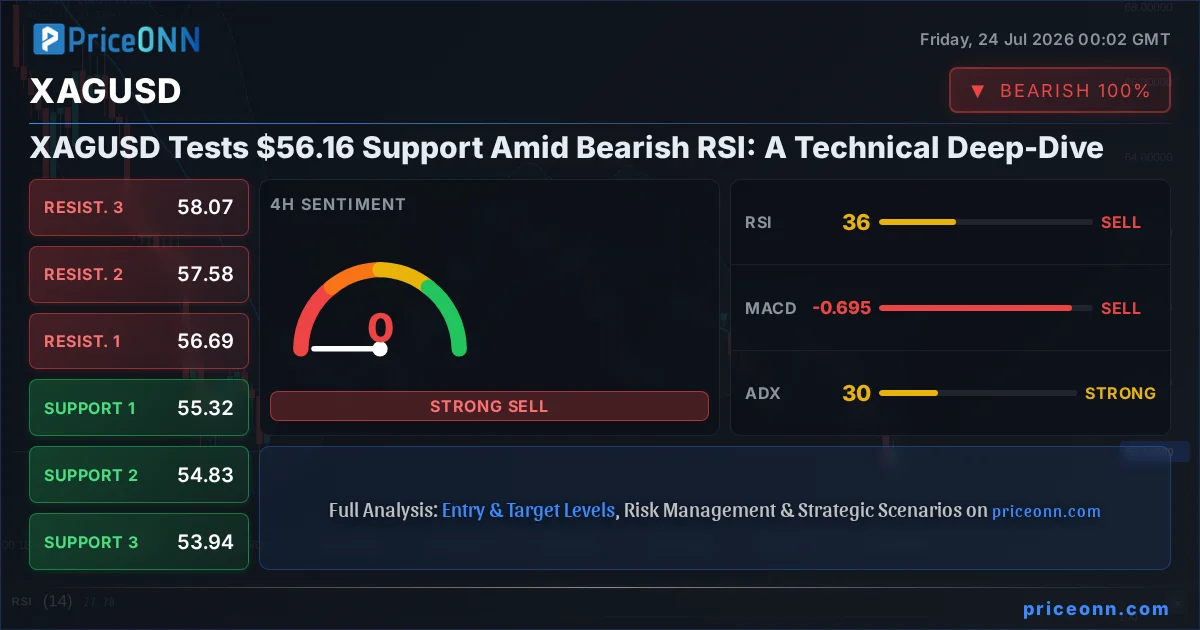
Technically, the outlook remains under pressure as long as resistance at the $63.25 level caps upward movement. A decisive breach below $55.59 could signal a resumption of the broader decline originating from the record high of $121.83. This path could lead towards the 76.4% Fibonacci retracement level, situated near $50.35, which also aligns with the psychologically significant $50 mark. Conversely, a sustained ascent above $63.25 would invalidate the bearish thesis, potentially extending the corrective rebound towards the 38.2% retracement of $68.49. However, until the US Dollar experiences a more generalized decline, silver appears increasingly susceptible to further downward pressure.
Reading Between the Lines
The current price action in silver suggests a disconnect between traditional inflation hedges and the actual market drivers. Despite a favorable CPI print, the Dollar Index's resilience, underpinned by Fed hawkishness, has effectively neutralized the typical positive correlation. This highlights a key risk for investors: the diminishing effectiveness of classic macro signals in the current environment. Traders should closely monitor the Dollar's performance against a basket of major currencies, not just its movement against a few select pairs.
The shift in industrial demand, particularly the move towards copper metallization in solar panels, represents a significant structural change. While solar accounted for about 17% of silver demand last year, this innovation could gradually erode that base. This development is crucial for understanding medium-term price prospects. Related assets to watch include copper (as a potential substitute and a driver of silver supply), the Australian Dollar (often correlated with commodity prices), and the broader equity markets, especially technology and renewable energy sectors, which could be impacted by solar industry trends.
Key levels to watch are the immediate resistance at $63.25 and support at $55.59. A break below the latter could accelerate declines towards the $50 psychological level. Conversely, a sustained push above $63.25, accompanied by a broader Dollar weakening, might signal a short-term reversal. Professionals will be watching options market positioning and any shifts in central bank communication regarding inflation targets and interest rate trajectories, which often precede retail market movements.
Track markets in real-time
Empower your investment decisions with AI-powered analysis, technical indicators and real-time price data.
Join Our Telegram Channel
Get breaking market news, AI analysis and trading signals delivered instantly to your Telegram.
Join Channel PriceONN News
The strong support at 4,000 helps gold defy the fundamentals. Rising Treasury yields and a strong US dollar are creating headwinds. The US dollar staged a four-day growth against the backdrop of air strikes on Iran. Rumours of a temporary ceasefire have not been confirmed, pushing Brent to near $93 per barrel and fuelling inflation […] The post Gold: The Floor Has Been Found, but Where Is the Ceiling? appeared first on ActionForex.
PriceONN News
The European Central Bank left its key interest rates unchanged as widely expected, keeping the deposit rate at 2.25%, while acknowledging that renewed energy market volatility has complicated the inflation outlook. Rather than signalling any change in policy direction, the Governing Council emphasized that the “outlook for energy prices, while highly volatile,” remains well above […] The post ECB Holds Rates, Closely Watches Energy Shock and Inflation Spillovers appeared first on ActionForex.
PriceONN News
EUR/CHF may already be telling investors what to expect from today’s European Central Bank meeting. The cross broke decisively above 0.9278 this week, extending its recent rally as surging oil prices revived inflation concerns across Europe. The move suggests markets have begun positioning for a relatively more hawkish ECB even though policymakers are almost universally […] The post EUR/CHF Rally Points to Hawkish ECB Hold as Oil Reignites Inflation Risks appeared first on ActionForex.
PriceONN News
Canada’s retail sales rose 1.0% mom to CAD 73.7B in May, marking a broad-based improvement in consumer spending as all nine retail subsectors posted gains. The increase was led by gasoline stations and fuel vendors, reflecting higher fuel prices, while motor vehicle and parts dealers also contributed with a second consecutive monthly increase. Excluding the […] The post Canada Retail Sales Rise 1.0% in May, June Momentum Seen Continuing appeared first on ActionForex.
PriceONN News
EURUSD is rising on expectations of ‘hawkish’ rhetoric from the ECB. The rally in Brent crude and Treasury yields is not helping the US dollar. The US dollar has retreated, despite rising oil prices and the resulting increase in US Treasury yields. Houthi attacks on tankers in the Red Sea have heightened geopolitical risks and […] The post Euro Focuses on the ECB appeared first on ActionForex.
PriceONN News
EUR/USD rose to 1.1429 on Thursday, with the US dollar continuing its moderate decline from the previous session. The market is assessing rising inflation risks driven by elevated energy prices against a backdrop of weakening economic data, while seeking further signals on Federal Reserve policy. At next week’s meeting, the regulator is expected to keep […] The post EUR/USD Recovers as Dollar Weakens appeared first on ActionForex.
PriceONN News
TL;DR: Brent oil has surged from to above $97 on Red Sea attacks and Strait of Hormuz escalation, bringing the psychological $100 level into view. While broader markets (stocks, bonds, currencies) have treated the move as a geopolitical risk premium, a decisive break above $100 could signal investors are pricing genuine supply disruption-a narrative shift that […] The post Red Sea Attacks Push Brent Oil Toward $100. Will Markets Finally React? appeared first on ActionForex.
PriceONN News
Australia’s labour market delivered a much stronger-than-expected performance in June, with employment jumping by 76.3k, far exceeding expectations of 15.0k and accelerating from May’s 40.3k gain. Despite the surge in hiring, the unemployment rate held steady at 4.4%, as forecast, with the participation rate climbing from 66.7% to a record-equalling 67.0%. The data point to […] The post Australian Jobs Blow Past Forecasts With 76.3k Growth as Participation Keeps Unemployment Steady appeared...
PriceONN News
The short‑term Elliott Wave outlook for FTSE highlights a sustained bullish progression since the March 23, 2026 low. From that base, the Index has carved a clear five‑swing advance, which is classified as a motive sequence and supports the expectation of further upside. The initial rally produced wave ((i)) at 10,687.88, followed by a corrective […] The post FTSE Elliott Wave Outlook: Bullish Bias with 5‑Swing Progression Since March 2026 appeared first on ActionForex.
PriceONN News
We expect the Federal Reserve to remain on hold in the July meeting, in line with consensus. Markets price in 20-25% probability for a hike. Without new projections or forward guidance from Warsh, the focus will be on the vote split. We think the most likely outcome is 2-4 votes in favour of a hike. […] The post US – Fed Preview: A Divided Hold appeared first on ActionForex.
PriceONN News
The Japanese Yen tumbled to another four-decade low today, with USD/JPY breaking above the 163 mark as investors continued to unwind Yen positions against the backdrop of widening global yield differentials and surging energy prices. The move has once again thrust Japan’s currency policy into the spotlight, raising familiar questions over whether authorities will step […] The post Yen Hits Fresh 40-Year Low. Can Japan Still Defend Its Currency? appeared first on ActionForex.
PriceONN News
Gold traded around 4,080 USD per ounce on Wednesday, having risen nearly 2% the previous day. Investors continue to assess developments in the Middle East and the impact of elevated oil prices on inflation and interest rates. Donald Trump has played down the prospects of an imminent resumption of negotiations with Iran and warned of […] The post Gold Rises Amid Heightened External Risks appeared first on ActionForex.