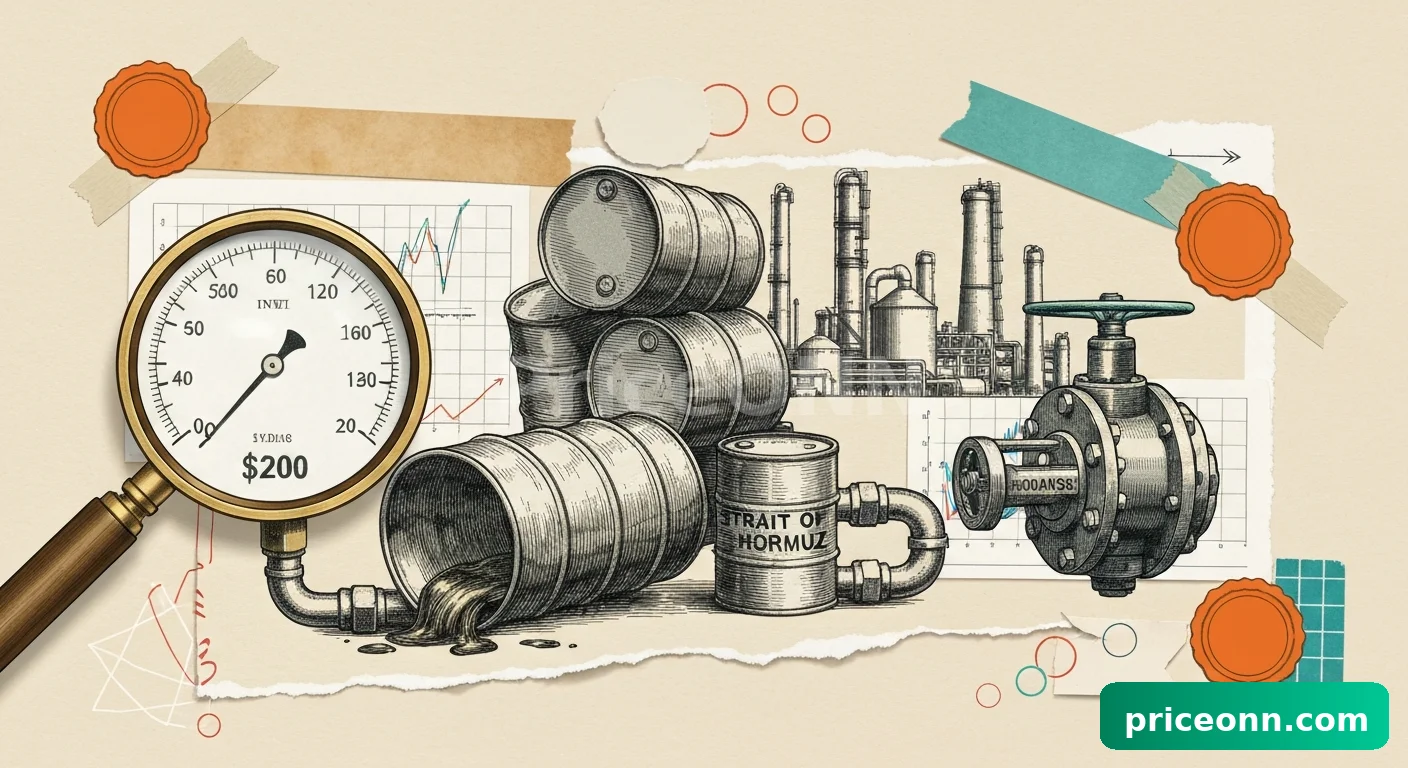
Strait of Hormuz Closure Triggers Oil Supply Crisis, U.S. Shale Poised for Windfall
The escalating conflict in the Middle East has led to a critical disruption in global oil supply, with the Strait of Hormuz, a vital chokepoint, now largely closed to commercial traffic. This development has effectively removed approximately 7 million barrels per day (bpd) of crude oil from the market, representing a significant 7% of global daily liquid fuel demand. The immediate consequence has been a sharp ascent in crude and natural gas prices, sparking widespread concerns about sustained energy flow disruptions and potential global economic fallout.
Market Context: A Chokehold on Global Supply
In less than three weeks since heightened US-Israeli actions impacted Iran and subsequently led to the closure of the Strait of Hormuz, over 12 million barrels of oil equivalent per day (boepd) of Middle East production has been taken offline. This includes the aforementioned 7 million bpd of crude. Iraq has been particularly hard-hit, experiencing a curtailment of over 60% of its pre-conflict volume. Industry reports indicate that the physical limitations of storage and export infrastructure are nearing their breaking point, suggesting that the situation could deteriorate further.
The Gulf Cooperation Council (GCC) nations, which include Saudi Arabia, the UAE, Qatar, Kuwait, Oman, and Bahrain, are now in a precarious position. With roughly 15 million bpd of their daily crude exports effectively stranded due to the Hormuz closure, these countries are estimated to be forfeiting as much as $1.2 billion in export revenues each day. The cumulative loss in oil and natural gas revenues since the conflict began has already surpassed $15 billion.
Analysis & Drivers: Geopolitical Tensions and Strategic Options
The primary driver behind this crisis is the escalating geopolitical tension in the Middle East, which has culminated in the de facto closure of the Strait of Hormuz. Vessel tracking data confirmed zero commercial transits on a recent Saturday, a stark contrast to the usual average of approximately 2.6 daily crossings since the conflict began. This severe disruption has prompted urgent diplomatic consultations in Europe and has placed significant leverage in the hands of Gulf oil producers.
Analysts note that GCC nations could potentially deploy an energy “nuclear option” by declaring force majeure on their oil and gas exports. Such a move would deliberately remove an additional 20% of global supply from the market, unleashing immediate global economic shockwaves and potentially compelling international powers to re-evaluate their military strategies. This drastic step, while seemingly extreme, underscores the immense power these producers now wield.
On the other side of the equation, U.S. shale oil producers are positioned to benefit significantly from sustained high prices. Intelligence firm Rystad Energy projects that if U.S. benchmark crude averages $100 per barrel for the year, these producers could generate an additional $63.4 billion in free cash flow. This potential windfall comes as the White House appears to be shifting its messaging away from consumer cost reduction towards managing the economic impacts of the Middle East crisis.
However, market watchers caution that a prolonged stay above $100 per barrel is not the consensus view. While short-term volatility is likely, the sustainability of such high prices hinges on the duration and severity of the Hormuz disruption and the broader geopolitical landscape. China, a major importer, remains publicly silent after U.S. President Donald Trump urged Beijing to help reopen the Strait, reiterating calls for de-escalation instead. Data shows that over one-third of the oil transiting Hormuz in early 2025 was destined for China, highlighting its vulnerability.
Trader Implications: Navigating Volatility and Key Levels
Traders should brace for continued volatility in crude oil markets. The immediate focus will be on any developments regarding the Strait of Hormuz and potential diplomatic efforts to reopen it. Key price levels to watch for West Texas Intermediate (WTI) and Brent crude will be influenced by supply-side news and demand outlooks.
- Monitor Supply Disruptions: Closely track any further curtailments from Middle Eastern producers or news regarding naval escorts for tankers.
- Watch for Diplomatic Breakthroughs: Any sign of de-escalation or successful negotiations to reopen Hormuz could lead to sharp price pullbacks.
- U.S. Shale Production: Observe reports on U.S. shale output and cash flow projections, as this sector's performance is directly tied to elevated price environments.
- Key Resistance/Support: For WTI, initial resistance may be found near the recent highs around $100-$105, with support potentially forming around $90-$95. Brent crude could face similar resistance levels.
The risk of further supply drops, potentially pushing Middle East output down to 6 million bpd in a pessimistic scenario, adds an upward bias to prices. However, the potential for an energy 'nuclear option' by GCC producers, while extreme, presents an even greater upside risk, albeit one with severe global economic consequences.
Outlook
The energy market faces an uncertain period, heavily dictated by the geopolitical situation surrounding the Strait of Hormuz. While prices have surged on supply fears, the potential for a negotiated reopening or further escalation looms large. Traders should remain vigilant, focusing on actionable intelligence related to supply flows, diplomatic progress, and the resilience of global demand. The coming weeks will be crucial in determining whether this supply crisis leads to a sustained period of significantly higher energy prices or a swift correction.
Frequently Asked Questions
What is the impact of the Strait of Hormuz closure on global oil supply?
The closure of the Strait of Hormuz has removed approximately 7 million barrels per day of crude oil from global markets, representing about 7% of daily global demand. This has led to significant price increases and fears of sustained energy disruption.
How much could U.S. shale producers gain from current oil prices?
Intelligence firms project that U.S. shale producers could generate an additional $63.4 billion in free cash flow if the U.S. benchmark crude price averages $100 per barrel for the year, driven by the current geopolitical supply concerns.
What is the 'nuclear option' for Gulf oil producers?
The 'nuclear option' refers to Gulf Cooperation Council (GCC) nations declaring force majeure on their oil and gas exports. This would deliberately remove another 20% of global supply from the market, causing severe economic shockwaves.
Track markets in real-time
Empower your investment decisions with AI-powered analysis, technical indicators and real-time price data.
Join Our Telegram Channel
Get breaking market news, AI analysis and trading signals delivered instantly to your Telegram.
Join Channel