
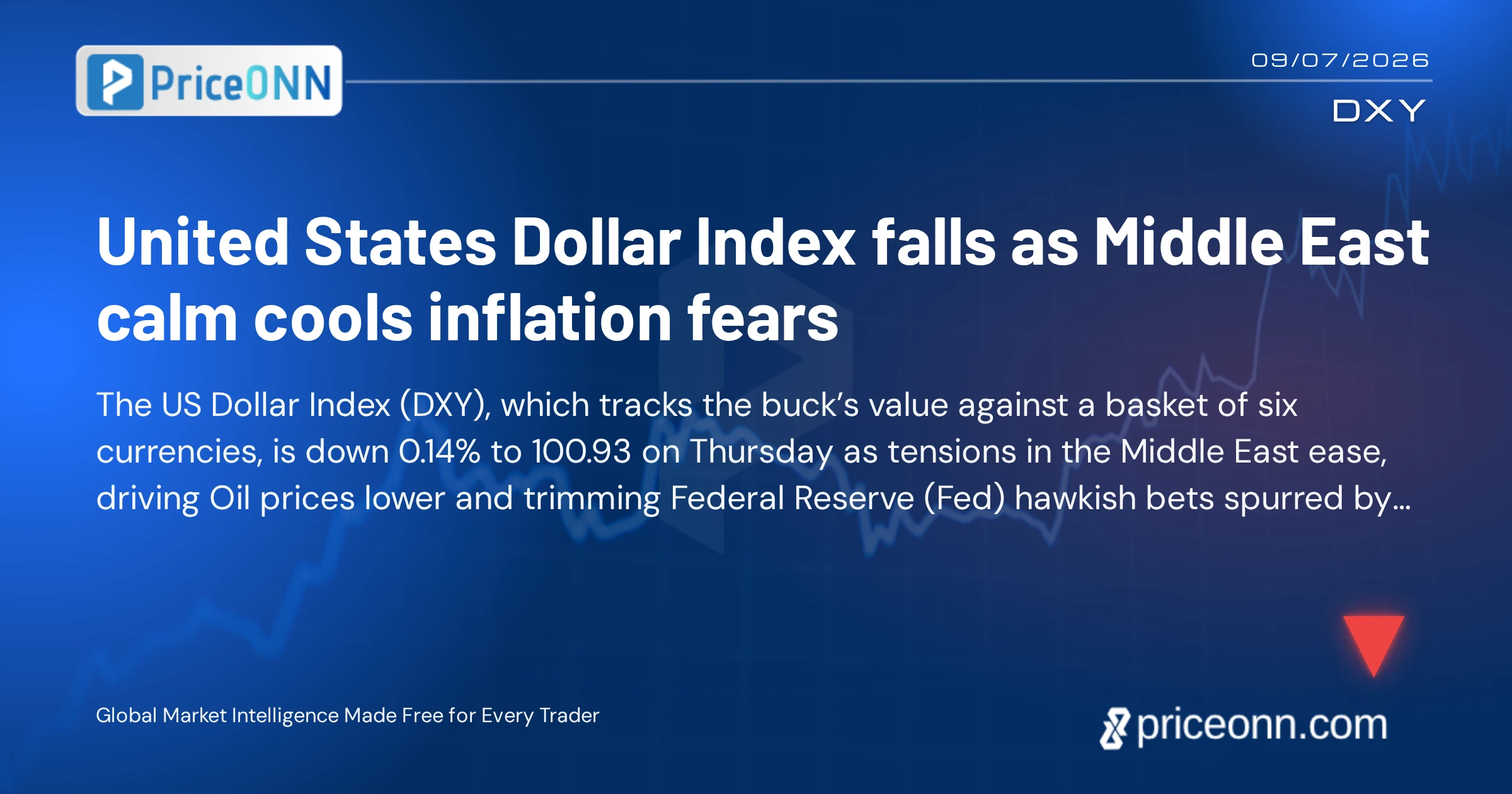
United States Dollar Index falls as Middle East calm cools inflation fears
 PriceONN Editorial Desk
Multi-source verification
PriceONN Editorial Desk
Multi-source verification
Dollar Index Retreats on Geopolitical Détente
A palpable sense of calm returning to the Middle East has sent ripples through global markets, most notably impacting the US Dollar Index (DXY). The benchmark, which gauges the greenback's strength against a basket of six major currencies, registered a 0.14% decline, settling at 100.93 on Thursday. This downward movement appears directly linked to a cooling of energy market anxieties.
The recent escalation of Middle Eastern tensions had previously fueled concerns over potential oil supply disruptions, a scenario that typically translates into higher energy prices and, consequently, heightened inflation fears. Such inflationary pressures often lead market participants to anticipate a more hawkish stance from central banks, particularly the Federal Reserve (Fed), prompting rate hike expectations. However, with diplomatic efforts seemingly gaining traction and the immediate threat of widespread conflict receding, oil prices have softened. This easing in the energy complex directly alleviates some of the inflation-driven pressure on the Fed.
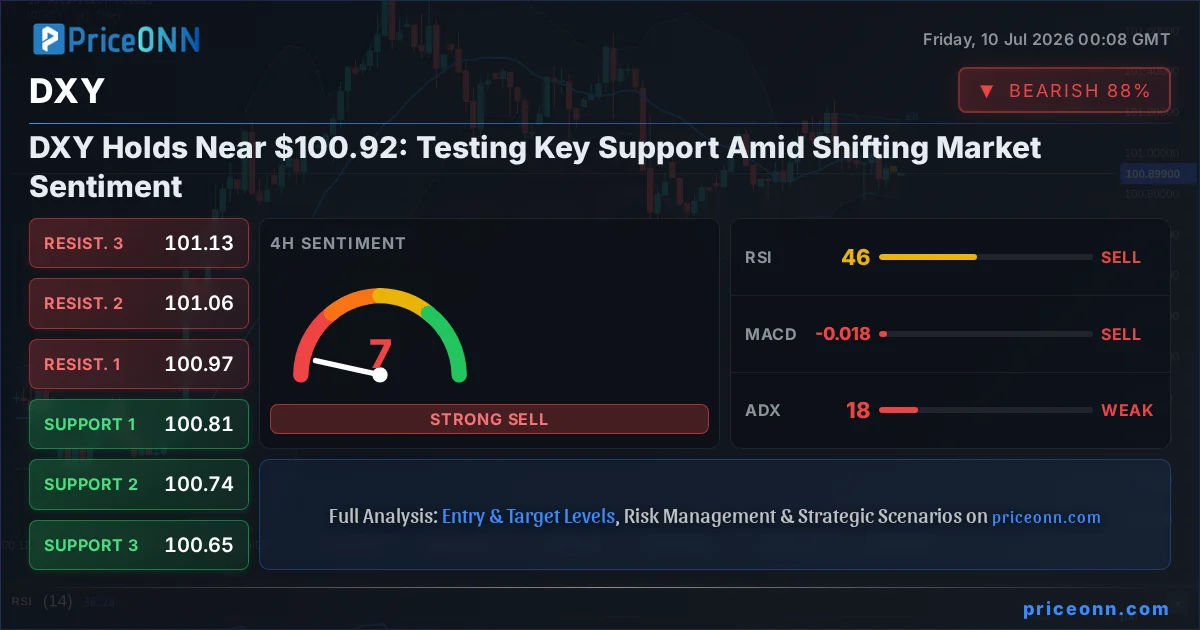
The Dollar's Foundation: Monetary Policy and Global Standing
The US Dollar, a linchpin of international finance, commands an unparalleled position in global trade. As the world's primary reserve currency, it underpins an astounding 88% of all foreign exchange turnover, with daily transactions averaging a staggering $6.6 trillion in 2022. Its ascent to this dominant status followed World War II, supplanting the British Pound.
Historically tethered to gold, the dollar's direct convertibility ended with the dissolution of the Gold Standard under the Bretton Woods Agreement in 1971. Since then, the value of the greenback has become intrinsically linked to the monetary policy decisions enacted by the Federal Reserve. The central bank operates under a dual mandate: maintaining stable prices, defined as keeping inflation around the 2% target, and promoting maximum employment.
Interest rate adjustments serve as the Fed's principal lever for achieving these objectives. When inflation accelerates beyond the Fed's comfort zone, rate increases typically bolster the dollar's value. Conversely, should inflation falter or unemployment rise significantly, the Fed might opt for interest rate cuts, exerting downward pressure on the greenback.
Unconventional Tools: QE and QT's Impact
In more extreme economic circumstances, the Federal Reserve possesses unconventional tools, including quantitative easing (QE) and quantitative tightening (QT). QE involves a substantial expansion of the money supply, typically through the Fed purchasing government bonds from financial institutions. This injection of liquidity aims to unfreeze credit markets when interbank lending seizes up due to counterparty default fears, a measure employed forcefully during the 2008 Great Financial Crisis. Historically, QE tends to weaken the US Dollar.
Quantitative tightening represents the inverse strategy. The Fed ceases its bond purchases and allows its existing holdings to mature without reinvestment, effectively shrinking its balance sheet and reducing the flow of credit. This process is generally viewed as supportive of a stronger US Dollar.
Reading Between the Lines
The recent dip in the DXY illustrates a critical market dynamic: the interplay between geopolitical stability, commodity prices, and monetary policy expectations. The easing of Middle Eastern tensions has provided a much-needed reprieve, directly impacting the inflation narrative that has dominated financial discussions for months. This development suggests that market sentiment can pivot rapidly based on perceived geopolitical shifts.
For traders, this event highlights the sensitivity of currency markets to external shocks, particularly those affecting energy prices. The implied reduction in imminent Fed tightening, a direct consequence of cooling inflation fears, offers a counterpoint to previous hawkish pronouncements. Key currency pairs to watch include USD/JPY, which often reacts inversely to risk appetite, and commodity-linked currencies like AUD/USD, which may see renewed interest if the global economic outlook brightens. Investors should monitor upcoming economic data releases, especially inflation figures and employment reports, for further clues on the Fed's future policy path.
Track markets in real-time
Empower your investment decisions with AI-powered analysis, technical indicators and real-time price data.
Join Our Telegram Channel
Get breaking market news, AI analysis and trading signals delivered instantly to your Telegram.
Join Channel PriceONN News
The Middle East is once again at the center of global energy markets due to the renewed military confrontation involving Iran. Markets, however, should recognize that, unlike in previous crises, the world is entering this new phase with a significantly weaker strategic safety net. At present, crude oil prices still respond to headlines surrounding military operations, shipping incidents, and diplomatic statements. Still, it is now time that markets should no longer overlook the structural...
PriceONN News
The United States is prepared for a continued exchange of fire with Iran over the Strait of Hormuz and Tehran’s attacks on commercial vessels in the chokepoint, U.S. officials have told Axios, while both sides continued to trade strikes early on Thursday. The U.S. is prepared for an escalation that could last from a day or two to multiple weeks to get Iran to back down from attacking ships in the Strait of Hormuz, a U.S. official told Axios. Iran’s next moves will determine how long and how...
PriceONN News
Kazakhstan is growing more possessive of its petroleum products as a gasoline shortage tightens its grip in Russia and the US-Iran conflict reignites. Kazakh officials have established new police checkpoints on almost 60 roads along the country’s lengthy border with Russia to curb ‘gasoline tourism,’ according to local news reports. In addition, new restrictions have been introduced at border checkpoints, limiting trucks and cars to one crossing per day. In recent weeks, as gasoline shortages...
PriceONN News
(RTTNews) - Extending the losses from Thursday's session, crude oil prices have declined sharply on Friday as efforts by third-party mediators to bring the U.S. and Iran back to the negotiating table intensify while the Middle East remained free from any new U.S. versus Iran atta
PriceONN News
Renewed U.S.-Iran strikes have revived the Middle East risk premium, lifting Brent above $76 as traffic through the Strait of Hormuz slows and supply disruption fears return. Friday, July 10, 2026 The return of the Middle Eastern geopolitical risk premium has lifted global oil prices by $4 per barrel this week, with ICE Brent set to settle above $76 per barrel. Renewed US-Iran strikes pushed traffic through the Strait of Hormuz back toward a near-standstill as market concerns about continued...
PriceONN News
Despite the tentative recovery of oil flows through the Strait of Hormuz and the first build-up in global stocks since the war began, this week’s re-escalation of the U.S.-Iran hostilities could flip the outlook for an oil market surplus for next year, the International Energy Agency said on Friday. Oil prices have plunged since the United States and Iran signed the memorandum of understanding (MoU) in the middle of June, with North Sea Dated prices down by $31 per barrel in June to $68 a...
PriceONN News
Refining margins for gasoline and diesel jumped this week to new record highs after the re-escalation in the Middle East, Russia’s ban on diesel exports, and crumbling global fuel inventories. The surge in fuel margins and the price spread over crude prices suggest that the global fuel markets remain very tight despite the millions of barrels of crude that have managed to exit the Strait of Hormuz in recent weeks. Diesel refining margins in Europe jumped to a record high of over $60 per...
PriceONN News
Close to half a dozen liquefied natural gas carriers have gone into the Strait of Hormuz in the past few days and six have exited the strait, despite the recent return to hostilities between the United States and Iran. According to Kpler data cited by Reuters, five ballast LNG tankers have entered the chokepoint in recent days, four of them linked to Qatar, and the fifth one owned by a Greek shipping company. The five vessels were previously seen outside Hormuz earlier this month. An earlier...
PriceONN News
West Texas Intermediate (WTI) – the benchmark US Crude Oil price – steadies during the Asian session on Friday, stalling the previous day's downfall amid mixed messaging from the US and Iran.
PriceONN News
When the UAE said it was leaving OPEC so it could boost production as much as it wanted, it sparked speculation, yet again, that OPEC was falling apart. The peace deal between the United States and Iran was a done deal in the eyes of oil traders, and the race for market share was on. Then the missiles started flying again, the U.S. president said the ceasefire is dead, and long-term oil disruption in the OPEC heartland came to the fore. Reuters’ Ron Bousso earlier this week suggested OPEC was...
PriceONN News
Who says price isn't a rationing mechanism? Rather than sink billions into long-term oil sands projects, Alberta energy companies are increasingly chasing the Clearwater formation, a conventional heavy oil field that allows producers to capitalize on rising crude prices far more quickly. The surge in activity has been significant. Alberta approved 1,764 drilling licenses between Jan. 1 and June 12, the busiest start to a year since 2014. Roughly one-fifth of those...
PriceONN News
Wednesday’s jump in oil prices to a two-week high suggests that market participants were too complacent about the U.S.-Iran ‘deal to make a deal’ and that the ceasefire would hold and oil flows through the Strait of Hormuz would only increase, analysts at ING said on Thursday. Oil prices surged by over 5% on Wednesday, gaining 7% at one point to a two-week high, after the escalation in the region. The Iranian attacks on three commercial ships on Tuesday, including an oil tanker and an LNG...