
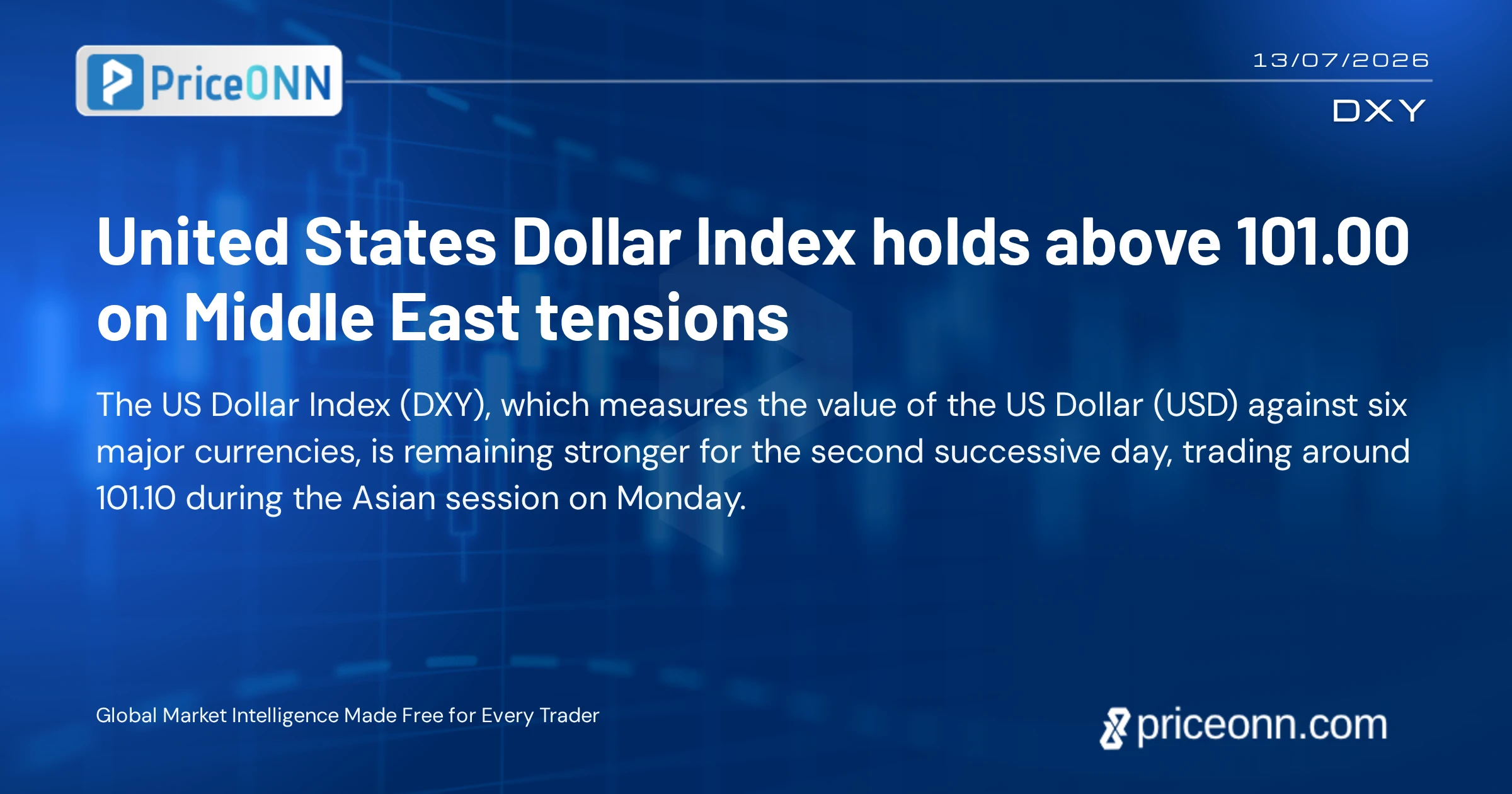
United States Dollar Index holds above 101.00 on Middle East tensions
 PriceONN Editorial Desk
Multi-source verification
PriceONN Editorial Desk
Multi-source verification
Dollar Strength Fueled by Global Uncertainty
The US Dollar (USD), a dominant force in global finance, is demonstrating resilience. Beyond its role as the official currency of the United States, it functions as a de facto medium of exchange in numerous other nations. Its preeminence is undeniable; in 2022, it represented over 88% of all global foreign exchange turnover, with daily transactions averaging a staggering $6.6 trillion. This vast liquidity underscores its central position in international commerce and investment.
Historically, the US Dollar ascended to its global reserve status, supplanting the British Pound, in the aftermath of World War II. For a significant period, its value was tethered to gold. However, this link was severed in 1971 with the dissolution of the Bretton Woods Agreement, ushering in the era of fiat currency.
Federal Reserve's Dual Mandate and Market Impact
At the heart of the US Dollar's valuation lies the monetary policy enacted by the Federal Reserve (Fed). This central bank operates under a dual mandate: maintaining price stability and promoting maximum employment. Its primary instrument for achieving these objectives is the strategic adjustment of interest rates.
When inflationary pressures mount, pushing prices higher and exceeding the Fed's target of 2%, the central bank typically raises interest rates. This action generally strengthens the dollar, making borrowing more expensive and curbing demand. Conversely, if inflation falters below the 2% threshold or if the unemployment rate climbs too high, the Fed may opt to lower interest rates. Such a move tends to exert downward pressure on the greenback.
In more severe economic circumstances, the Federal Reserve possesses additional tools. It can resort to printing more dollars and implementing quantitative easing (QE). QE is an unconventional policy designed to inject liquidity into a struggling financial system when interbank lending freezes due to counterparty default fears. It is a measure of last resort, deployed when rate cuts alone are insufficient. The Fed famously utilized QE to address the credit crisis of 2008, buying U.S. government bonds from financial institutions to unfreeze credit markets. This expansionary monetary policy typically weakens the dollar.
The inverse of QE is quantitative tightening (QT). Under QT, the Federal Reserve scales back its bond purchases and allows maturing bonds to roll off its balance sheet without reinvestment. This process is generally viewed as supportive of the US Dollar's value.
Reading Between the Lines
The current strength of the DXY, holding firm above 101.00, is a clear signal of risk aversion rippling through global markets. While the specific catalyst mentioned is Middle East tensions, the underlying dynamic is a flight to perceived safety. In times of geopolitical uncertainty or economic instability, investors often pivot away from riskier assets and seek refuge in assets perceived as more stable, with the US Dollar often being a primary beneficiary.
This dynamic is particularly relevant when considering the interconnectedness of global markets. A stronger dollar can have significant implications for various asset classes. Emerging market currencies, for instance, often face pressure as dollar-denominated debt becomes more expensive to service. Commodity prices, frequently priced in dollars, can also see fluctuations; a stronger dollar can make these commodities more expensive for holders of other currencies, potentially dampening demand.
Traders and portfolio managers will be closely monitoring the geopolitical developments and the Fed's communication. Any escalation in regional conflicts could further bolster the dollar, while signs of de-escalation might prompt a retracement. Furthermore, the Fed's own policy stance, particularly any hints about future interest rate adjustments or balance sheet operations, will be critical. Market desks are often focused on subtle shifts in Fed language or forward guidance that retail participants might overlook, seeking to anticipate policy moves before they are fully priced in.
The interplay between geopolitical risk, central bank policy, and currency valuations creates a complex environment. Understanding these forces is key to navigating the current market landscape. The DXY's current posture above 101.00 is not just a technical level; it reflects a broader sentiment of caution and a demand for dollar liquidity in the face of global instability.
Track markets in real-time
Empower your investment decisions with AI-powered analysis, technical indicators and real-time price data.
Join Our Telegram Channel
Get breaking market news, AI analysis and trading signals delivered instantly to your Telegram.
Join Channel PriceONN News
EUR/USD rose to 1.1429 on Thursday, with the US dollar continuing its moderate decline from the previous session. The market is assessing rising inflation risks driven by elevated energy prices against a backdrop of weakening economic data, while seeking further signals on Federal Reserve policy. At next week’s meeting, the regulator is expected to keep […] The post EUR/USD Recovers as Dollar Weakens appeared first on ActionForex.
PriceONN News
The Euro’s (EUR) modest upside attempt against the US Dollar (USD) witnessed during Wednesday’s Asian session has been short-lived. The EUR/USD pair was capped below 1.1420, before pulling back to levels a few pips above 1.1400 during the European trading session.
PriceONN News
The Brent crude rally is a bigger ‘bearish’ factor for EURUSD than the ECB. The Fed may spring a surprise as early as July. The US dollar paid no heed to the ECB’s hawkish rhetoric and continued its advance against major global currencies, including the euro. The European Central Bank left its deposit rate at […] The post Dollar: Oil Leaves the Fed with No Choice appeared first on ActionForex.
PriceONN News
TL;DR: Gold and Silver tumbled as markets returned to the oil-rates relationship that governed Q2, with Brent above $100 and 10-year Treasury yields above 4.7% restoring pressure on the metals - leaving their next move hostage to Trump’s binary decision on Iran. Why This Matters Gold and Silver tumbled as markets returned to trading precious […] The post Gold and Silver Tumble as Oil Link Returns; Trump’s Looming Decision on Iran Adds Binary Risk appeared first on ActionForex.
PriceONN News
Key insights from the week that was. The June Labour Force Survey offered both noise and signal. Employment surprised materially to the upside, rising 76.3k in the month. However, the gain was matched by a sizeable lift in labour supply, the participation rate bouncing 0.3ppts to 67.0%, a 13-month high. The ABS noted in the […] The post Cliff Notes: Markets on Edge appeared first on ActionForex.
PriceONN News
EURUSD is rising on expectations of ‘hawkish’ rhetoric from the ECB. The rally in Brent crude and Treasury yields is not helping the US dollar. The US dollar has retreated, despite rising oil prices and the resulting increase in US Treasury yields. Houthi attacks on tankers in the Red Sea have heightened geopolitical risks and […] The post Euro Focuses on the ECB appeared first on ActionForex.
PriceONN News
TL;DR: Brent oil has surged from to above $97 on Red Sea attacks and Strait of Hormuz escalation, bringing the psychological $100 level into view. While broader markets (stocks, bonds, currencies) have treated the move as a geopolitical risk premium, a decisive break above $100 could signal investors are pricing genuine supply disruption-a narrative shift that […] The post Red Sea Attacks Push Brent Oil Toward $100. Will Markets Finally React? appeared first on ActionForex.
PriceONN News
EUR/CHF may already be telling investors what to expect from today’s European Central Bank meeting. The cross broke decisively above 0.9278 this week, extending its recent rally as surging oil prices revived inflation concerns across Europe. The move suggests markets have begun positioning for a relatively more hawkish ECB even though policymakers are almost universally […] The post EUR/CHF Rally Points to Hawkish ECB Hold as Oil Reignites Inflation Risks appeared first on ActionForex.
PriceONN News
The strong support at 4,000 helps gold defy the fundamentals. Rising Treasury yields and a strong US dollar are creating headwinds. The US dollar staged a four-day growth against the backdrop of air strikes on Iran. Rumours of a temporary ceasefire have not been confirmed, pushing Brent to near $93 per barrel and fuelling inflation […] The post Gold: The Floor Has Been Found, but Where Is the Ceiling? appeared first on ActionForex.
PriceONN News
The Japanese Yen tumbled to another four-decade low today, with USD/JPY breaking above the 163 mark as investors continued to unwind Yen positions against the backdrop of widening global yield differentials and surging energy prices. The move has once again thrust Japan’s currency policy into the spotlight, raising familiar questions over whether authorities will step […] The post Yen Hits Fresh 40-Year Low. Can Japan Still Defend Its Currency? appeared first on ActionForex.
PriceONN News
Gold traded around 4,080 USD per ounce on Wednesday, having risen nearly 2% the previous day. Investors continue to assess developments in the Middle East and the impact of elevated oil prices on inflation and interest rates. Donald Trump has played down the prospects of an imminent resumption of negotiations with Iran and warned of […] The post Gold Rises Amid Heightened External Risks appeared first on ActionForex.
PriceONN News
The Japanese Yen (JPY) attracts significant bids against its major currency peers during the European trading session on Wednesday. The USD/JPY pair falls vertically to near 162.65, but quickly recovers some losses and rebounds to around 162.90.