US Crude Oil, Product Inventories Rise

Surprising Inventory Surge
The United States witnessed an unexpected accumulation of crude oil reserves, with the American Petroleum Institute reporting a 2.3 million barrel increase for the week concluding March 20. This development stands in stark contrast to the previous week's substantial 6.556 million barrel climb and, crucially, deviates from the consensus forecast of a 1.3 million barrel drawdown among market watchers. The discrepancy suggests that market participants were anticipating a stronger pull on inventories than what ultimately materialized.
Meanwhile, the nation's Strategic Petroleum Reserve (SPR) maintained its steady level, holding firm at 415.4 million barrels for several consecutive weeks as of the reporting period's end. This consistent figure indicates no immediate adjustments to strategic reserves, which currently sit 310.1 million barrels below their maximum capacity. The lack of movement in the SPR, coupled with the unexpected build in commercial crude, paints a complex picture of current oil market conditions.
Production Dip and Product Piles
Adding another layer to the market narrative, U.S. domestic oil production has now contracted for four consecutive weeks. Data indicates a dip of 10,000 barrels per day (bpd) in the week ending March 13, bringing the average output down to 13.668 million bpd. While this represents a slight decrease, it is still notably higher by 95,000 bpd compared to the same period last year, highlighting the resilience of U.S. output despite recent declines.
The inventory landscape for refined products also saw notable shifts. Gasoline stockpiles experienced a 500,000 barrel increase in the week ending March 20. This rise follows a significant 4.6 million barrel decrease in the prior week. Despite the recent build, gasoline inventories remain approximately 3% above the typical five-year average for this time of year, according to the latest Energy Information Administration (EIA) figures. Distillate fuel inventories, conversely, climbed by 1.4 million barrels, reversing a 1.4 million barrel decrease from the preceding week. These distillate supplies are currently running about 3% below their five-year average, the EIA data reveals.
A particularly striking development occurred at the Cushing, Oklahoma storage hub, the key delivery point for West Texas Intermediate (WTI) futures. Inventories there surged by an impressive 4 million barrels, signaling a significant accumulation at a critical juncture for oil futures trading.
Market Ripple Effects
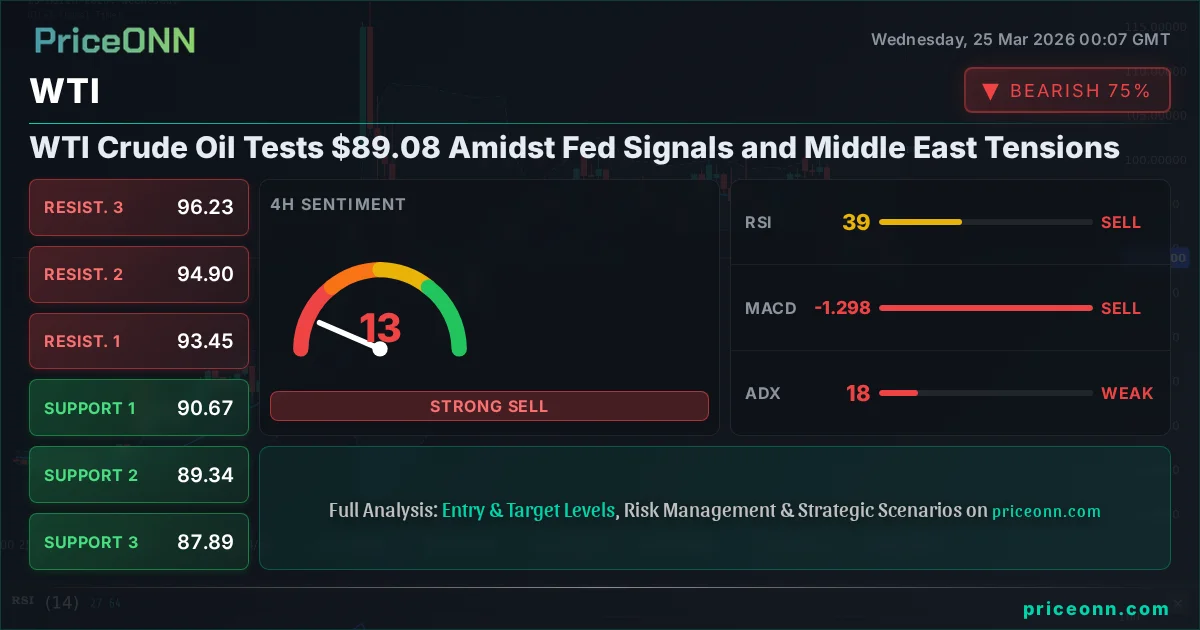
The confluence of rising crude inventories and mixed signals in refined product stocks presents a challenging environment for oil traders. The unexpected build in crude, particularly the substantial addition at Cushing, could exert downward pressure on WTI futures. Meanwhile, ongoing disruptions to tanker traffic through the Strait of Hormuz and production challenges in key Middle Eastern regions continue to provide a floor for Brent crude prices, creating a divergence in the benchmarks. At 4:14 pm ET, Brent crude was trading up 3.79% at $103.70 per barrel, demonstrating resilience despite the broader inventory build. WTI also saw gains, rising 4.32% to $91.94 per barrel on the day, though both benchmarks remain closely watched for shifts influenced by these inventory movements.
Trader Takeaways
This week's API report injects a dose of bearish sentiment into the crude oil market, directly challenging optimistic analyst expectations. The significant build, especially the 4 million barrel jump at Cushing, is a critical signal for traders. It suggests that demand, while perhaps recovering in some areas, is not yet strong enough to absorb current production levels, even with a recent dip in output. This could put a lid on immediate upside for WTI.
The resilience in Brent crude, buoyed by geopolitical tensions and supply route concerns, highlights a market bifurcated by different fundamental drivers. Traders should monitor the spread between Brent and WTI closely for signs of changing risk premiums. The slight build in gasoline inventories, while not alarming given the recent draw, bears watching. If this trend continues, it could indicate softening consumer demand for fuel, a key component of overall oil consumption. The divergence between current inventory levels and historical averages for refined products also presents opportunities for nuanced trading strategies. Key levels to watch include the recent highs for Brent and the psychological $90 mark for WTI, which may see increased support if the bearish inventory trend persists.
Track markets in real-time
Empower your investment decisions with AI-powered analysis, technical indicators and real-time price data.
Join Our Telegram Channel
Get breaking market news, AI analysis and trading signals delivered instantly to your Telegram.
Join Channel