
Why Did WTI Crude Oil Rebound Above $90 After a Sharp 11% Plunge?

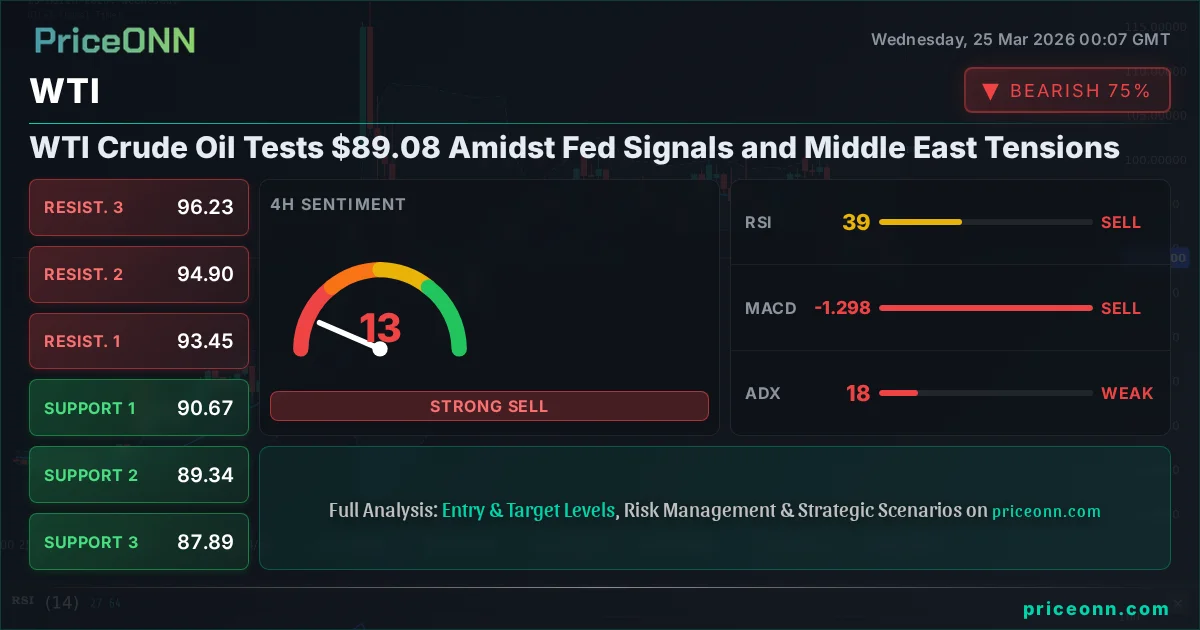
West Texas Intermediate (WTI) crude oil experienced a dramatic U-turn, rebounding approximately 3% to trade above $90.00 per barrel on Tuesday, just a day after suffering an 11% plunge that saw prices briefly dip towards the $85 area.
Market Context: A Diplomatic Dance and Price Volatility
The volatile price action was largely dictated by geopolitical pronouncements rather than traditional supply and demand fundamentals. Initially, WTI crude prices experienced a false bullish breakout, briefly breaching the significant $100 per barrel psychological level. However, this surge was swiftly extinguished by statements from the US President indicating a postponement of planned strikes on Iranian energy infrastructure for five days, citing ongoing diplomatic efforts. This news, intended to ease tensions and suppress oil prices, led to a sharp decline.
This narrative was complicated by conflicting reports. Representatives from Iran publicly denied any active negotiations aimed at de-escalation. Simultaneously, regional tensions persisted with reports of continued strikes in the Middle East. This complex information environment suggests that the US President's comments may have been a deliberate, albeit unconventional, attempt to exert downward pressure on prices through verbal intervention. The impact was undeniable, pushing WTI below its levels from the preceding week.
Analysis & Drivers: Geopolitics and Technical Levels
The sudden reversal and subsequent rebound highlight the market's sensitivity to geopolitical developments and the interplay between diplomatic signaling and underlying market mechanics. While the initial drop was driven by the perceived de-escalation, the market's skepticism regarding the sincerity of de-escalation efforts and the continuation of regional conflicts fueled the recovery. Analysts note that the market may have overreacted to the initial geopolitical statement, leading to a swift correction as traders reassessed the true risk premium still embedded in oil prices.
Technically, the price action around the $100 psychological barrier was significant, with substantial selling activity noted there previously. Following the initial descent, a support cluster formed after the price exited a descending channel. This zone proved critical in slowing the sharp decline near the $85 mark. The broader price action has since allowed for the mapping of a wide ascending channel, with its lower boundary now serving as a crucial support level.
Trader Implications: Navigating Uncertainty
Traders should remain highly attuned to geopolitical developments in the Middle East, as these will likely continue to be the primary catalyst for short-term price movements in WTI crude. The conflicting signals between diplomatic statements and ongoing regional actions create a high-volatility environment. Key technical levels to watch include the $90 per barrel mark as immediate resistance, followed by the psychological $100 level. On the downside, the $85 area represents a critical support zone. A sustained break above $90 could signal further upside potential, while a fall back below $85 might indicate a continuation of the bearish sentiment seen on Monday.
The market's rapid recovery suggests that the perceived risk premium has not been entirely removed. Investors and traders should consider hedging strategies if they anticipate further geopolitical escalation, as this could rapidly push prices back towards or even above the $100 mark. Conversely, any concrete signs of de-escalation or a significant increase in global oil inventories, such as a substantial build reported by the EIA or API, could exert renewed downward pressure.
Outlook: A Fragile Balance
The immediate outlook for WTI crude remains uncertain, balanced precariously between geopolitical rhetoric and the reality of ongoing conflict. While the rebound above $90 offers some short-term relief to bulls, the underlying tensions suggest that price volatility will persist. Traders will be closely monitoring statements from global leaders, OPEC+ production decisions, and weekly inventory reports for direction. Any significant shift in the geopolitical landscape or a clear indication of increased supply could trigger another sharp move in either direction.
Frequently Asked Questions
What caused WTI Crude Oil to drop 11% on Monday?
WTI Crude Oil dropped sharply by approximately 11% on Monday, falling towards the $85 level, primarily due to pronouncements from the US President suggesting a postponement of strikes on Iranian energy infrastructure. This was perceived as a de-escalation, although conflicting reports and ongoing regional tensions later fueled a rebound.
What are the key technical levels for WTI Crude Oil traders to watch?
Key resistance levels for WTI Crude Oil are the $90 per barrel mark and the psychological $100 level. Crucial support is observed in the $85 area, which acted as a floor following Monday's sharp decline. Traders should monitor these levels for potential breakout or breakdown signals.
What is the short-term outlook for WTI Crude Oil prices?
The short-term outlook for WTI Crude Oil is characterized by high volatility, driven by ongoing geopolitical uncertainties in the Middle East. While the price has recovered above $90, any escalation could push prices higher, whereas confirmed de-escalation or increased supply could lead to renewed declines.
Track markets in real-time
Empower your investment decisions with AI-powered analysis, technical indicators and real-time price data.
Join Our Telegram Channel
Get breaking market news, AI analysis and trading signals delivered instantly to your Telegram.
Join Channel

PriceONN