
US Dollar Tumbles Below 100 as Iran Tensions Ease and Risk Appetite Surges


The US Dollar Index (DXY) experienced a sharp reversal on Monday, shedding significant ground to trade below the psychologically important 100.00 level and settling near 99.12. This decline, representing a roughly 0.5% drop on the day, was primarily fueled by a surge in global risk appetite, a direct response to signals suggesting a potential de-escalation of geopolitical tensions involving Iran.
Market Context: From Safe Haven to Risk-On
The trading session saw a dramatic shift in market sentiment. Early in the day, as concerns about Middle East instability lingered, the DXY briefly tested higher ground, touching an intraday peak of approximately 100.15. This initial move reflected traditional safe-haven demand for the dollar amid heightened geopolitical uncertainty. However, as reports emerged indicating a potential softening of rhetoric and a move towards diplomatic solutions, the market's perception of risk recalibrated rapidly.
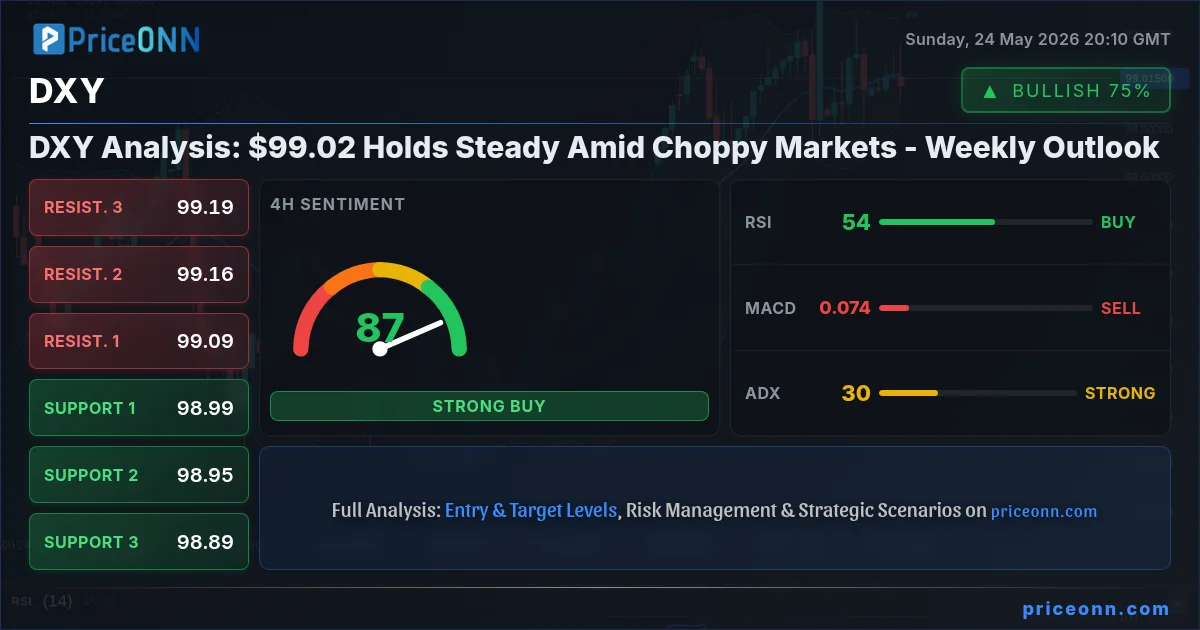
This shift in sentiment led investors to unwind dollar-denominated positions, seeking out riskier, higher-yield assets. The US Dollar Index, which had briefly benefited from its safe-haven status, reversed course sharply, illustrating the market's sensitivity to geopolitical developments and its swift pivot towards risk-on behavior when immediate threats appear to recede. Despite underlying support from steady U.S. Treasury yields and a cautious outlook on Federal Reserve policy, the overwhelming wave of optimism proved to be the dominant driver.
Analysis & Drivers: Geopolitics and Market Psychology
The primary catalyst for the dollar's sharp decline appears to be the perceived easing of tensions between the United States and Iran. Historically, periods of heightened geopolitical friction in the Middle East have often led to increased demand for the U.S. dollar as a safe store of value, coupled with a surge in oil prices. Conversely, any indications of de-escalation tend to reduce this demand premium for the dollar and can lead to a decrease in oil prices as supply disruption fears subside.
The dollar's status as the world's primary reserve currency, involved in over 88% of foreign exchange transactions, means its movements are keenly watched. Its value is largely influenced by the monetary policy of the Federal Reserve, which aims for price stability and maximum employment. However, in the short term, geopolitical events can exert significant influence, overriding typical economic considerations. The swift reversal in the DXY from 100.15 to 99.12 underscores how quickly market psychology can shift when perceived risks diminish, leading to substantial capital flows away from safe-haven assets.
Trader Implications: Watching Key Levels and Sentiment
For forex traders, the break below the 100.00 level in the DXY is a significant technical development. This level has often acted as a key psychological and technical support/resistance zone. Its breach suggests a potential shift in near-term sentiment, favoring riskier currencies against the dollar.
Traders should closely monitor:
- Geopolitical Developments: Any renewed escalation or further de-escalation signals from the Middle East will be critical.
- Risk Appetite Indicators: Movements in global equity markets and other risk assets will provide clues about sustained risk-on sentiment.
- Key Dollar Levels: A sustained move below 99.00 could signal further dollar weakness, while a reclaim of 100.00 might indicate a temporary reprieve or a false breakout.
- Commodity Prices: The reaction in oil prices, particularly WTI, will continue to be a barometer of geopolitical risk sentiment.
The current environment suggests that as long as geopolitical tensions remain subdued, the dollar may face headwinds, creating opportunities for currencies that benefit from improved global risk sentiment.
Outlook: Navigating Uncertainty
The immediate future for the US Dollar will likely depend on the continued evolution of the geopolitical situation and the market's interpretation of Federal Reserve policy signals. While de-escalation fears provided a strong tailwind for risk assets and a headwind for the dollar today, any resurgence in Middle East tensions could quickly reverse this trend. Traders should remain vigilant, prepared for continued volatility as these competing forces play out. Upcoming economic data releases from the U.S. will also be crucial in shaping the Fed's policy outlook and, consequently, the dollar's trajectory.
Frequently Asked Questions
What caused the US Dollar Index (DXY) to fall below 100?
The DXY fell below 100, reaching around 99.12, due to a significant increase in global risk appetite. This shift was triggered by signals of potential de-escalation in Middle East geopolitical tensions, reducing demand for the dollar as a safe-haven asset.
What are the key levels to watch for the US Dollar Index (DXY)?
Traders should monitor the 100.00 level as a key resistance. A sustained break and hold below 99.00 could indicate further dollar weakness, while a move back above 100.00 might suggest a temporary reversal or consolidation.
What is the outlook for the US Dollar amidst ongoing geopolitical events?
The outlook remains sensitive to geopolitical developments. Continued de-escalation could lead to further dollar weakness as risk sentiment prevails. However, any resurgence in tensions would likely see a swift return of safe-haven demand for the dollar.
Track markets in real-time
Empower your investment decisions with AI-powered analysis, technical indicators and real-time price data.
Join Our Telegram Channel
Get breaking market news, AI analysis and trading signals delivered instantly to your Telegram.
Join Channel PriceONN News
Markets are pricing in a potential de-escalation in the US-Iran conflict, leading to a significant drop in crude oil prices and a weakening US Dollar as diplomatic efforts appear to be gaining traction.
PriceONN News
EUR/USD stalled below 1.1660 as the US Dollar defied expectations, refusing to weaken despite reports of a US-Iran ceasefire extension. Market participants remain cautious, awaiting concrete confirmation and assessing lingering inflationary pressures.
PriceONN News
EUR/USD closed at 1.1640, showing resilience amid mixed signals. Easing US-Iran tensions initially pressured the dollar, but persistent inflation concerns and political ratification hurdles are keeping the greenback surprisingly steady.
PriceONN News
EUR/USD stabilized around 1.1640 as reports of a US-Iran ceasefire extension and potential Strait of Hormuz reopening eased inflation fears. However, the US Dollar's resilience suggests lingering caution among forex traders.
PriceONN News
USDJPY has returned to the area of previous interventions. The ECB is moving towards a rate hike in June. The US dollar retreated on Friday amid new record highs for stock indices and rumours of amendments to the US-Iran agreement. However, tit-for-tat exchanges between the adversaries pushed the dollar index back into the support zone […] The post Yen Braces for a New Storm appeared first on ActionForex.
PriceONN News
The USD/JPY pair is flirting with the 160 level as stalled US-Iran negotiations and hawkish Federal Reserve rhetoric fuel inflation concerns. Traders are closely watching upcoming US Non-Farm Payrolls and Eurozone CPI data.
PriceONN News
The EUR/USD faces headwinds as core US PCE inflation unexpectedly rose to 3.3% year-over-year, reinforcing a 'higher for longer' interest rate narrative. Meanwhile, a US-Iran ceasefire extension boosted global risk appetite, potentially drawing capital away from safe-haven currencies.
PriceONN News
The US Dollar experienced a notable decline last week as markets priced in a potential diplomatic resolution to the US-Iran conflict, leading to a drop in oil prices and Treasury yields. This shift in sentiment suggests a move away from stagflation fears towards a more stable economic outlook.
PriceONN News
USD/CAD faces pressure as Canada's economy shows signs of stalling, with Q1 GDP contracting 0.1% and domestic demand weakening. This comes as trade negotiations and geopolitical shifts add layers of uncertainty.
PriceONN News
AUD/USD’s late break of 0.7183 resistance suggests that pullback from 0.7277 has already completed at 0.7076, after defending 55 D EMA. Initial bias is back on the upside this week for retesting 0.7277 high first. Firm break there will resume larger up trend. For now, risk will stay on the upside as long as 0.7076 […] The post AUD/USD Weekly Report appeared first on ActionForex.
PriceONN News
USD/CAD is showing signs of potential upward movement as Canada's economy grapples with a significant slowdown, marked by weak domestic demand and stalled investment, while trade negotiations loom large.
PriceONN News
USD/JPY is testing the critical 160 level as stalled US-Iran negotiations and hawkish Federal Reserve rhetoric fuel inflation concerns and a potential for further rate hikes. Traders are closely watching upcoming US Non-Farm Payrolls and Eurozone CPI data for direction.