
Venezuela’s Debt Overhaul Faces New Controversy
 PriceONN Editorial Desk
Multi-source verification
PriceONN Editorial Desk
Multi-source verification
The Collapse That Never Arrived
Topple a leader who ruled for years, and the textbook outcome is wreckage. When Saddam Hussein fell, Iraq's oil output sank 36% and its economy contracted by nearly a quarter. So when the United States pushed Nicolás Maduro out of power, analysts braced for a similar unraveling.
It did not happen.
Against steep odds, Venezuela held together. President Delcy Rodríguez steadied the domestic situation and threw open the nation's oil sector to American capital at a striking pace. The recovery looked real. Yet that fragile momentum is now arguably at risk, and the source of the threat sits far from Caracas.
At the heart of the controversy stand Centerview Partners and a French financier named Matthieu Pigasse. Pigasse has been maneuvering to claim a lead negotiating seat on Venezuela's $170 billion debt restructuring, one of the most consequential sovereign financial processes the world has ever seen, and a matter tied directly to America's energy security.
How the Debt Crisis Began
Venezuela stopped paying its national debt in 2017, after years of mismanagement bled the oil revenues dry and left American firms and investors out billions. Fixing that wound, restructuring the obligations so the country can repay as its oil industry heals, sits squarely in Washington's economic interest. But repayment only works if the restructuring offers a believable route forward.
This is delicate work. For a negotiation this hard and this central to American energy and commerce, the people steering it, at least by the standards of the Trump administration, are expected to operate from American priorities. Pigasse does not fit that mold.
He is no ally of the America First agenda. He has been a longtime backer of the French Socialist Party, and his media holdings have drawn criticism over allegations of circulating antisemitic material. His Venezuelan résumé deepens the unease: Pigasse once advised Hugo Chávez, whose socialist program gutted the oil industry and manufactured the very debt crisis now demanding a fix. With no competitive bidding and no request for proposals, he is somehow the figure lined up to run the process.
The Man Behind the Appointment
So how did Pigasse reach such a perch? The answer is Mauricio Claver-Carone.
A Florida lawyer, Claver-Carone served briefly as President Trump's special envoy to Latin America. He holds no government role today. He now runs a private equity outfit, LARA Fund, alongside partner Jessica Bedoya, a veteran of both the CIA and the National Security Council. The fund pours money into Latin America, and Claver-Carone operates at the dead center of US policy toward Venezuela.
The Washington Post recently called him the unofficial US viceroy of Venezuela, reporting that he has been ferrying messages between Caracas and Washington.
What that coverage left unexamined is what he has done with this informal power. Without any mandate, it is Claver-Carone who put Pigasse forward.
Pigasse's strategy is itself a flashpoint. He is expected to chase a fast resolution, a quick deal that projects forward motion. Yet in a crisis this large, speed matters far less than making sure creditors actually recover what they are owed. American giants such as Morgan Stanley, Fidelity Management and ConocoPhillips could forfeit billions if the talks are rushed.
A clean restructuring helps more than Venezuela. A Venezuela pumping crude again is one that helps hold fuel prices down for ordinary Americans. Installing an operator as contested as Pigasse at the core of that effort points to a real lapse in oversight by administration officials. With the president preoccupied by Iran, he may not yet grasp how far this informal influence reaches. He should be told.
What Smart Money Is Watching
For investors, this is less a price story than a structure story, and structure is where the real risk hides. A credible, orderly restructuring of the $170 billion debt could unlock Venezuelan supply over time and reward the bondholders still carrying defaulted paper since 2017. A rushed, politically compromised deal could lock in losses and stall the very oil recovery markets are counting on.
Watch the energy complex first. Reopened Venezuelan output is a slow but genuine swing factor for Brent and WTI, and any pace of recovery feeds directly into US gasoline costs and broader inflation expectations. Equity exposure runs through ConocoPhillips and other firms with Venezuelan claims, where headlines about negotiator credibility can move sentiment faster than barrels move.
Distressed-debt desks are the tell here. The price action in defaulted Venezuelan bonds will signal whether professional money believes the restructuring has a serious path or a cosmetic one. If governance concerns harden, expect skepticism to show up in those quotes long before it reaches the political press. The opportunity, and the danger, both live in who ends up holding the pen.
Track markets in real-time
Empower your investment decisions with AI-powered analysis, technical indicators and real-time price data.
Join Our Telegram Channel
Get breaking market news, AI analysis and trading signals delivered instantly to your Telegram.
Join Channel PriceONN News
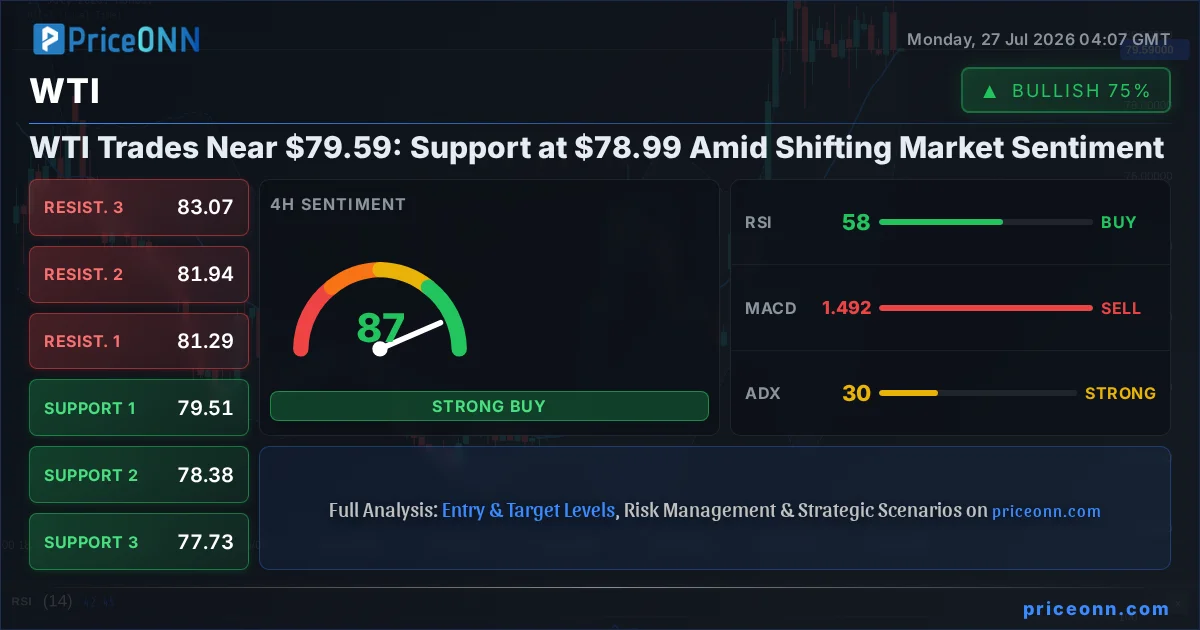
WTI crude oil plunged by more than 7% on 27 July 2026 after the US suspended a series of strikes against Iran over the weekend, raising hopes of a diplomatic solution and the reopening of shipping through the Strait of Hormuz. Brent crude also fell below $90 per barrel. Meanwhile, Bloomberg reported […] The post WTI Analysis: Gap Breaks Short-Term Trend as Price Remains Trapped Between the Poc and Profile Boundary appeared first on ActionForex.
PriceONN News
Oil prices gave up earlier gains on Friday after reports that Pakistan is trying to broker a return to U.S.-Iran nuclear negotiations. China is strongly backing the effort as the conflict and the closure of the Strait of Hormuz continue to threaten its energy security and weigh on its economy. Brent crude for September delivery fell 4.4% to trade at $96.36 per barrel at 1.35 pm ET while WTI crude for September delivery was down 3.6% to change hands at $88.86/bbl. However, Standard Chartered...
PriceONN News
(RTTNews) - Partially offsetting the gains from five consecutive sessions, crude oil prices have plunged on Friday as investors opted to book profits made from the recent trades. While U.S. President Donald Trump threatened to intensify attacks on Iran, investors analyzed the imp
PriceONN News
Australia’s government has launched a feasibility study for an oil refinery that, if approved, would be the first such facility to be built in the country in six decades. According to Prime Minister Anthony Albanese, a new refinery would strengthen Australia’s self-sufficiency in fuel supply, protecting it from potential future oil shocks, Reuters reported, citing the top official. “One of the things that building national resilience does is it makes Australia less vulnerable to the impact of...
PriceONN News
Oil prices continued to trend lower in early Asian trade on Tuesday as a fourth night passed without any attacks from either Iran or the United States. At the time of writing, WTI crude was trading at $81.55 per barrel, down 1.28% on the session, while Brent crude had slipped to $87.36 per barrel, a decline of 1.13%. On Monday, President Trump sought to boost hopes of a diplomatic resolution between Washington and Tehran by claiming that the U.S. was engaged in "good talks" with Iran. Iranian...
PriceONN News
The Houthi threats to shipping in the Red Sea and its chokepoint, the Bab el-Mandeb Strait, have forced at least one oil tanker carrying Saudi crude to Asia to choose the much longer route through the Suez Canal, the Mediterranean, and around Africa. The supertanker Olympic Luck, partially laden with Saudi crude at Yanbu on the Red Sea, transited the Suez Canal into the Mediterranean late on Sunday, according to shipping data monitored by Bloomberg. The U-turn from Bab el-Mandeb indicates that...
PriceONN News
China is likely to have increased its crude oil imports this month, with the daily average at 7.8 million barrels, according to calculations by Kpler, as cited by Bloomberg. Refiners have been buying more Russian crude and have seen more tankers arrive from the Middle East, the report noted. The figure could add fuel to oil’s rally, as the July average would be a solid increase from the 6.2 million barrels daily that Chinese refiners imported in June. That was the lowest import rate for China...
PriceONN News
Oil prices plunged by more than 5% in early Asian trade on Monday as the U.S. and Iran halted attacks after two weeks of escalation that had driven Brent above $100. At the time of writing, WTI crude was trading at $84.47, down 5.39%, while Brent crude had fallen to $91.80, a decline of 5.15%. The retreat came after Washington signaled on Friday that it would temporarily halt its bombing campaign against Iran. Talking to Face the Nation on Sunday, U.S. Ambassador to the United Nations Mike...
PriceONN News
U.S. airlines are grappling with soaring jet fuel costs again after the return of hostilities in the Middle East shattered the three-week-long U.S.-Iran ‘deal to make a deal’ and sent Brent crude oil prices soaring past $100 per barrel again. The U.S. jet fuel market has been tightening since March, although there haven’t been concerns about any shortages in America, unlike in Europe, which in April was supposed to run out of stockpiles within six weeks. Europe didn’t see shortages, but the...
PriceONN News
The European Commission (EC) has informed EU governments that they should waive penalties for oil and gas companies that breach its methane emissions law for the next three years, owing to pressure from the United States government to scrap the rules. While the decision is not binding, many member states are expected to follow the EC’s advice. The EC made the move after the U.S. and Qatar, as well as oil and gas industry groups and most EU member states, voiced concerns about the strict rules...
PriceONN News
For years, Saudi Arabia's strategic answer to any disruption in the Strait of Hormuz has been remarkably straightforward. If volumes via the Persian Gulf were threatened, the answer was to pump west through the East-West Pipeline to Yanbu on the Red Sea. Markets have always seen this as reassuring, while strengthening Saudi energy security and reducing dependence on Hormuz. Current developments in the Red Sea, especially Bab El Mandab, however, have exposed a critical weakness in that...
PriceONN News
Saudi Arabia may raise the price of the crude it ships to Asia via the Suez Canal, Reuters has reported, to reflect higher shipping costs due to the Houthi maritime blockade in the Red Sea. The price hike could reach $5 per barrel of crude. Citing unnamed sources, the publication said Aramco was responding to the need to redirect oil flows from its Red Sea port of Yanbu to the Ain Sukhra port in Egypt, from where the crude gets transported via the Suez-Mediterranean pipeline to the port of Sidi...