
Why Did Gold Surge Past $4,500 Amid Escalating Global Tensions?
Gold (XAU/USD) prices experienced a significant rally on Friday, pushing past the $4,500 level and marking an increase of over 3%. This surge is largely attributed to a renewed 'flight to safety' as geopolitical tensions escalate, with ongoing hostilities entering their fifth week without clear signs of de-escalation. The yellow metal was trading at $4,510 at the time of reporting, recovering strongly from an intraday low of $4,375, underscoring its enduring appeal as a safe-haven asset during periods of global uncertainty and rising inflation pressures.
Market Context
The current market environment has seen investors increasingly favor traditional safe-haven assets, with gold leading the charge. The conflict, now in its fifth week, continues to present significant global economic risks, driving demand for assets that offer stability. This renewed interest comes at a time when inflation concerns are also resurfacing, further bolstering gold's attractiveness as a hedge against the erosion of purchasing power. The bounce from the $4,375 low to above $4,500 demonstrates strong buying interest at lower levels, indicating that market participants are actively seeking to increase their exposure to gold amid the heightened uncertainty.
Analysis & Drivers
Several key factors are driving the upward momentum in gold prices. Firstly, the intensification of geopolitical conflict is the primary catalyst. The lack of a clear resolution to the ongoing hostilities creates an environment of heightened risk aversion, prompting investors to seek refuge in assets like gold. Historically, gold has performed well during periods of geopolitical instability due to its perceived intrinsic value and independence from specific government policies. Secondly, rising inflation pressures globally are also playing a crucial role. As the cost of living increases and the value of fiat currencies is questioned, gold's role as an inflation hedge becomes more pronounced. Its intrinsic worth, not tied to any single currency, makes it an attractive alternative when monetary policy may be perceived as insufficient to combat rising prices. Furthermore, market data indicates that central banks continue to quietly bolster their gold reserves. This trend, observed over recent periods, suggests a strategic diversification by monetary authorities seeking to enhance the perceived strength of their national economies and currencies, adding another layer of underlying support for the precious metal.
Trader Implications
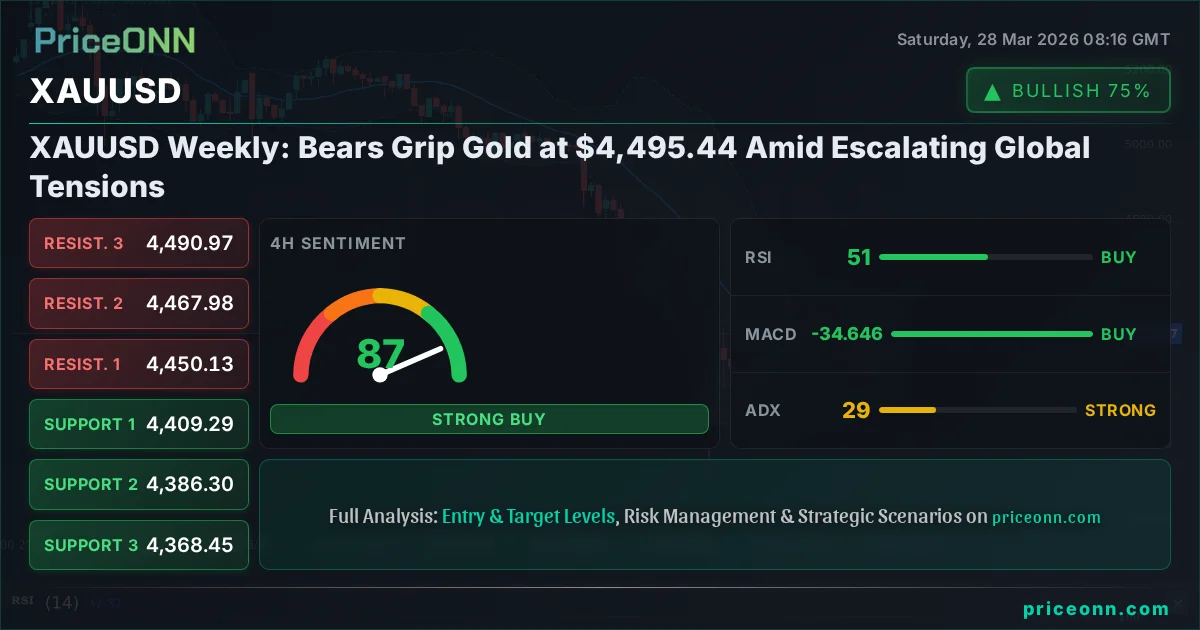
For traders, the break above $4,500 is a significant technical development. Key levels to watch include the recent high of $4,510 and potential resistance around $4,600. Support is now expected to be found near the $4,375 intraday low, with a break below this level potentially signaling a short-term pullback. The current market sentiment strongly favors upward momentum, but traders should remain vigilant for any signs of de-escalation in geopolitical tensions or shifts in inflation data, which could quickly alter the market's direction. Given the current volatility, a risk management strategy is paramount. Consider utilizing stop-loss orders to protect capital and taking partial profits on upward moves to lock in gains. The sustained safe-haven demand suggests that dips towards the $4,400-$4,450 range could present buying opportunities, provided geopolitical risks remain elevated.
Outlook
The outlook for gold remains bullish in the short to medium term, contingent on the continued escalation of geopolitical risks and persistent inflation. If the conflict deepens or spreads, further upward pressure on gold prices is likely. Central bank buying also provides a stable floor. However, a sudden resolution to the conflict or a significant shift in central bank policies towards aggressive tightening could lead to a correction. Traders should closely monitor developments in the conflict zone and upcoming economic data releases, particularly inflation figures and central bank commentary, for potential shifts in market sentiment and price direction.
Frequently Asked Questions
What is the current price of gold and what drove its recent surge?
As of the latest reports, gold (XAU/USD) is trading around $4,510, having surged over 3%. This rally was primarily driven by escalating geopolitical conflicts, which increased demand for gold as a safe-haven asset, and concerns over rising global inflation.
What are the key technical levels traders should watch for gold?
Traders should monitor the recent high of $4,510 for potential resistance. Key support is now seen around the $4,375 intraday low. A sustained move above $4,500 suggests continued bullish sentiment, while a break below $4,375 could signal a reversal.
What is the short-term outlook for gold prices?
The short-term outlook for gold remains cautiously optimistic, largely dependent on the trajectory of geopolitical tensions and inflation data. Continued conflict and rising prices are likely to support prices, potentially pushing gold towards $4,600. However, a swift de-escalation could lead to profit-taking.
Track markets in real-time
Empower your investment decisions with AI-powered analysis, technical indicators and real-time price data.
Join Our Telegram Channel
Get breaking market news, AI analysis and trading signals delivered instantly to your Telegram.
Join Channel
PriceONN