
Why Did Gold Jump Past $4,500 Amid Escalating Geopolitical Tensions?

Gold (XAU/USD) prices experienced a significant rally on Friday, breaking above the $4,500 mark and climbing over 3% to reach $4,510. This upward momentum was primarily fueled by a renewed surge in safe-haven demand as geopolitical tensions intensified, with hostilities entering their fifth week without signs of de-escalation. The precious metal demonstrated resilience by bouncing back from intraday lows of $4,375, underscoring its role as a preferred asset during periods of global uncertainty and rising inflation pressures.
Market Context
The precious metal's sharp ascent follows a period of heightened uncertainty and a notable 3% decline experienced just a day prior. Despite the strong intraday recovery, gold remained under pressure for the week due to persistent inflation anxieties and the potential for further interest rate hikes by major central banks. Market sentiment has been delicate, with the U.S. dollar finding some footing amidst a general risk-off environment. Escalating conflicts in the Middle East, including reports of strikes in Iran, Israel, and the UAE, have contributed to a cautious trading atmosphere. These regional risks pose a threat to vital oil supply routes, adding another layer of complexity to market dynamics.
Analysis & Drivers
The primary catalyst for gold's recent surge is the intensification of geopolitical conflicts, which traditionally drives investors towards safe-haven assets like gold. The lack of a clear de-escalation path in the ongoing hostilities has revived demand for the yellow metal as a hedge against uncertainty and potential economic disruption. Concurrently, rising inflation pressures globally are enhancing gold's appeal as an inflation hedge. Historically, gold has served as a store of value, particularly when fiat currencies are threatened by devaluation or when central banks are perceived as losing control over price stability. Market data indicates that central banks, historically the largest holders of gold, have been quietly bolstering their bullion reserves, diversifying portfolios during economic uncertainty to enhance national economic strength. This trend suggests a long-term strategic shift towards gold among institutional players.
Trader Implications
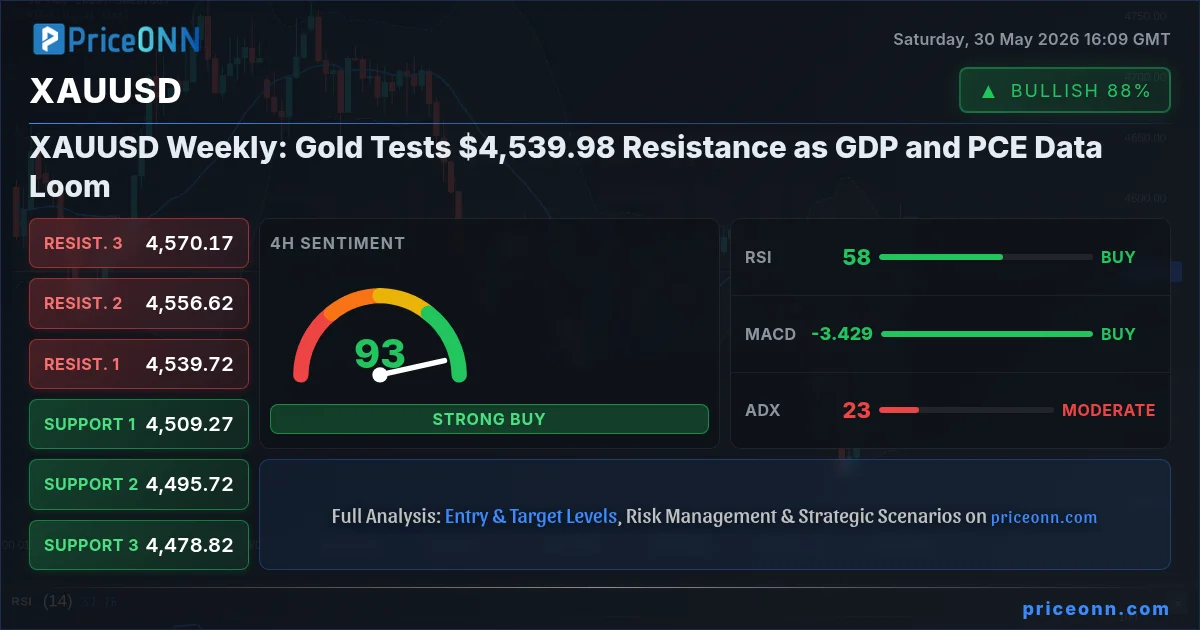
Traders should closely monitor the ongoing geopolitical developments in the Middle East, as any further escalation or de-escalation could significantly impact gold prices. Key support levels to watch are around $4,375 and $4,300, while resistance is now established above the recent high of $4,510, with a decisive break above potentially targeting higher levels. The U.S. dollar's performance and the trajectory of inflation data will also be critical factors. A weakening dollar and persistent inflation would likely provide further tailwinds for gold. Conversely, a significant cooling of geopolitical tensions or hawkish signals from central banks could lead to profit-taking and a retracement in gold prices. Traders looking to capitalize on this volatility might consider strategies that account for potential sharp moves in either direction, while maintaining a close eye on risk management parameters.
Outlook
The outlook for gold remains highly sensitive to geopolitical events and inflation trends. While recent conflict escalation has provided a strong boost, any diplomatic breakthroughs or easing of tensions could quickly reverse this trend. The persistent underlying inflation concerns and central bank reserve diversification strategies suggest a supportive environment for gold in the medium to long term. However, short-term price action will likely remain volatile, dictated by headlines and shifting market sentiment. Traders should remain vigilant for upcoming economic data releases and geopolitical updates that could shape gold's trajectory in the coming weeks.
Frequently Asked Questions
What is the current price of gold and what caused its recent surge?
As of Friday, gold (XAU/USD) was trading at $4,510 per ounce. The surge was driven by intensifying geopolitical conflicts and rising inflation concerns, which increased demand for gold as a safe-haven asset.
What are the key support and resistance levels for gold traders to watch?
Key support levels are situated around $4,375 and $4,300. Resistance is now in play above the recent high of $4,510; a sustained break above this level could signal further upside potential.
What factors could influence gold prices in the near future?
Future gold prices will likely be heavily influenced by the evolution of geopolitical tensions in the Middle East and global inflation data. Central bank policy shifts and U.S. dollar strength will also play a significant role.
Track markets in real-time
Empower your investment decisions with AI-powered analysis, technical indicators and real-time price data.
Join Our Telegram Channel
Get breaking market news, AI analysis and trading signals delivered instantly to your Telegram.
Join Channel PriceONN News
Gold prices experienced a significant decline on Wednesday, falling over 1% as diplomatic optimism surrounding U.S.-Iran talks grew, despite ongoing military actions. The June gold contract settled at $4,444.50.
PriceONN News
Gold prices experienced a significant downturn, shedding 2% this week to settle near $4,444.50 per ounce. This decline is attributed to evolving U.S.-Iran diplomatic efforts and concerns over potential central bank rate hikes.
PriceONN News
Gold prices fell on Friday as concerns over crude oil inventories and the prolonged closure of the Strait of Hormuz fueled inflation anxieties, overshadowing U.S.-Iran peace talks. The June Comex Gold contract settled down 0.55% at $4,517.40.
PriceONN News
Gold futures broke above $4,500 per ounce on Friday, driven by increasing optimism for a de-escalation in the U.S.-Iran conflict and the potential reopening of the Strait of Hormuz. Silver also saw significant gains, reflecting a broader shift towards precious metals as geopolitical tensions ease.
PriceONN News
(RTTNews) - After moving sharply lower earlier in the day, the price of gold has shown a significant turnaround over the course of the trading session on Thursday.
PriceONN News
Gold prices fell below the $4500 mark on Wednesday, extending previous losses as oil prices tumbled and geopolitical tensions between the US and Iran remained a key market driver. Investors are weighing inflation concerns against hopes of de-escalation.
PriceONN News
(RTTNews) - Extending the losses from yesterday's session, gold prices have slumped on Wednesday as traders watch the ongoing efforts to end the U.S.-Iran standoff with cautious optimism while the blockade on the Strait of Hormuz continues. The rising inflationary pressure weighe
PriceONN News
(RTTNews) - Gold prices traded lower on Wednesday, extending losses from the previous session as investors fretted about oil-driven inflation and the potential impact on interest rates.
PriceONN News
Gold prices retreated to $4,504.30 per troy ounce despite ongoing geopolitical tensions and the closure of the Strait of Hormuz, suggesting a complex market dynamic beyond typical safe-haven demand. Silver, however, managed a modest gain.
PriceONN News
(RTTNews) - Gold prices have edged lower on Tuesday amid renewed concerns of inflationary pressure following fresh U.S. military strikes on Iran yesterday while the Strait of Hormuz remains closed for oil and energy transit.
PriceONN News
(RTTNews) - Gold prices have soared on Friday amid rising optimism about an end to the Middle East war with the chances of reopening of the Strait of Hormuz and resumption of oil and energy trade growing stronger.
PriceONN News
(RTTNews) - Gold held firm above $4,500 an ounce on Friday, the dollar headed for a small weekly loss on improved risk sentiment in markets, and oil prices slipped to a one-month low amid investor optimism that the Middle East conflict is inching toward an end and that the reopen